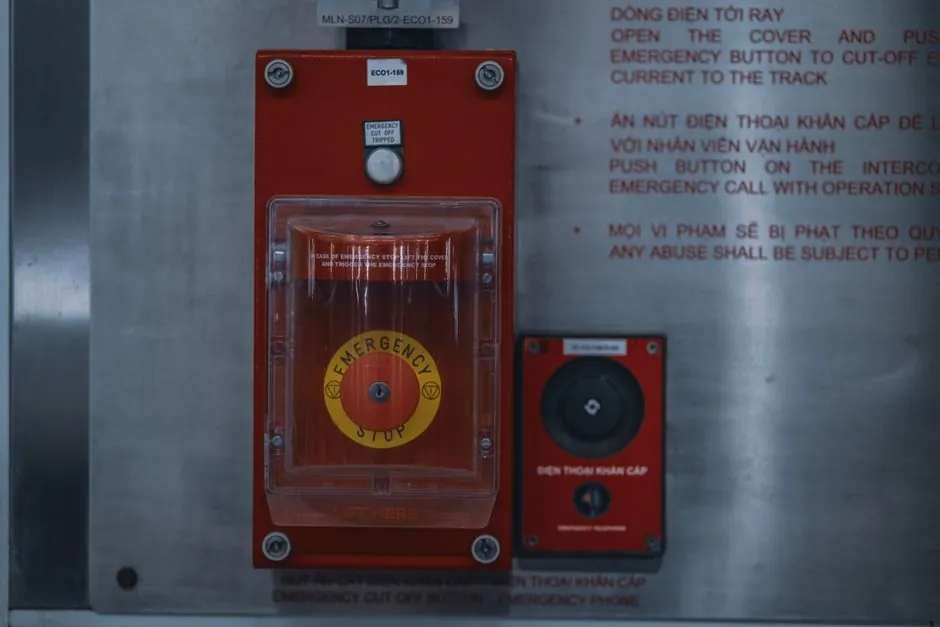
Pushbutton and pilot light sizing collapses to four engineering gates: mounting cut-out diameter, IP/ingress rating, contact configuration, and hazardous-area zone. The mainstream industrial cut-outs are Ø16 mm, Ø22 mm, Ø25 mm, and Ø30 mm, with Ø22.5 mm and Ø30.5 mm the dominant global sizes for control panels [S3][S7].
For a greenfield panel, default to Ø22 mm plastic IP65 with 1NO-1NC contacts and a 24 V DC LED element unless the duty demands otherwise. That single spec line covers roughly seven of ten general-purpose machine HMI stations I see on discrete-assembly lines, and the pushbutton pilot light family covers every contact/colour combination on that footprint.
Cut-out diameter and panel layout rules
Ø22 mm is the workhorse cut-out and is offered in plastic and metal bodies across Schneider, Clipsal, Tend, Allen-Bradley, and Teknic ranges; Ø30 mm is specified where the operator wears gloves or the bezel must survive impact, and the 30.5 mm series is widely used in railway rolling stock [S7]. Below Ø22 mm, the Ø16 mm TN16 / TT16 / T16 series is the compact alternative for dense panels and instrumentation front-plates, with three-piece removable construction for fast contact-block swaps [S3].
Layout rule: keep ≥30 mm centre-to-centre between Ø22 mm operators and ≥50 mm for Ø30 mm mushroom or selector types, otherwise the anti-rotation collar and contact-block depth will collide in the back-of-panel cavity. For mushroom or emergency-stop heads, jump to Ø30 mm or larger; the 800GP1EX family from Allen-Bradley is built on the 30 mm footprint for that reason [S2][S4].
Ingress, contact blocks, and electrical ratings
IP65 (per IEC 60529 referenced as IEC 144 in vendor literature) is the standard protection grade for TT2, TN2, and T2 series pushbuttons; the Twin-Touch and illuminated-pushbutton variants drop to IP40 because of the lens interface, which is a real spec trap when you need a washdown-rated illuminated button [S3]. For wet, food-grade, or outdoor panels, overspec to IP66/IP67 rather than accept the IP40 illuminated-variant default.
Contact block options on the SZB022-BP family cover 1NO, 1NC, 1NO-1NC, 2NO, and 2NC, and the flat illuminated type accepts three contacts per layer for six contacts total per operator [S1]. Illumination runs directly off AC/DC 6 V, 12 V, 24 V, 36 V, 48 V, 110 V, or 220 V with no step-down transformer required, which removes a whole class of 24 V only mis-wiring failures on retrofit jobs [S1]. For a like-for-like review of how these contact blocks compare with adjacent control-panel hardware, the lamps and light fittings reference covers the matching indicator-lamp families.
Illumination technology: LED vs incandescent

Modern pushbutton-pilot-light units ship with integral LED elements that accept 6 V to 220 V AC/DC without a transformer, replacing the legacy incandescent + resistor + transformer stack [S1]. LED drops steady-state consumption from roughly 1.5–2.5 W (incandescent) to 0.5–1.0 W per indicator, which matters on long panels with 30+ lamps and on battery-backed control circuits.
The 120 VAC Schneider 30 mm Type SK pilot light with green Fresnel cap and incandescent bulb is the legacy pattern still in service; when replacing, verify lamp socket (BA9s, BA15d, or wedge) because the LED retrofit bulb must match the base, not just the voltage [S6]. For full indicator-circuit design context, the lighting equipment and electric lamps page covers the lamp-base standards and life ratings to cross-check.
Hazardous-area and zone-rated pilot lights
Zone 1 and Zone 2 classified areas (per IEC 60079-10-1 zoning) require pilot lights rated for the gas group; the Allen-Bradley 800GP1EX 30 mm white pilot light is listed for Zone 1/Zone 2, and distributors in Australia price it at $58.20 against a $72.50 list, indicating active 2026 channel stock [S2][S4]. Specifying an Ex d flameproof or Ex e increased-safety enclosure is non-negotiable for Zone 1; an ordinary IP65 plastic operator is a Zone 2 only part.
For 22 mm hazardous-area duty, the Clipsal SCHZB5AW7A1721 / SCHZB5AW7A3740 range is plastic, illuminated, double-headed with green/red or single white configurations, listed at AUD $53.90 / list $67.20 [S5][S8][S9]. These are industrial-panel parts, not Ex certified, so they belong in safe-area panels or Zone 2 only when the OEM datasheet confirms compliance. Always cross-check the certification document, not the distributor landing page, before installing in a classified area.
Selection criteria: a four-option comparison

Line the four realistic options against the four decision gates (mounting, ingress, contacts, zone):
1) Ø16 mm TN16/TT16 plastic, IP65, 1NO/1NC modular, safe-area only: best for compact instrumentation front-plates where panel real estate is the constraint; not suitable for illuminated variants that drop to IP40 [S3]. 2) Ø22 mm TT2/TN2 plastic, IP65, up to 2NO+2NC, safe-area: the default for general machine HMI, balanced cost and parts availability, with illuminated variants downgraded to IP40 [S3][S7]. 3) Ø22.5 mm metallic (Teknic), IP65, clip-on or screwed contact elements: chosen for railway and food-and-beverage stainless panels, higher impact and chemical resistance [S7]. 4) Ø30 mm 800GP1EX, Zone 1/2, hazardous-area: mandatory for oil & gas, chemical, and fuel-handling panels, premium unit cost (~$58) but eliminates Ex enclosure rework [S2][S4].
Who should NOT pick the default Ø22 mm plastic
Skip the Ø22 mm plastic default in three cases: (1) any panel that gets hosed down or sits in a food-processing washdown zone, where the illuminated-variant IP40 rating will fail first-year audits; (2) panels in Zone 1 hazardous areas, which require the 30 mm Ex-rated 800GP1EX-class devices [S2][S4]; (3) panels with more than 30 operators where the cost delta of metal-body Ø30.5 mm parts is recovered in impact-resistance and lower replacement frequency [S7]. For deeper procurement context, see the choosing pushbutton and pilot light combos reference for spec gates and zone logic.
Standards, sourcing, and 2026 spec verification
Core standards governing this product family include IEC 60947-5-1 for control-circuit devices and IEC 60079-0 / IEC 60079-1 / IEC 60079-7 for hazardous-area enclosures, with AS/NZS 3000 cited on the 800GP1EX distributor listing for Australian installations [S2][S4]. Ingress claims trace to IEC 60529; vendors commonly reference IEC 144, which is the legacy designation for the same standard [S3].
Distributor pricing in August 2026 places the 800GP1EX at $58.20 (list $72.50) and the Clipsal SCHZB5AW7A1721 / SCHZB5AW7A3740 at AUD $53.90 (list $67.20), useful as a 2026 channel-stock signal [S2][S4][S5][S8][S9]. Before specifying, request the OEM datasheet and confirm three things: IP rating under the illuminated configuration (not the base spec), hazardous-area certificate number and gas group, and contact-block mechanical life (typically 1 million operations for Ø22 mm, 3 million for heavier-duty lines).