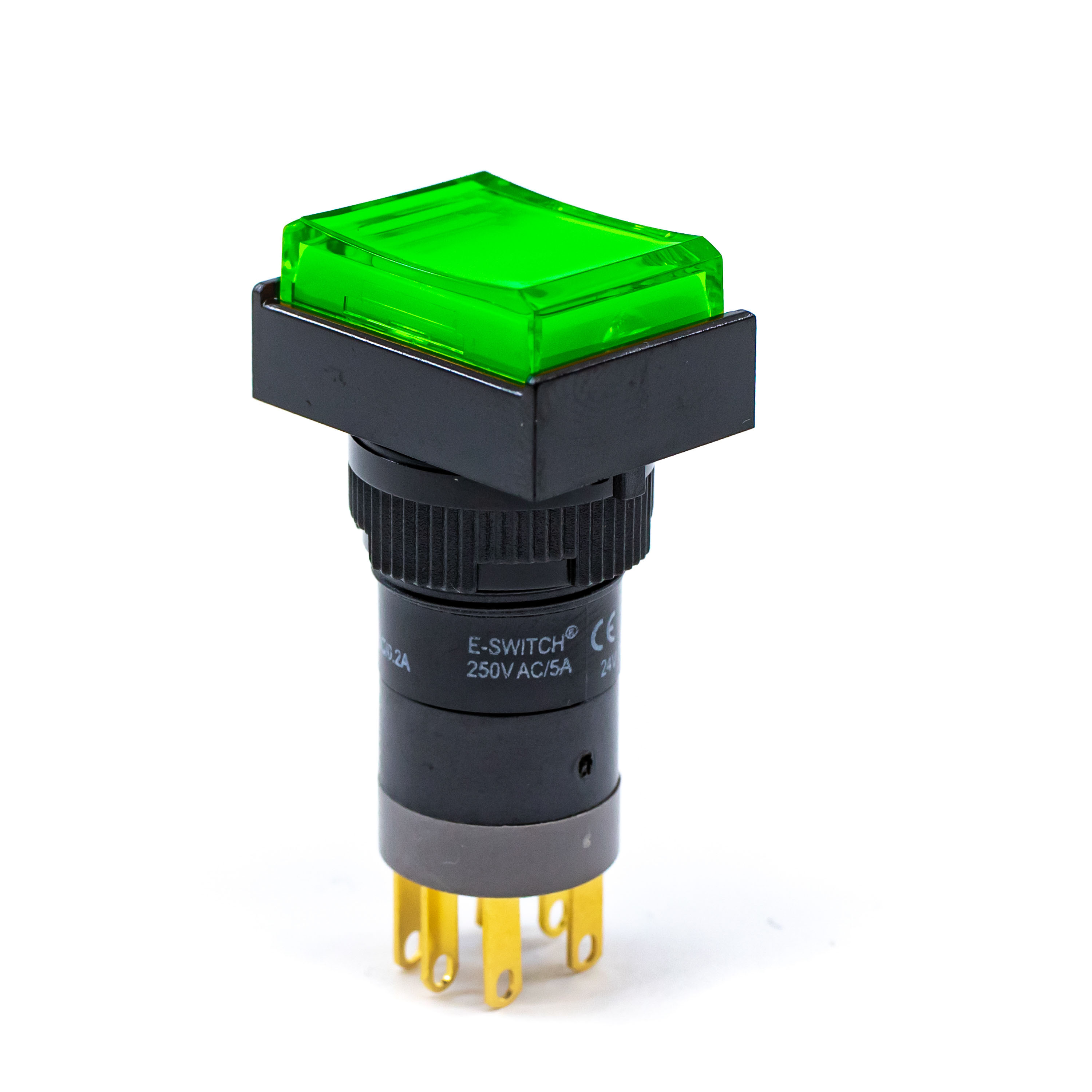
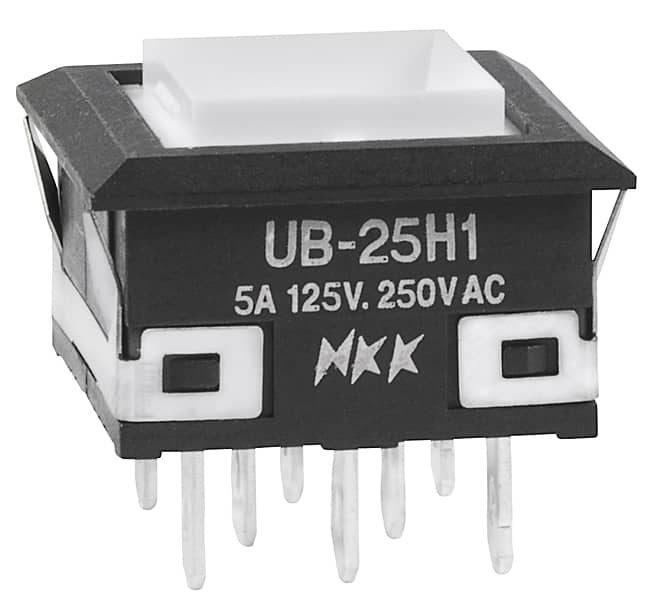
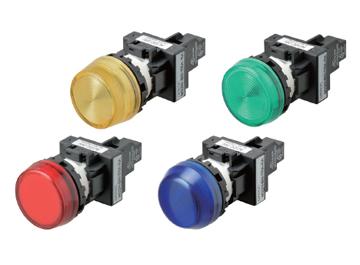
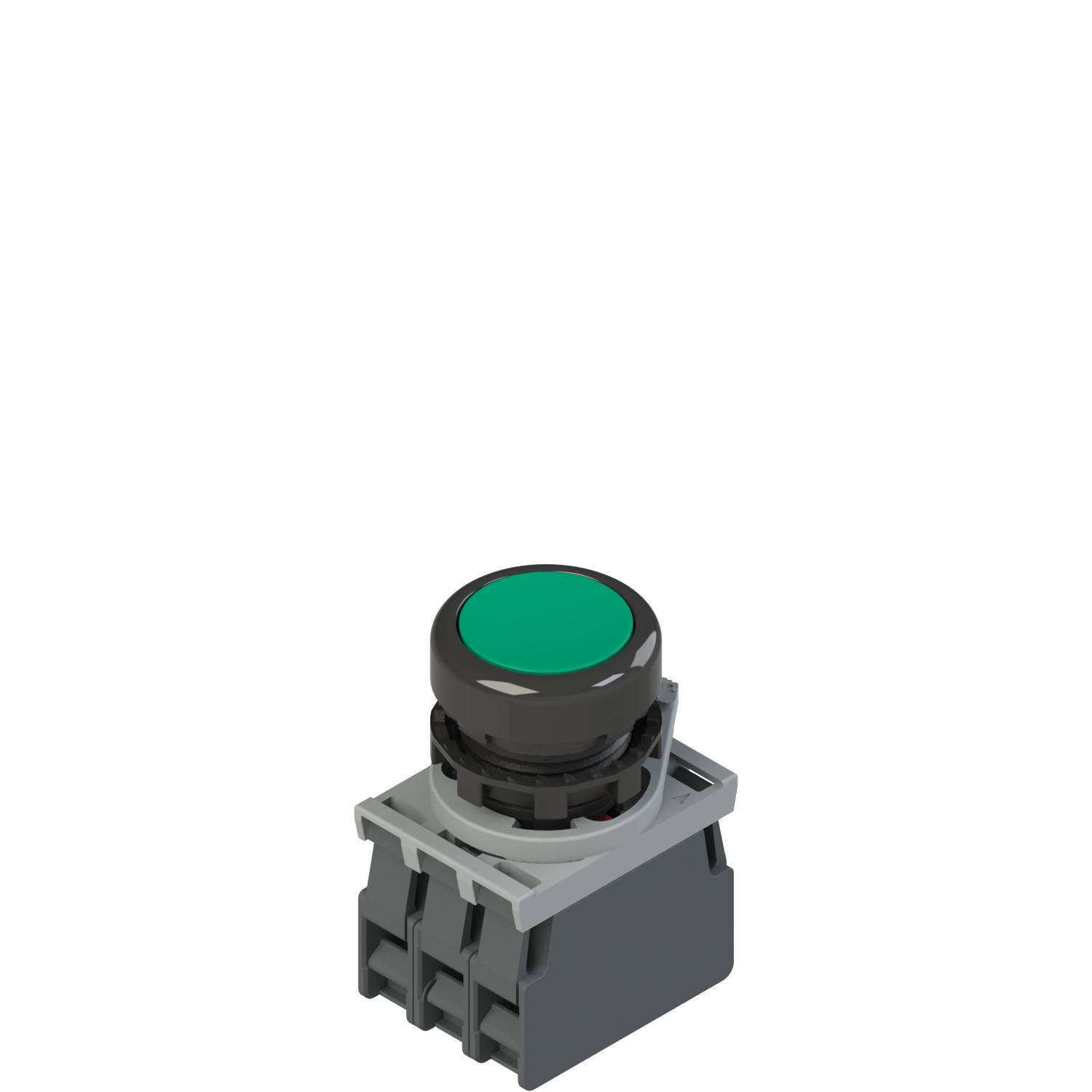
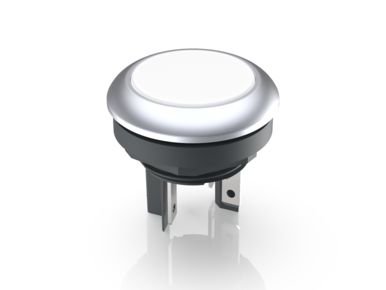
Pushbuttons and pilot lights are the human-machine interface of almost every industrial control panel: the operator presses a button to issue a command, and an indicator light reports the resulting machine state. Both are built as modular 22 mm panel-mount devices, where a head (the visible actuator or lens) snaps to one or more contact blocks or light blocks behind the door. This guide treats them as one device family because they share the same mounting standard, the same color-coding rules, and the same governing standards: IEC 60947-5-1 for the switching elements and IEC 60073 for the colors.
Although a button looks trivial next to a transmitter or a PLC, selection errors here are common and costly: the wrong utilization category burns contacts in months, the wrong color violates machinery-safety law, and a non-compliant emergency stop can void a CE declaration. The chapters below decode the operator types, contact-block ratings, LED indicator specifications, color standards, and the decision sequence a procurement engineer should follow before placing an order.
Photo: Mithilrkadam, CC BY-SA 4.0, via Wikimedia Commons
This guide is aimed at industrial purchasing engineers and panel-build engineers. It covers 6 chapters from device anatomy and history, operator and indicator types, switching and illumination technologies, color and safety standards, to spec-sheet decoding and selection decisions, with 7 selection FAQs and manufacturer comparisons. All parameters reference IEC 60947-5-1, IEC 60947-5-5, IEC 60073, IEC 60204-1, ISO 13850, and NEMA ICS 5 public standards.
Chapter 1 / 06
What Pushbuttons and Pilot Lights Are
A pushbutton is a manually operated control switch in which an actuator, pressed by a finger or palm, opens or closes one or more electrical contacts. A pilot light (also called an indicator light, signal light, or pilot lamp) is an illuminated device that displays the status of a circuit or machine without itself switching power. Together they form the operator-facing layer of a control system: the human commands the process through buttons, and the process reports back through lights. International standards group both under the heading of "control circuit devices and switching elements," and IEC 60947-5-1 is the master document defining their electrical behavior.
Mechanically, a modern 22 mm device is modular and assembled from three layers. First is the head or operator, the visible part mounted through the panel: a flush, projecting, or mushroom button, an illuminated lens, or a plain indicator lens, secured by a locking ring or collar from behind. Second is the holder or fixing collar that clamps the head to the panel and provides the snap rails. Third are the rear function blocks: contact blocks that carry the switching contacts for a button, and light blocks (LED or lamp holders) for an indicator. A single 22 mm head can typically stack two to three contact blocks, mixing normally open (NO) and normally closed (NC) elements to suit the control logic.
The panel cutout standard matters more than any single electrical figure because it dictates physical interchangeability across brands. The IEC world standardized on a 22 mm round hole (actual drilled diameter 22.3 mm, with an anti-rotation flat or notch), and Schneider Harmony XB4/XB5, ABB Modular and Compact, Siemens SIRIUS ACT, Eaton M22, and Omron A22N all share it. North America historically used a 30 mm (30.5 mm) heavy-duty oil-tight format, exemplified by Allen-Bradley 800T and Eaton 10250T. A 22 mm device cannot seal a 30 mm hole, so a panel's existing cutout fixes the device family before any electrical decision is made.
The history of these devices tracks the history of industrial control itself. Early twentieth-century motor-control panels used heavy oil-tight pushbutton stations with incandescent indicator lamps. The 22 mm modular concept matured in Europe through the late twentieth century, decoupling the head from the contact block so a single inventory of bodies could serve many functions. The decisive recent shift is the move from incandescent and neon lamps, rated around 1,000 to 2,000 hours, to integral LED light blocks rated on the order of 50,000 to 100,000 hours, which has all but eliminated the routine bulb-replacement maintenance that defined older panels.
Four engineering attributes determine the quality and total cost of these devices: the utilization-category rating of the contact block (which governs how fast contacts erode under inductive load), the ingress protection of the front face (which governs survival in washdown and dust), the color and emergency-stop compliance (which governs legal conformity), and the indicator service life (which governs maintenance frequency). A cheap button that looks identical on a catalog page can fail in months if its contacts are under-rated for the coil it switches, so specification, not appearance, drives selection.
Chapter 2 / 06
Operator and Indicator Types
The operator (head) type defines how the device behaves under and after the operator's hand. The most common confusion for newcomers is between momentary and maintained action: a momentary button springs back when released, while a maintained (latching) button stays in the pressed state until pressed or released again. Choosing maintained where momentary was intended, or the reverse, breaks the control logic regardless of how the contacts are wired. The table below summarizes the mainstream operator and indicator types found in a 22 mm catalog.
Knob, key, or lever; with or without spring return
Pilot light (indicator)
None (display only)
Run, fault, power-on status
LED or lamp; no switching contacts
Momentary pushbuttons are the workhorse of process control. A green start button momentarily closes a normally-open contact to energize a contactor coil through a seal-in (latch) rung in the PLC or relay logic, so the machine keeps running after the finger lifts. A red stop button momentarily opens a normally-closed contact to drop that seal-in. The button itself does not hold the state; the control logic does. This is why a stop function is almost always built on a normally-closed contact: a broken wire then fails toward stop, which is the safe direction.
Maintained and selector operators hold a position mechanically. A two-position selector implements Off/On or Local/Remote; a three-position selector implements the classic Hand/Off/Auto used on motor starters. Selector heads come with detented (stay-put) or spring-return (momentary) positions in any combination, and key-operated versions restrict mode changes to authorized staff. Maintained pushbuttons, which latch down on first press and pop up on second, suit simple on/off duties where no separate latching logic exists.
Emergency stop deserves separate treatment because it is a safety component, not merely a maintained button. It uses a red mushroom or palm actuator that latches on impact and can only be released by a deliberate pull, twist, or key action, paired with a direct-opening normally-closed contact. Chapter 4 covers the governing standards. Illuminated pushbuttons combine an actuator and an LED behind a translucent lens, giving press-and-confirm feedback in a single 22 mm hole, which saves panel space versus a separate button and lamp. Pilot lights contain no switching contacts at all; they are pure status displays driven by the control logic.
Across all these types the ingress-protection grade of the front face is a parallel selection axis. Standard control rooms accept IP65, but food, beverage, and pharmaceutical lines that endure high-pressure hot washdown require IP66/IP67 and increasingly IP69K, with corresponding NEMA Type 4X/13 ratings. Harsh-environment ranges such as Schneider Harmony XB4/XB5 reach IP69K precisely for these duties, while outdoor and marine installations add salt-spray and UV resistance to the requirement list.
Chapter 3 / 06
Switching and Illumination Technologies
Two distinct technologies live inside the same 22 mm body: the contact mechanism behind a button and the light source behind an indicator lens. The contact block is governed by utilization categories that describe the worst-case electrical duty, while the light block is chosen by source type and service life. The table below compares the switching characteristics of the main contact technologies and the headline figures that drive their selection.
Utilization categories are the heart of contact selection. IEC 60947-5-1 classifies the duty an auxiliary contact must survive, not just a resistive rating. AC-15 describes switching AC electromagnetic loads (contactor and solenoid coils), and DC-13 describes switching DC electromagnets. Both are far harsher than a resistive lamp because the coil's stored magnetic energy produces an inductive break arc. A representative 22 mm contact block is rated about 3 A at 240 V AC-15 and 6 A at 120 V AC-15, but only 0.27 A at 250 V or 0.55 A at 125 V under DC-13. The DC figures collapse because a DC arc has no current zero to extinguish itself at, so the mechanical gap alone must quench it.
Slow-break versus snap-action. Slow-break contacts open at the speed of the operator's finger, which keeps the device simple and is adequate for most coil-switching duties when correctly rated. Snap-action (spring-loaded) contacts store energy and break independently of finger speed, shortening the arc dwell time, reducing contact erosion, and giving repeatable timing. Many emergency-stop and safety blocks use snap or positive mechanisms specifically so the break is fast and definite rather than dependent on how slowly a hand moves.
Contact materials set the low end of the current envelope. Standard silver-alloy (fine silver or silver-nickel) contacts need a minimum wetting current, commonly around 5 mA at 17 V, to burn through the silver-oxide film and stay reliable. When a button wires straight into a 24 V or 5 V logic input drawing only a few milliamps, that threshold is not reached and silver contacts can read intermittently. Gold-plated or gold-flashed contacts solve this: they make reliable contact at roughly 1 mA with no oxide to pierce, at the cost of rapid erosion if power loads are ever switched through them. The rule is simple: gold for signals, silver for coils.
Illumination technology has consolidated on the LED. Legacy incandescent and neon indicator lamps last roughly 1,000 to 2,000 hours and draw 1 to 3 watts, meaning a continuously-lit lamp needs replacement once or twice a year. Modern integral LED light blocks are rated on the order of 50,000 to 100,000 hours, draw only about 14 to 18 mA, run far cooler, and survive panel vibration because they have no filament. Universal LED blocks accept a wide supply window (for example 24 V AC/DC) through an internal resistor or driver, while voltage-specific blocks are offered for 6, 12, 24, 48, 120, and 230 V mains circuits. Color is set either by the LED itself or by a colored lens over a white LED.
Chapter 4 / 06
Color Coding and Safety Standards
Color on a pushbutton or pilot light is not decoration; it is regulated information. IEC 60073 assigns meaning to indicator and actuator colors, and IEC 60204-1 (the electrical safety standard for machinery, harmonized in Europe as EN 60204-1 and mirrored in North America by NFPA 79) makes specific colors mandatory for start, stop, and emergency functions. Getting the color wrong is therefore both a usability problem and a conformity failure that can block a CE declaration or a machinery acceptance. The table below summarizes the standard meanings.
Color
Indicator Light Meaning (IEC 60073)
Actuator Use (IEC 60204-1)
Red
Emergency / dangerous condition, immediate action
Emergency stop; STOP/OFF permitted
Yellow / amber
Abnormal or impending-critical condition
Abnormal-condition action; intervention
Green
Normal / ready / safe-to-proceed condition
START/ON permitted (white preferred)
Blue
Mandatory action required
Action requiring mandatory operation
White
Neutral / general information
Preferred for START/ON; general functions
Indicator-light coding follows a safety hierarchy. Red means an emergency or dangerous condition demanding immediate action; yellow or amber means an abnormal condition or an approaching critical limit that needs attention; green means a normal, ready, or safe condition; blue means a mandatory action; and white is neutral, used for general status where none of the safety colors applies. Flashing modes layer on top: a flashing light typically raises urgency relative to its steady equivalent, drawing the operator's eye to a condition that needs faster response than a steady light of the same color.
Actuator coding under IEC 60204-1 is stricter for the safety-critical functions. START or ON actuators should be white, with green permitted, and red must never be used to start a machine. STOP or OFF actuators should be black, with white or grey permitted. The emergency stop must be red. Where a background frame is provided immediately around an actuator, only the emergency operator may sit on a yellow background, and the red-on-yellow combination is reserved exclusively for emergency operation so that operators learn one unambiguous visual signal for danger.
Emergency stop compliance is governed by IEC 60947-5-5 together with the functional-design standard ISO 13850. Three requirements are non-negotiable. First, the actuator must be a red mushroom or palm type, sited on a yellow background, reachable without obstruction. Second, the stop contact must use direct opening action: the normally-closed contact is forced apart through non-resilient mechanical members so that contact separation does not depend on a spring that could fail welded-closed. Third, the device must latch in the stopped state and require a deliberate reset (pull, twist, or key) so a machine cannot restart simply because a hand left the button. The direct-opening symbol and the IEC 60947-5-5 marking on the contact block are the proof of compliance.
Beyond colors and emergency stop, two umbrella standards frame the category. IEC 60947-5-1 defines the contact ratings, utilization categories, mechanical and electrical endurance, and test regime for the switching elements, and NEMA ICS 5 plays the equivalent role in North American practice for control-circuit and pilot devices. UL 508 (and the newer UL 60947 series) provides the North American product-safety listing that buyers in that market specify alongside the IEC ratings, which is why many catalog devices carry IEC, UL, and CSA marks together.
Chapter 5 / 06
Key Specification Parameters
A 22 mm device datasheet can list two dozen lines, but only a handful drive a selection decision. The parameters below are the ones a procurement engineer should extract and compare across brands before issuing a purchase order, because they determine whether the device survives its duty cycle, seals its environment, and conforms to the machinery standards.
Utilization category and rated operational current (Ie). This is the single most important contact figure. Specify the category that matches the load: AC-15 for AC coils, DC-13 for DC coils, with the corresponding voltage and current. A typical 22 mm block delivers about 3 A at 240 V AC-15 and 0.27 A at 250 V DC-13. The resistive AC-12 figure printed in large type is almost never the limiting case in real control wiring; read the AC-15 and DC-13 lines instead.
Conventional thermal current (Ith) and rated insulation voltage (Ui). Ith is the maximum continuous current the contact can carry without overheating, commonly 10 A for a 22 mm block, and it caps the wire gauge and fuse you can run through the device. Ui, often 250 to 690 V, sets the maximum system voltage the insulation is designed for. Both are headroom figures; the switching duty is still governed by the utilization category, not by Ith.
Mechanical and electrical durability. Mechanical durability is the number of operate cycles the head and block survive with no load, often 1,000,000 to 10,000,000 operations under IEC 60947-5-1 Annex C test conditions (for example AC-15, 2 A at 230 V, operating rate below 3,600 cycles per hour, load factor 0.5). Electrical durability is lower and depends on the switched load. For a frequently pressed jog or inching button, this figure separates a multi-year service life from premature failure.
Ingress protection and operating temperature. Front-face IP rating runs from IP65 (general industrial) through IP66/IP67 to IP69K (high-pressure hot washdown), with matching NEMA Type 1, 4, 4X, 12, or 13 designations. Operating temperature for industrial ranges is typically about minus 25 to plus 70 degrees Celsius, with storage to minus 30 to plus 85 degrees Celsius; outdoor and cold-store duty pushes the lower bound and demands seal materials that stay flexible in the cold.
Indicator electrical and life parameters. For pilot lights and illuminated buttons, capture the supply voltage and whether the block is universal (wide-window, for example 24 V AC/DC) or voltage-specific (6, 12, 24, 48, 120, 230 V); the current draw, on the order of 14 to 18 mA for LED blocks; the light-source type and rated service life, roughly 50,000 to 100,000 hours for LED versus 1,000 to 2,000 hours for incandescent or neon; and the color, set by the LED or by a lens. A mismatch between a voltage-specific block and the actual control voltage either fails to light or burns out the LED.
Connection, mounting, and contact configuration. Terminal type (screw-clamp, spring-clamp/push-in, faston, or PCB pins) governs wiring labor and vibration resistance, with spring-clamp now favored for fast, maintenance-free panel build. Mounting torque on the M22 locking ring is typically around 1.2 to 2 Nm. Finally, count the contact configuration you actually need, expressed as NO and NC elements (for example 1NO+1NC), and confirm the head can stack that many blocks; a stop or safety function should be built on an NC element so a broken wire fails to the safe state.
Chapter 6 / 06
Selection Decision Factors
To turn the preceding chapters into a specific order, follow the decision sequence below. Most field problems trace not to a single wrong value but to skipping a step, for example choosing a beautiful flush button whose contact block is under-rated for the AC coil it switches. These eight steps double as a fixed RFQ template for pushbutton and pilot-light requisitions.
Panel cutout and mounting: Confirm the existing or specified hole, almost always 22 mm (22.3 mm) for IEC panels, or 30 mm for legacy North American oil-tight stations. This fixes the device family before anything else and prevents ordering parts that cannot physically mount.
Function and operator type: Decide momentary versus maintained, then the head style (flush, projecting, mushroom, illuminated, selector, or emergency stop). Match the action to the control logic: momentary buttons feed seal-in logic; maintained operators hold their own state.
Color and standards conformity: Assign colors per IEC 60073 and IEC 60204-1: white or green for start, black for stop, red for emergency stop on a yellow background. Verify any emergency stop carries IEC 60947-5-5 direct-opening contacts and latching reset.
Contact-block rating: Identify the load each contact will switch and choose the utilization category accordingly: AC-15 or DC-13 with the right voltage and current, gold contacts for direct PLC/logic inputs, silver for coils. Count the NO/NC configuration needed.
Indicator specification: For pilot lights and illuminated buttons, fix the supply voltage and block type (universal or voltage-specific), the LED color and service life, and the current draw, ensuring the control transformer or PLC output can source it.
Environment and ingress protection: Set the front-face IP and NEMA rating to the duty: IP65 for control rooms, IP66/IP67 for washdown, IP69K for high-pressure hot cleaning, plus the operating-temperature window and any salt-spray, UV, or oil-tight requirement.
Connection and panel-build method: Choose screw-clamp for legacy familiarity or spring-clamp/push-in for faster, vibration-proof, maintenance-free assembly; choose PCB or faston terminals for OEM volume builds. Confirm wire-gauge compatibility against the conventional thermal current.
Certification and total cost of ownership: Require the marks the destination market needs (IEC, UL 508 or UL 60947, CSA, CE), then weigh purchase price against contact and LED service life. A device that saves a few dollars but erodes contacts within a year of coil switching costs more in downtime and replacement labor than it ever saved.
One last commonly overlooked dimension is manufacturer serviceability and parts standardization: long-term availability of matching heads, contact blocks, and lens caps, the ability to mix-and-match within one modular family, and local stock for fast replacement. Because these devices are modular, standardizing a panel on one ecosystem, Schneider Harmony XB4/XB5, ABB Modular and Compact, Siemens SIRIUS ACT 3SU1, Eaton M22, Rockwell Allen-Bradley 800F, or Omron A22N, lets a single inventory of spares cover the whole installation and keeps mean-time-to-repair low over the ten-to-twenty-year life of a production line. Domestic Chinese makers such as CHINT NP2/NP4 and APT pattern these formats at lower cost for non-safety, non-critical control circuits.
FAQ
What does the 22 mm standard panel cutout mean, and is 30 mm different?
22 mm refers to the diameter of the round hole drilled in the panel to mount the operator. It is the dominant IEC global standard (actual cutout 22.3 mm with an anti-rotation flat or notch), used by Schneider Harmony XB4/XB5, ABB Modular and Compact, Siemens SIRIUS ACT, and Eaton M22. The 30 mm (30.5 mm) cutout is the traditional NEMA heavy-duty format common on North American oil-tight stations. They are not interchangeable: a 22 mm device will not seal a 30 mm hole. Always confirm the cutout before ordering replacement operators for an existing panel.
Why do contact blocks list both AC-15 and DC-13 ratings?
AC-15 and DC-13 are utilization categories from IEC 60947-5-1 describing the most demanding real-world duty: switching the coil of an electromagnetic load such as a contactor or solenoid. AC-15 covers AC electromagnets, DC-13 covers DC electromagnets, both of which produce an inductive inrush and break arc far harsher than a resistive lamp. A typical 22 mm contact block is rated about 3 A at 240 V AC-15 and 0.27 A at 250 V DC-13. The DC current is far lower because a DC arc does not self-extinguish at a zero crossing, so the contact gap must break it mechanically.
When do I need gold-plated contacts instead of standard silver alloy?
Standard silver-alloy contacts need a minimum wetting current, commonly 5 mA at 17 V or higher, to burn through surface oxide and stay reliable. When the button wires directly into a low-voltage PLC or PCB logic input at 5 V to 24 V and only a few milliamps, that threshold is not met and silver contacts can read intermittently. Gold-plated (or gold-flashed) contacts make reliable connection at logic levels with virtually no oxide to pierce, rated down to roughly 1 mA. The trade-off: gold plating erodes quickly if you switch power loads through it, so reserve gold contacts strictly for signal duty.
What do the standard pushbutton and pilot light colors mean?
IEC 60073 and IEC 60204-1 codify the meanings. For indicator lights: red signals an emergency or dangerous condition requiring immediate action, yellow or amber signals an abnormal or impending-critical condition, green signals a normal or ready condition, blue signals a mandatory action, and white is neutral. For actuators: emergency stop must be red, and START or ON is preferably white (green is permitted) while STOP or OFF is preferably black. Red must never be used for a normal start function. These conventions are mandatory on machinery built to EN 60204-1 and NFPA 79.
What makes an emergency stop button compliant, beyond just being red?
A compliant emergency stop must satisfy IEC 60947-5-5 and ISO 13850. Three features are mandatory: a red mushroom or palm actuator on a yellow background, a normally-closed contact with direct opening action (the contact is forced open through non-resilient mechanical members, not relying on a spring), and a latching action that mechanically holds the stop state until deliberately reset by pull, twist, or key. The marking IEC 60947-5-5 and the direct-opening arrow symbol on the contact block confirm compliance. A plain red button without direct-opening contacts is not a valid emergency stop.
How much longer does an LED pilot light last than an incandescent one?
Incandescent and neon indicator lamps typically last 1,000 to 2,000 hours, so a continuously-lit station may need a bulb change once or twice a year. Industrial LED light blocks are rated on the order of 50,000 to 100,000 hours, effectively the life of the panel, and they draw far less current (often 14 to 18 mA versus 1 to 3 W for a filament bulb). LEDs are also solid-state, so they tolerate the shock and vibration of machine frames far better than filaments. The only reason to keep incandescent or BA9s sockets is legacy spare-parts standardization.
Which manufacturers and series are standard for 22 mm pilot devices?
For 22 mm IEC operators the mainstream lines are Schneider Electric Harmony XB4 (metal) and XB5 (plastic), ABB Modular (MP/MCB) and Compact (CP) ranges, Siemens SIRIUS ACT 3SU1, Eaton M22 and the RMQ-Titan family, Rockwell Allen-Bradley 800F and 800FP, and Omron A22N. Harsh-duty versions reach IP66/IP67/IP69K and NEMA Type 4X/13 with operating ranges around minus 25 to plus 70 degrees Celsius. For North American 30 mm oil-tight stations, Allen-Bradley 800T and Eaton 10250T are the legacy heavy-duty references. Domestic Chinese makers such as CHINT NP2/NP4, Chnt, and APT pattern these formats at lower cost for non-critical control circuits.
Pushbutton & Pilot Light Manufacturers
Source-backed product routes. Open a company dossier for procurement scope and cited evidence.