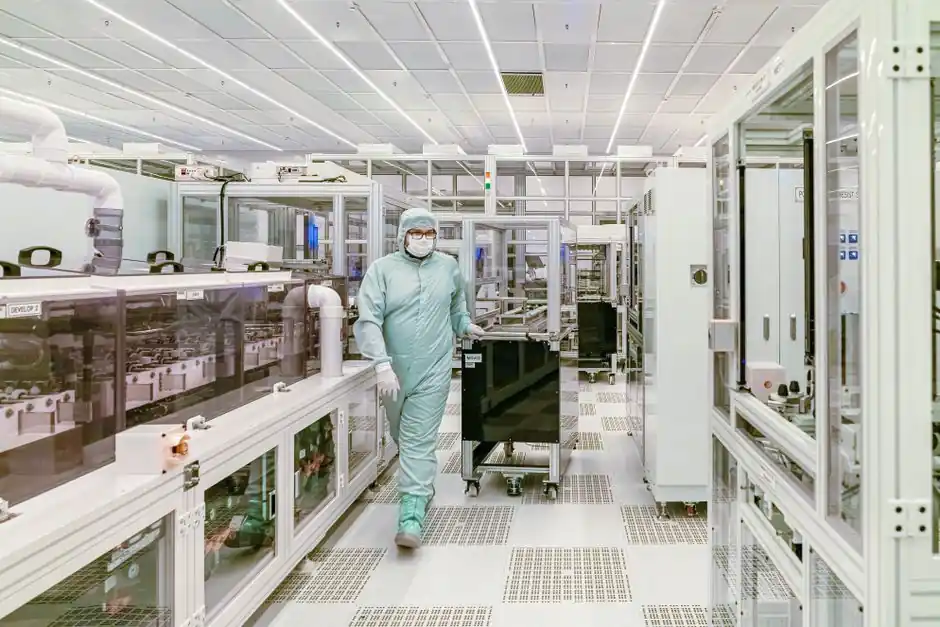
On 25 July 2026, Putailai announced a 5.6 billion yuan phase in Qionglai, Chengdu, adding 7.2 billion m²/year of lithium battery separator capacity split across two wholly-owned subsidiaries, with full ramp scheduled for Q1 2028 and base capacity at the site set to exceed 10 billion m²/year, a level Putailai's own disclosure describes as the largest single-site separator base in China [S3].
The two sub-projects are independently executed: Sichuan Zhuoqin is investing 2.6 billion yuan for 8 base film lines delivering 3.2 billion m²/year, and a new vehicle, Sichuan Gaoju, is investing 3 billion yuan for another 8 base film lines delivering 4 billion m²/year, with the new lines specified for high-end dry and wet process film plus high-porosity film aimed at first-tier power and large-scale energy storage customers [S3].
Coated-separator capacity tracks solid-state ramp
Jinlongyu New Energy (Huidong) Co., Ltd. is mid-build on a 1.2 billion yuan solid-state battery materials project in Huizhou New Materials Industrial Park, with a lithium battery coating separator line of 1,550 t/year, alongside 3,000 t/year of solid electrolyte and 10,000 t/year of lithium manganese iron phosphate cathode, ground broken 7 May 2025 on a project that registered on 2 April 2025 [S2].
Coated film in this context means a base film receiving a secondary coating, typically ceramic, polymer, or hybrid, to raise heat resistance, mechanical strength, and electrolyte wettability, a stack that the project disclosure explicitly ties to semi-solid and all-solid-state battery safety [S2]. Demand-side validation has already appeared: on 20 May 2025 Jinlongyu New Energy (Shenzhen) signed a 100,000-cell purchase order for high-energy-density solid-state drone batteries, and on 20 November 2025 the group confirmed semi-solid cells passed customer testing with orders and key materials sampled by multiple customers [S2].
2-micron ultra-thin base film and commodity supply benchmarks
In Dongming County, Shandong, the Linlong New Materials R&D Base is constructing a 2-micron high-end battery separator production base on a 2.5 billion yuan total investment, one of the thinnest commercial base film targets publicly disclosed in domestic Chinese coverage this year [S9].
For reference, current commercial separators from Chinese suppliers cluster at thicker gauges: the Fancyco advanced PE separator lists a 300 ton/month production capacity and a US$0.10-0.20 per square meter price band for export rolls, with pallet stack limited to no more than 2 layers and 15-25 day delivery against T/T, L/C, or D/P payment [S1]. Dongguan Gelon Lib's PP/PE/PP multilayer separator is offered at US$65.00 per roll for 1-19 rolls and US$55.00 for 20+ rolls, with 12 micrometer thickness as a typical spec [S6]. Xiamen AOT lists the Celgard 2325-class PP/PE/PP separator at US$85.00 for 1-4 rolls, US$80.00 for 5-9, and US$75.00 for 10+, a useful spot benchmark for imported-grade film [S8].
Dry vs wet process line choices for new builds
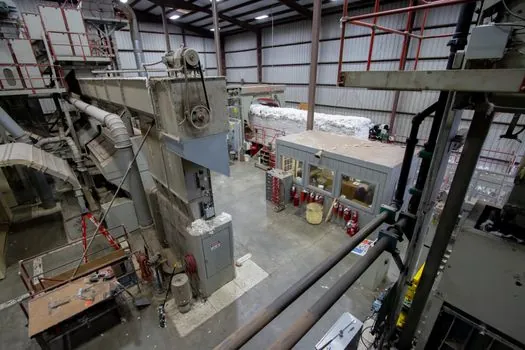
Putailai's new Qionglai lines are specified for both high-end dry and wet process separators, plus high-porosity film, so a process selection must be made per line [S3]. Dry process, the historical workhorse for PP single-layer film, uses uniaxial stretching of extruded cast film and tends to deliver uniform pore structure at competitive cost, while wet process, dominant for PE and PE/PP bilayers, requires an extraction step after biaxial stretch and is the standard route for sub-20 micrometer film with high puncture strength.
The Asahi Kasei capacity disclosure from 2015, still useful as a process benchmark, lists 350 million m²/year wet Hipore™ capacity (255 million m²/year current plus 60 million m²/year new Hyuga line No.5 at approximately 5 billion yen investment) and 200 million m²/year of dry Celgard™ and Hipore™ combined, illustrating the typical 1.5-2x scale ratio between wet and wet-plus-dry lines in a global supplier footprint [S4]. For a deeper equipment-level comparison, see the wet vs dry separator line equipment and coater spec gate. On instrumentation and inline measurement, the anode material process control spec map covers temperature, tension, and coat-weight sensor bands that overlap with separator coating lines.
Project scale comparison: which bets matter
Comparing the three named 2025-2026 Chinese projects on a normalized basis, Putailai Qionglai leads on area output at 7.2 billion m²/year for 5.6 billion yuan (roughly 0.78 yuan per m² of annual capacity), Jinlongyu's coated-separator line is sized at 1,550 t/year of finished coated film inside a 1.2 billion yuan multi-product site, and Linlong's 2-micron base film base sits on a 2.5 billion yuan envelope for an undisclosed annual area output, with the 2 micrometer gauge being the differentiating spec rather than headline tonnage [S3][S2][S9].
Older and smaller but still referenced 2023 build-outs, such as Changyang Technology's 187 million yuan, 400 million m²/year project for energy storage and EV separators, sit one to two orders of magnitude below Putailai's 2026 phase, evidence that domestic separator capacity additions are now consolidating into billion-m² annual units per site rather than the few-hundred-million m² tiers of three years ago [S5]. Adjacent-format separators also continue to scale: Heilongjiang JinHan runs two AGM separator lines at over 4,000 t/year for telecom, rail, and standby battery markets, a separate but parallel track from coated LIB film [S7].
Downstream matching, green systems, and supply concentration
Putailai explicitly ties its Qionglai output to first-tier power battery and grid-scale energy storage customers, with a water-recycling system sized to take separator process water reuse above 90% once the new lines are running [S3]. The Jinlongyu project targets captive solid-state cell consumption plus external sales, with about 90% of the 3,000 t/year solid electrolyte output flagged for external sale and the 1,550 t/year coated film line sized to internal cell demand [S2].
Process instrumentation for coating, drying, and calendering is the spec layer where capacity plans translate into measurable throughput, and the flow meter spec landscape and pressure transmitter selection map both feed into wet-process and coating-line instrumentation stacks used on these builds. Valve manifold and isolation choices for solvent and NMP recovery loops likewise pull from the industrial valve reference set, since dry process lines run hot oil and stretch-oven loops at lower pressure while wet process lines route extraction baths and solvent recovery through corrosion-resistant valve trim.
Risks, constraints, and failure modes in 2026-2028 ramp
Three real constraints sit on top of these capacity plans: sub-2 micrometer base film yield and pinhole rates are still the gating quality metric for ultra-thin dry-process film, a fact implicit in Linlong's 2.5 billion yuan commitment to a 2 micrometer base [S9]; coated-film capex is the gating capex line for solid-state supply, with Jinlongyu's 1,550 t/year line sized against an actual customer order book rather than speculative demand [S2]; and site-level water and waste heat systems are non-optional, since Putailai's own commitment is for process water reuse above 90% [S3].
For a process engineer, the watch list for the next 6-12 months is concrete: (a) whether Putailai's Qionglai Phase 2 lines hit mechanical completion milestones on the Q1 2028 schedule, with the 8+8 base film line configuration and the 10 billion m²/year single-site threshold as verifiable markers [S3]; (b) whether Jinlongyu's 1,550 t/year coated line ramps within the disclosed 12-month to 3-year construction window and whether the semi-solid cell orders convert into coated-separator pull-through [S2]; and (c) whether the 2 micrometer Linlong base film reaches commercial yield, since 2 micrometer gauge is the published spec and any drift to 3-4 micrometer would materially change the project's competitive position versus the 12 micrometer and 25 micrometer benchmarks that dominate current commercial offerings [S9][S6][S8].