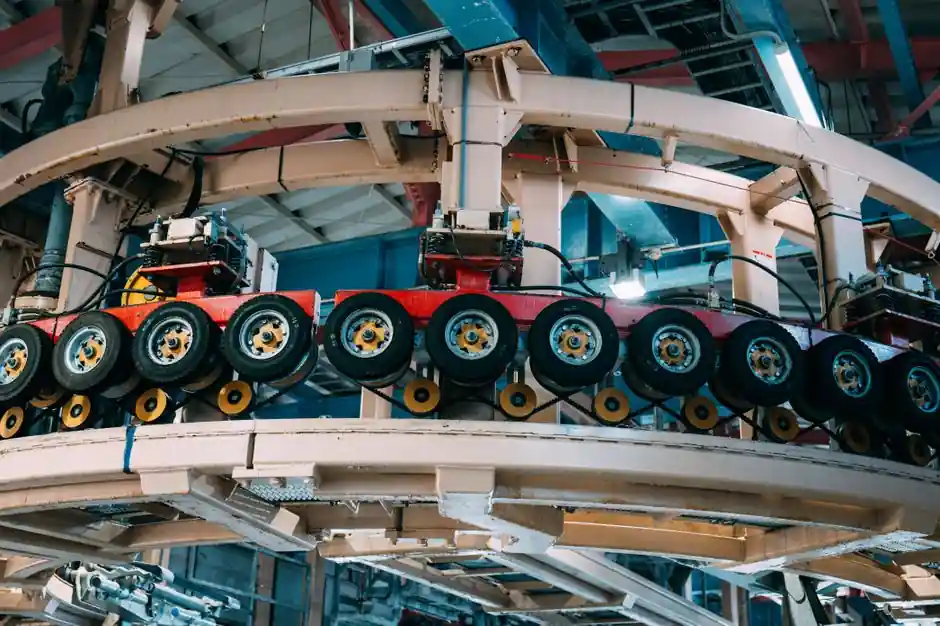
A wet-process Li-ion battery separator line runs an asynchronous biaxial stretching cycle between casting and winding, with process speed capped at 105 m/min, machine-direction stretch up to 12×, and transverse-direction stretch up to 15×, per KATOP's published line parameters [S2].
Diaphragm output thickness sits in a 5–25 µm window, maximum web width is 6800 mm, and oven zones are built as 3 m sections with 3–6 sections per zone, a layout that controls horizontal temperature uniformity across the long dryer [S2].
Wet-process line architecture and the specs that actually decide capex
The wet line is sequenced as casting → MD stretch → first TD stretch → extraction → second TD stretch → winding → slitting, with the casting stage accepting both extrusion and calendering feed [S2]. The two stretch stages, MD and TD, are the reason these lines are sold as "asynchronous biaxial stretching" rather than simultaneous; the ratio split (12× MD vs 15× TD max) is what gives PE and PP separators their final porosity anisotropy, so any sourcing decision needs to confirm the actual achievable ratio under the buyer's target throughput, not just the catalog maximum [S2].
Roller roundness on the casting station is held to ≤0.01 mm, roller speed-difference fluctuation is ≤3‰, and chain synchronicity is rated at 5‰, three numbers that separate a 105 m/min production-capable line from a pilot line dressed up with the same model code [S2]. Dryer heating is selectable between electric, oil, and steam, and the oven's horizontal temperature control accuracy is specified at ±1°C, the figure a process engineer should pin into the technical agreement rather than accept as a "typical" claim [S2].
Separator coater selection: micro-gravure, micro-concave and slot-die trade-offs
Xiaowei offers the XW-W400-1.2 separator coating machine for precision coating of Li-ion separators, with a 15-day lead time and 1-set MOQ for OEM builds [S5]. TOB's TOB-W400-2.4 micro-concave coater is positioned for the same separator coating application, and is sold as a 2.4 m class platform rather than the 1.2 m class on the Xiaowei unit [S7]. Tmax's TMAX-PE-battery-sepa platform covers both separator soaking and coating duties, ships CE-marked with a 2-year limited warranty, and lists a 3–5 day lead time from Xiamen on the related listing pages [S1][S3][S4].
On a 2.4 m wide micro-concave head, the coating weight uniformity you can hold is the binding constraint, not the line speed, because the separator substrate is thin and any wet-film pressure spike on the backing roller telegraphs straight into pinholes. The 1.2 m XW-W400-1.2 format suits pilot or small-batch R&D, while a 2.4 m class head is closer to the upstream casting width on a production wet line, so the two are not direct substitutes [S5][S7].
Slitting and rewinding: where yield loss is made or prevented
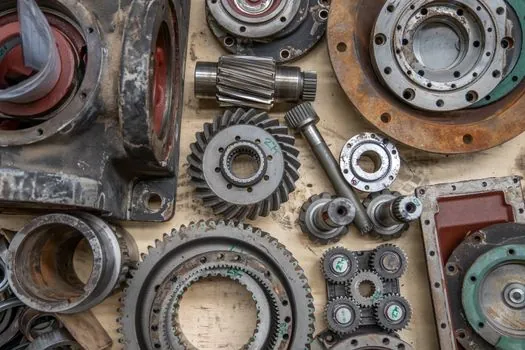
After the wet line, the separator film is converted to customer widths on a slitter-rewinder, and the LITH-RP600 class of automatic separator slitter combines unwinding, slitting, and rewinding into one frame so the operator can hold edge quality and tension under one control loop [S6]. For Li-ion cell formats, slit width tolerance, burr height, and web tension stability through acceleration and deceleration are the three yield-driving parameters, and on a thin 5–25 µm diaphragm, tension transients above roughly 10–15% of setpoint typically start to register as wrinkle or stretch marks at the cell winding station [S2][S6].
Rewinder quality also determines how cleanly the film unwinds inside the dry room during cell stacking; a slitter without closed-loop tension control is the most common source of the "static-induced stacking defects" that buyers blame on the separator supplier. Pairs the slitter stage with the wet line's 105 m/min ceiling: any slitter rated below that cap becomes a throughput bottleneck the moment the upstream stretch ratio is dialled up to chase higher porosity [S2][S6].
Selection criteria: who needs a full wet line vs a coater-only retrofit
A buyer building greenfield separator capacity needs the full wet line with asynchronous biaxial stretching, extraction, and a multi-zone dryer, because that is the only configuration that produces a 5–25 µm microporous PE or PP film from resin in one pass [S2]. A buyer running R&D on next-gen separators (sodium-ion, solid-state) typically starts with a pilot coater and a tabletop slitter, not a 6800 mm production line, because the development cycle is dominated by coating chemistry, not web width [S2][S5].
Lines meeting 105 m/min at 6800 mm with 12×/15× stretch and ±1°C oven accuracy are at the upper end of catalog offerings and the buyer's RFQ should call those five numbers out explicitly, with the oven section count written in (3 m per section, 3–6 sections per zone) so vendor quotes are comparable [S2].
Standards, certifications and sourcing signals to lock in before PO
CE marking is the baseline conformity signal on Chinese-built separator equipment: the TMAX-PE-battery-sepa separator soaking and coating machine is CE compliant, and Tmax also lists ROHS certification on the same model code across two of its product pages [S1][S3][S4]. Lead-time discipline is a useful vendor signal: Tmax ships the separator soaking and coating machine in 3–5 days from Xiamen, Xiaowei quotes 15 days for the XW-W400-1.2, and KATOP positions the wet-process line as a configured build rather than a shelf item [S1][S3][S4][S5][S2].
Payment terms matter on a capex line: T/T, LC, and Western Union are common across these vendors, with Tmax additionally accepting D/A, D/P, and PayPal on smaller separator coater units [S3][S4]. Warranty language should be checked line-by-line: Tmax publishes a 2-year limited warranty with lifetime technical support on the separator soaking and coating machine, while KATOP and Xiaowei publish product-spec data without a published warranty term on the pages reviewed [S3][S4][S5][S2]. For buyers outside China, Incoterms and the on-site commissioning scope (vs remote FAT-only) are the two clauses that swing the total cost of ownership more than the unit price.
Failure modes and limits engineers hit in real production
Three failure modes dominate field reports on wet separator lines: (1) oven temperature drift outside ±1°C, which shows up as non-uniform porosity across the web and downstream cell inconsistency; (2) extraction-stage solvent residue above the residual limit, which collapses shutdown performance and forces the cell maker to scrap incoming lots; (3) tension-loop instability at line speeds above roughly 80 m/min, which presents as edge weave and gauge bands on the final film [S2]. Each one is addressable at commissioning, but only if the spec values above are pinned into the purchase contract, not taken as "typical".
On the coater side, the most common retrofit failure is running a 1.2 m class head on a 2.4 m upstream web, which forces either a width-halving build or a spliced-feed workaround, both of which hurt yield. The second most common is specifying a coater without confirming coating-weight uniformity on a 5–25 µm substrate, because the same head that holds ±2% on a 100 µm electrode film can drift to ±5–7% on a 9 µm separator, and that drift is the difference between a sellable ceramic-coated separator and a lot return [S5][S7].
2026 sourcing map: where the catalog buyers and the engineering buyers diverge
For a Chinese-built pilot or small-batch separator coater in the 1.2 m class, the catalog vendors (Tmax, Xiaowei, TOB) list ready-to-ship units with 3–15 day lead times, CE marking, and a 2-year warranty on at least the Tmax platform [S1][S3][S4][S5][S7]. For a production-scale wet line with 6800 mm width and 105 m/min throughput, KATOP and similar system integrators are the realistic shortlist, and the RFQ needs to call out oven section count, stretch ratio band, tension-control accuracy, and roller roundness as numeric gates, not as features [S2].
Related factory floor specs that share the same selection logic, including dry-type transformer sizing for plant power and temperature transmitter sizing for the oven zones, are worth reading alongside this map because the wet line's ±1°C oven accuracy is only as good as the temperature measurement chain feeding it. Track next: the KATOP wet-process line spec page was published on 2026-08-28 [S2], and a refresh of Tmax's TMAX-PE-battery-sepa listing with updated lead-time and warranty terms is the next signal worth re-checking before any 2026 Q4 PO.
For the relevant spec sheets and selection criteria, see additive manufacturing material, cyclone separator, and linear guide.