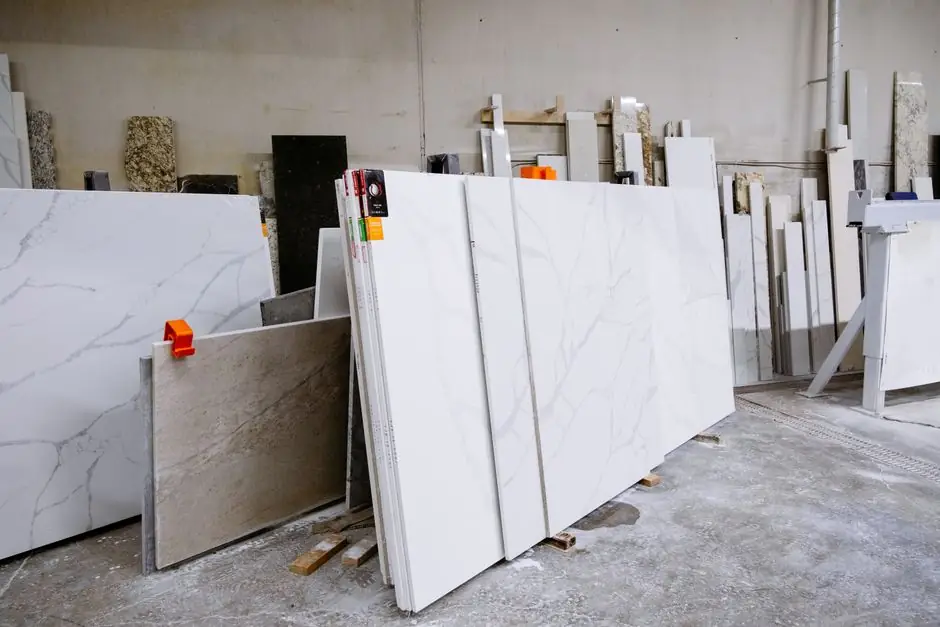
Fused quartz plates and engineered quartz slabs are specified by very different buyer workflows, and confusing the two is the single most common sourcing error in 2026: a 1600x3200 mm architectural slab with 93% natural quartz aggregate and 7% polyester resin (HS code 681099) has nothing in common with a 99.99% SiO₂ JGS1 optical window beyond the Si-O bond [S2][S4].
This guide separates those two material families, lays out the thickness, purity, and tolerance decision tree for fused quartz plates used in semiconductor, furnace, and laser service, and benchmarks the option against borosilicate, sapphire, and ceramic substitutes on thermal shock, optical transmission, and chemical resistance [S3][S4].
Two material families that share a name but not a spec sheet
Engineered quartz surfacing (the kitchen-countertop grade) is a composite of roughly 93% natural quartz powder, 7% unsaturated polyester resin, and trace pigment, pressed into slabs at 1600x3200 mm or cut to 600x600 mm / 800x800 mm tiles, with a 26,000 m²/day line capacity typical of large Chinese plants and ISO/CE/NSF certifications carried for food-contact use [S2]. Thickness options for that product cluster at 15 mm, 20 mm, and 30 mm, with polished, honed, and leathered surface finishes, and the design driver is aesthetics plus stain and scratch resistance, not purity [S2].
Fused quartz and fused silica plates are an entirely different product: flat pieces of SiO₂ glass with purity from 99.9% (standard grade) through 99.99%+ (high-purity) to 99.999% (synthetic fused silica for UV optics), specified for semiconductor wafer carriers, furnace observation ports, laser substrates, and chemical processing liners where the operating envelope can exceed 1000°C continuous service [S3]. A separate product tree covers opaque (milky) fused silica heat shields for IR-blocking furnace baffles, plus CNC-drilled, grooved, and double-side-polished (DSP) variants for OEM reactor lids and wafer-boat fixtures [S4]. For background on the base material families, see the quartz material and glass quartz encyclopedia entries.
Thickness bands and the load that drives each one
Fused quartz plate thickness should be picked from four bands tied to mechanical and thermal load, not from a generic catalog page: 0.5–2 mm thin plates for optical windows, UV transmission, and lightweight covers where thermal mass must be minimized; 2–6 mm medium plates for furnace observation windows, semiconductor chamber components, and general-purpose covers requiring moderate rigidity; 6–20 mm thick plates for furnace baffles, heavy-duty support plates, and high-pressure chamber windows; and 20 mm+ extra-thick plates for high-pressure seals, precision optical blanks, and custom structural components [S3].
For engineered quartz slabs the call is simpler because the catalog is narrow: 15 mm is the standard backsplash and residential vanity choice, 20 mm is the workhorse for kitchen countertops and commercial islands, and 30 mm is reserved for high-span kitchen islands, laundry tops, and floor tile where unsupported span and impact load both rise [S2]. Across both families, the rule of thumb is identical, namely that doubling plate thickness roughly quadruples bending stiffness, so the jump from 15 mm to 30 mm on an architectural countertop is a structural decision, not a visual one.
Purity grades: 99.9% versus 99.99% versus JGS1/JGS2/JGS3
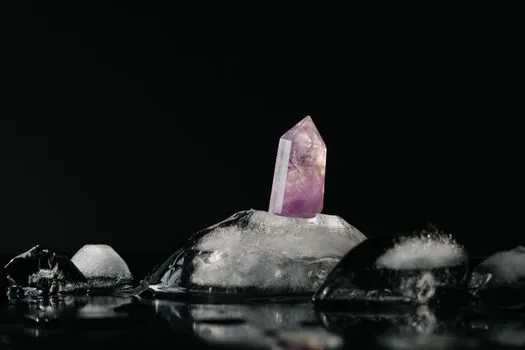
Standard fused quartz at 99.9% SiO₂ is the commodity grade used for furnace tubes, general observation windows, and chemical liners where metallic contamination is not a process-killer; high-purity fused silica at 99.99%+ SiO₂ is the minimum for semiconductor wafer processing, where sodium, potassium, iron, and copper at part-per-million levels will diffuse into the device; and synthetic fused silica at 99.999% SiO₂ is the entry ticket for UV-grade optics below 200 nm where OH content and metallic trace contamination both have to be controlled [S3].
For laser and spectroscopy windows the convention is the Chinese JGS grade series: JGS1 (synthetic fused silica, deep-UV transparent, OH content controlled to a few ppm), JGS2 (high-purity fused quartz, mid-UV to near-IR), and JGS3 (standard fused quartz, visible and near-IR), each delivered as a double-side-polished (DSP) substrate with a scratch/dig specification tied to the application [S4]. A common error is specifying JGS3 for a 266 nm laser line and then watching the window solarise inside 200 operating hours; the correct pick is JGS1 because the metallic impurity ceiling, not the geometry, is what limits UV life.
Thermal, optical, and chemical properties that decide the shortlist
Three material properties carry most of the selection weight. Coefficient of thermal expansion for fused quartz sits at approximately 5.5 x 10⁻⁷ /°C, an order of magnitude below borosilicate and roughly two orders below soda-lime glass, which is why quartz plates survive thermal cycling that cracks the alternatives [S3]. Continuous use temperature exceeds 1000°C for fused quartz, with short-term tolerance well above that, and softening only begins near 1650°C, so the practical limit in most furnace service is hardware (seals, flanges) rather than the quartz itself [S3].
Optical transmission spans deep UV at roughly 180 nm through visible and into near-IR at roughly 3500 nm, with the cut-on wavelength and the OH absorption band set by the JGS grade [S3][S4]. Chemical resistance covers all common acids except hydrofluoric acid (HF), which attacks the Si-O network directly, plus hot concentrated phosphoric acid and strong alkaline solutions above pH 12 at elevated temperature, so any pick for a chemical cover plate has to clear the HF exclusion first. Buyers who want a deeper cross-family comparison of quartz against borosilicate, sapphire, and ceramic for optical windows can use the quartz material reference and the linear guide entry for adjacent precision-engineering context.
Options compared: fused quartz plate versus borosilicate, sapphire, ceramic

Four materials cover most high-temperature, high-clarity plate duty, and the right pick depends on which of four criteria is binding. On maximum continuous use temperature, fused quartz leads above 1000°C, sapphire follows near 1800°C in inert atmospheres but is cost-limited, ceramic (alumina, silicon carbide) sits at 1200–1600°C, and borosilicate tops out around 500°C [S3]. On thermal shock resistance, fused quartz and sapphire are roughly comparable and both beat borosilicate by a wide margin, while dense ceramic is poor because of its higher CTE and lower toughness.
On broad optical transmission, only fused quartz and sapphire span deep UV through near-IR, and borosilicate cuts off near 350 nm while most technical ceramics are opaque. On unit cost for a 200x200 mm plate in the 2–6 mm thickness band, borosilicate is cheapest, fused quartz is roughly 3 to 8 times that, sapphire is one to two orders of magnitude above fused quartz, and ceramic sits between quartz and sapphire depending on the formulation [S3][S4]. The shortlist rule is straightforward: pick fused quartz for thermal cycling plus UV-to-IR transparency at moderate cost, sapphire only when scratch hardness or extreme temperature overrides cost, ceramic when optical clarity is not required and abrasion resistance is, and borosilicate only when the thermal budget stays below 500°C and the duty is static.
Who should NOT pick the mainstream 99.9% plate
A 99.9% SiO₂ standard fused quartz plate is the wrong call in three specific cases. Buyers running 193 nm or 248 nm lithography, or any deep-UV laser service, will pull metallic impurities into the beam path; they need synthetic fused silica at 99.999% SiO₂ (JGS1) regardless of the cost premium, because the alternative is optics that solarise and scrap within weeks [S3][S4]. Buyers with hydrofluoric acid, hot phosphoric, or strong caustic exposure need a different material entirely, since HF dissolves SiO₂, and the correct pick is PTFE-lined or graphite hardware, not a thicker quartz plate.
Buyers who need a structural or impact-resistant window, such as a personnel viewing port on a high-pressure vessel, should not substitute a thicker quartz plate for a laminated safety glass or sapphire solution, because fused quartz is brittle and fails without warning under impact; the standard mitigation is a sacrificial borosilicate or polycarbonate shield in front of the quartz, not a thicker quartz plate. The same logic explains why 30 mm engineered quartz slabs are not used as industrial flooring despite their scratch resistance: the resin binder softens above 200°C, so any process heat above that limit rules the product out [S2].
Spec checklist before releasing a PO

A clean RFQ for fused quartz plates carries six line items and prevents the rework that vague RFQs cause: material grade (99.9%, 99.99%+, or 99.999% SiO₂ with the JGS code for optics), nominal dimensions L x W in mm with explicit tolerance per axis (typical is +/-0.1 mm on small optics and +/-0.5 mm on plates above 300 mm), thickness in mm with a parallelism and flatness call-out, shape (rectangular, circular, annular) and edge finish (as-cut, fine-ground, bevelled, chamfered), machining operations (through-holes, stepped holes, V/U-grooves, DSP polish) with hole coordinates and surface scratch/dig spec, and end-use environment (max temperature, thermal cycling rate, chemicals present, vacuum level) [S3][S4].
For engineered quartz slabs the equivalent checklist collapses to: nominal slab size (1600x3200 mm, 760x3050 mm, or cut-to-size like 1200x1200 mm), thickness (15/20/30 mm), finish (polished, honed, leathered), color and pattern code (Calacatta White, Pure White, Mirror White, or custom), edge profile, packaging (15–20 slabs per seaworthy bundle, 60–80 cut-to-size per crate, 12–25 countertops per crate with PE film), and required certifications (ISO, CE, NSF for food contact) [S2]. The S3 selection workflow on quartz material and the S4 CNC-and-optical-fabrication guide both reinforce that the RFQ discipline, not the supplier, drives the quality outcome. For engineers cross-referencing adjacent precision components, the crossed roller guide entry covers linear-motion hardware that often shares a vacuum or cleanroom envelope with quartz plates.
Trackable signals to watch between now and the next sourcing cycle: any update to the JGS1 OH-content ceiling for 193 nm immersion service, and any revision to NSF/ANSI 51 food-contact limits for resin-bound engineered quartz at elevated temperature. The quartz material workflow guide and the thin-film PV sputtering target reference cover adjacent high-purity material decisions for buyers building out a wider process-equipment bill of materials.