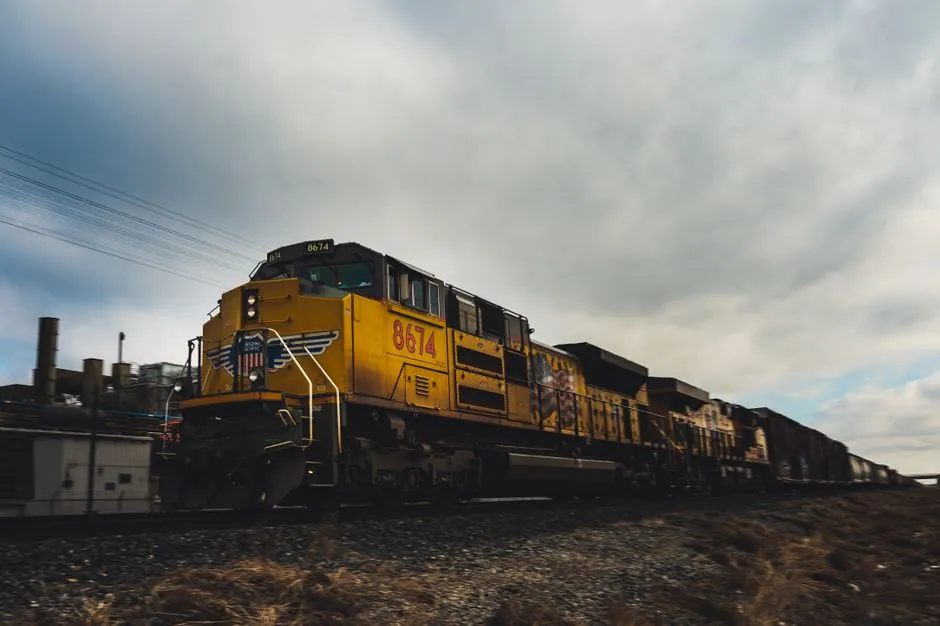
Rail lubricant selection is not a single product decision but a four-zone specification problem: axle-box and traction-motor bearings, wheel-flange/top-of-rail contact, switch slide plates, and rolling-stock hardware (buffers, couplings, brake rigging) each demand a different chemistry, thickener, and base-oil system [S1][S2][S3].
Modern high-speed axle-box bearings can rotate above 2,000 rpm under radial loads measured in tonnes, while enduring track-side water, tunnel humidity, and thermal swings from a cold-soak of -40 °C to traction-motor housing temperatures above 120 °C during sustained grade-climbing [S2]. Wheel flanges run against rail gauge faces at contact pressures that can exceed 800 MPa, which is the regime that drives the choice of friction-modifier grease over a conventional EP grease [S2].
Axle-Box and Traction-Motor Bearing Greases
Axle-box greases are typically lithium-complex NLGI 1-2 with EP and anti-wear additives, formulated to retain structure when emulsifying track-side water; DIN 51807 washout at elevated temperature is the lab test that ranks candidates for this duty [S2]. Traction-motor bearings add an electrical-current threat (shaft-voltage passage through the film) and an oxidation challenge above 120 °C, so oxidation-stability and copper-corrosion ratings carry as much weight as base-oil viscosity [S2]. Long-life journal roller bearing greases specified to AAR M-942-98 sit at the high end of this duty cycle, combining high oxidation stability, shear stability, water resistance, and corrosion resistance for non-field-lubricated freight car applications [S5].
Selection gate for this zone: operating temperature window (-40 to 120 °C minimum), DIN 51807 washout rating, oxidation stability, EP/anti-wear additive package, and, for freight, AAR M-942-98 compliance [S2][S5]. A general-purpose industrial lubricant chosen from a plant-floor catalog rarely meets the combined thermal and washout envelope.
Wheel-Flange and Top-of-Rail Friction Modifiers
Wheel-flange and top-of-rail products split into two functional classes: high-pressure curve greases (typically NLGI 0 with graphite or MoS2 solid lubricants, designed to be pumped long distances by trackside or wayside lubricators) and low-adhesion friction modifiers (biodegradable fluids applied at the wheel-rail interface to stabilize friction, suppress curve squeal, and reduce wear) [S3][S5]. Biodegradable, vegetable-base lithium-soap curve greases with high-purity synthetic graphite are an established eco-friendly option, formulated NLGI 0 for pumpability and NLGI 00 for very cold climates where thinner winter pumping is required [S5].
For stationary trackside systems, a high-viscosity rail-head conditioner is specified to lubricate the contact zone with the wheel flange, eliminate curve squeal, and reduce wear, while onboard systems use a low-adhesion grease that simultaneously treats wheel flange and rail head and reduces noise [S3]. CICO® TL 22 B, TL 1500 B, TL 1600 B (wheel-flange and gear-rim), RS 20 B (low-adhesion onboard), and SM 1200 MB (stationary rail-head) are representative product codes for this duty class [S3]. Comparison on three criteria: NLGI 0 graphite-vegetable grease vs. NLGI 00 winter variant vs. low-adhesion synthetic onboard fluid, on temperature range, biodegradability, and pumpability. The first two win on eco-compliance and load-carrying capacity; the onboard fluid wins on noise/squeal suppression but trades off on solid-lubricant content [S3][S5].
Switch Slide Plates, Crossings, and Track Hardware

Switches require a low-temperature pumpable grease with high load-carrying capacity and corrosion resistance in wet, salty, or humid environments; a special synthetic graphite content is the differentiator for extreme-pressure resistance on slide plates [S5]. Surface preparation gates the grease: rust, scale, and debris must be removed before fresh grease is applied, because applying grease over an oxidized surface embeds abrasive particles and accelerates wear on the slide plate [S2]. Roller-equipped switches need a separate grease selection, since rolling elements operate under different kinematics than a plain sliding switch plate [S2].
For modern switch mechanisms, a grease that "ensures smooth operation of switch mechanisms and reliable movement of switch blades even under severe weather conditions" is the procurement language to anchor a spec on, paired with a minimum low-temperature pumpability limit (commonly -20 to -30 °C) and a salt-spray corrosion rating [S3]. CICO® WSM 3000 T is a named product code for switch and crossing lubrication in this class [S3].
Buffers, Couplings, and Brake Rigging
Buffers, screw couplings, draw-hook guides, handbrake spindles, and brake rigging are a separate grease class: biodegradable, often high-viscosity pastes and assembly compounds that resist seizure and wash-off under outdoor exposure [S3]. A modern biodegradable buffer-and-coupler grease is specified for buffer plates, screw couplings, and various transmission/brake mechanism parts, while a service and assembly paste handles brake-rigging joints and bolted connections where long-service disassembly without seizure is required [S3]. A synthetic lubricating and preserving agent covers brake components, screws, pins, and other metal parts exposed to high loads and aggressive environmental conditions [S3].
Selection gate for this zone: biodegradability requirement (often mandated by trackside environmental rules), wash-off resistance under rain/wash-down, anti-seize performance for bolted joints, and compatibility with rubber seals on buffer and coupler components [S3]. CICO® BF 45 B (buffer/coupler), SM 1200 B (assembly paste), and TGM 2000 K (preserving agent) are representative codes [S3].
Locomotive Engine Oils and Hardware Lubrication

Locomotive engine oils are a separate sub-domain: high-performance railroad diesel engine oils designed for Generation III and IV engines, qualified against Alco, GE, and GM-EMD requirements, formulated zinc-free to prevent corrosion of silver bearings, and built on highly refined base stocks with rust and oxidation inhibitors, anti-wear, anti-foam, detergents, and dispersants [S5]. SAE 40 is the most common viscosity grade; 17 TBN is a published specification level that has been shown in diesel engine tests to greatly reduce deposits compared to lower-TBN products, which matters when locomotives burn higher-sulfur fuels [S5].
For on-equipment maintenance (gearboxes, journal boxes, traction-motor suspension bearings), a fluid-lubricant family with additives for extended oxidation protection, improved adhesion, higher viscosity index, and rust protection is the standard offering, with plain journal bearings in railroad car journal boxes and traction-motor suspension bearings on locomotives as the named applications [S5]. Onboard fluid treatments and top-of-rail friction modifiers are not interchangeable: a trackside industrial lubricant qualified for journal-box service is not a substitute for a wheel-flange curve grease.
Decision Matrix: Picking the Right Product Class
Map the four zones against three decision criteria. For axle-box and traction-motor bearings, the dominant criteria are thermal range (-40 to 120 °C), DIN 51807 washout, and AAR M-942-98 (freight) or OEM traction-motor approval; product class is lithium-complex NLGI 1-2 or qualified long-life journal roller bearing grease [S2][S5]. For wheel-flange/top-of-rail, criteria are pumpability (NLGI 0 or 00), biodegradability, and friction-stability (graphite or low-adhesion synthetic); product class is graphite-vegetable curve grease or low-adhesion onboard fluid [S3][S5]. For switch slide plates, criteria are low-temperature pumpability, EP load-carrying, and corrosion resistance (often salt-spray); product class is special-graphite low-temperature pumpable grease [S3][S5]. For rolling-stock hardware, criteria are biodegradability, anti-seize, and seal compatibility; product class is high-viscosity biodegradable paste plus assembly/preserving compound [S3].
Field Preparation, Compatibility, and Limits

A clogged lubricator nozzle starves a curve and can cause pressure build-up across the entire circuit, so filtration and nozzle maintenance are as much part of the lubricant spec as the grease itself [S2]. Where onboard additive systems (for example, MTC-style engine treatments or fuel conditioners) are evaluated for locomotive engines, transmissions, and hydraulics, the application must be distinguished from wheel-flange, top-of-rail, and trackside lubrication, since the additive chemistry is designed for in-engine oil-film performance rather than wheel-rail traction control [S4]. Industrial-grade greases qualified to general factory-bearing specs will not meet the combined thermal, washout, and biodegradability envelope of a modern rail tender, and specifying one as a substitute is a common source of premature bearing failures and curve-squeal complaints.
Trackable signals for the next selection cycle: AAR M-942-98 revision movements, tightening of biodegradable-content requirements in European rail tenders, and convergence of onboard low-adhesion fluids with trackside rail-head conditioners into a single platform spec. For related hardware prep, see also this sand blasting machine selection for rail components spec path, since surface condition before grease application is the most common hidden failure driver in slide-plate lubrication [S2].
Component reference pages worth checking: industrial adhesive, and industrial borescope.