
Most high-rise jobs spec 1 to 4 tower cranes, with 1 crane common on buildings under roughly 20 stories, 2 cranes on 20-40 story towers, and 3 to 4 cranes on skyscrapers above 40 stories or projects with large footprints, per industry guidance [S1][S3][S5].
Beyond a simple floor count, the real sizing inputs are heaviest single lift, maximum working radius, cycle-time target, and the number of trailers feeding prefabricated modules or concrete buckets to the crane [S2]. For context on other vertical-construction equipment, see this spec-level guide to stacker crane fork choices.
Why Floor Count Alone Does Not Set Crane Count
Tower cranes can be extended to well over 1,000 ft when anchored to a structure, which is why a single hammerhead or flat-top unit can service a building that would otherwise look like it needs a fleet [S1]. Each crane, however, is bounded by a load-radius curve: capacity at the jib tip is a fraction of capacity close to the tower, so a single crane cannot always cover a wide floor plate at full lift weight [S2][S3].
For skyscrapers or structures above 20 stories, climbing (internal or external) tower cranes become the default, with the crane anchored to the core and climbed hydraulically as floors are added [S1][S5]. In modular housing, the model is sharper: the literature treats each crane's position, radius, and trailer distance as coupled variables in a mixed-integer linear program, because overestimating radius-driven capacity creates a direct safety hazard [S2].
The Decision Rule Engineers Actually Use
Specifiers start with three numbers: the heaviest pick (usually a prefabricated module or a concrete placement bucket), the maximum radius at which that pick must land, and the desired hook-cycle time per hour. Tower crane capacity at the working radius, not nameplate maximum, is the binding constraint, and the number of cranes is whatever is required so that no single unit is asked to lift beyond its radius curve at the heaviest pick [S2][S3].
Once one crane cannot cover the floor plate or the cycle-time target at the worst-case radius, a second unit is added, and additional units are added for shared-airspace sites, very heavy module weights, or staged supertall cores [S2]. A common rule from rental guidance is to spec for greater reach, higher capacity, or enhanced mobility depending on whether the project bottleneck is height, weight, or site geometry [S4].
Crane Type Comparison for High-Rise Spec
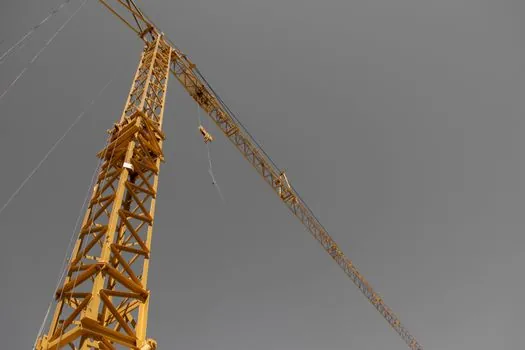
Four tower crane types dominate high-rise work, and the choice changes how many units a site needs [S3][S5].
Hammerhead (saddle jib) and flat-top (topless) cranes carry a fixed horizontal jib with a trolley, give the highest capacity at a given radius, and suit open sites where one crane can cover the full plate; flat-tops are preferred when several cranes must share airspace, because the missing tower-top cap lowers the head profile [S3].
Luffing jib cranes raise and lower the jib to change reach, which is why they are the typical pick on tight urban sites and on jobs with multiple tower cranes overlapping, since the luffing motion avoids slewing into a neighbor's envelope [S3][S5]. Self-erecting cranes are the smallest of the four, set up without a mobile assist crane, and are usually limited to lower-rise work, early-stage high-rise support, or mid-rise residential jobs where one unit is enough [S3][S5].
Typical Crane Count by Building Class
For buildings under about 20 stories on a compact footprint, 1 hammerhead or luffing jib crane is the standard configuration, paired with a self-erecting unit for early material handling if the cycle-time target is aggressive [S1][S3][S5].
For 20 to 40 story towers, 2 cranes is the common configuration: typically one climbing hammerhead for heavy steel and module lifts at the core, and one luffing jib on the perimeter to clear adjacent structures and serve the far corners of the plate [S3][S5].
For skyscrapers above 40 stories, supertall residential, or modular projects with several active trailer positions, 3 to 4 cranes are common, with multiple luffing jibs used to manage shared airspace and avoid overlap of working radii [S2][S3]. Operational references put the typical working height of standard tower cranes near 230 ft, which is why climbing or multiple-unit configurations take over as the building rises past that band [S4].
Use Cases Where the Count Skews Higher

High-density modular housing projects drive crane count up because every module is a discrete, non-reducible lift coming off a moving trailer, so the limiting factor is hook-cycle time, not raw capacity [S2]. A high-rise modular complex will frequently run 2 to 4 tower cranes simultaneously, with trailer positions and crane locations co-optimized to keep the trailer-to-crane and crane-to-structure distances short [S2].
Supertall cores, twin-tower footprints, and sites with restricted ground footprint that rules out a mobile assist crane also push count up, since the only way to add lifting capacity is to add a second climbing unit rather than upsize one [S1][S3]. The same logic shows up in adjacent heavy-lift specs, such as fleet sizing a 60 m³/h concrete pour with mixer trucks, where count, not size, is the binding lever once per-unit capacity is fixed.
Limits and Failure Modes to Spec Against
Three failure modes drive over-spec and under-spec on tower crane count. First, radius overestimation: the literature on modular high-rises explicitly warns that ignoring trailer relocation when sizing the crane can push the unit past its safe capacity at the worst-case radius, with a direct safety hazard [S2]. Second, airspace collision: adding a second or third hammerhead on a tight site without switching to flat-top or luffing jib geometry creates slewing conflicts that can halt lifts [S3].
Third, single-crane dependency on a long critical path: a single climbing crane that goes down for maintenance or wind stops the entire vertical material flow, so projects on tight schedules frequently spec a second smaller unit as a swing crane for HVAC, formwork, and rebar cages even when one heavy unit could in theory cover the heaviest pick [S1][S4]. For buyers cross-checking adjacent load-bearing decisions, the carbon-steel grade selection rules for buyers and engineers cover the material side of the same question.
Trackable Signals Going Forward

Two signals to watch on tower crane count decisions: published case studies of supertall modular projects, where the number of cranes and the trailer-positioning model together are the most reliable proxy for actual cycle-time capacity, and OEM guidance on shared-airspace geometry, which is where the hammerhead to luffing-jib mix on multi-crane sites keeps shifting [S2][S3]. A third, narrower, signal is rental-fleet announcements of flat-top and luffing jib capacity classes, since those models directly gate how many units a dense urban site can run without airspace conflicts [S3].
For component-level specifications, see high voltage tester, tower crane, and signal tower light.