A rate-of-rise heat detector triggers when the sensing element sees a 12-15°F (6.7-8.3°C) increase per minute, regardless of the absolute starting temperature, while a parallel fixed-temperature element latches at a set point such as 135°F, 165°F, 200°F, or 285°F [S2][S4]. On combination units the ROR portion is restorable and the fixed-temperature portion is non-restorable: a fusible link melts, a disc falls, and the head stays in alarm until replacement [S1][S2].
Most U.S. commercial panels still use conventional 135°F ROR heads, with 194°F versions reserved for attics and boiler rooms, and 285°F heads for oven and kiln service. For designers sizing a fire-alarm branch, the operative fact is simple: the rate of rise channel is fast but slow-flaming fires below the threshold can defeat it, so fixed-temperature backup is non-negotiable in code-listed applications [S4][S7].
What 15°F per Minute Actually Means Mechanically
The ROR element is a sealed air chamber with a calibrated vent leak. Slow ambient drift equalises through the vent and never pushes the diaphragm past trip. A genuine fire ramps faster than the vent can bleed off, the diaphragm distorts, and the contacts close: this is the heat-absorbing-device (HAD) principle that almost all North American ROR heads share [S6]. Specification sheets and field tests cite 15°F per minute as the typical trip rate, and the safer DIY verification is a hair dryer or heat gun held at a distance that lifts the head from 70°F to 85-90°F inside one minute, well below the 135°F fixed set point [S1][S6].
Two real numbers from public spec sheets: the Potter THERMOFLEX CR-165W lists the ROR function at 15°F/min alongside a 165°F fixed set point, with contact ratings of 3 A at 125 VAC, 1 A at 28 VDC, and 0.3 A at 125 VDC [S2]. The Honeywell 5809SS wireless combination head pairs 135°F fixed with the same 15°F/min ROR channel, in a plastic housing sized for a 4-inch octagon box [S5]. Operating ceiling on the CR-165W is 250°F (120°C), and the lower limit is -20°F (-30°C), excluding the set-point rating itself [S2].
Trip Thresholds Compared: 135°F, 165°F, 200°F, 285°F
Combination ROR + fixed heads ship in four common fixed set points, and the right one is a function of ambient ceiling temperature and nuisance source. 135°F (57°C) is the workhorse for offices, corridors, and dwelling units and is the value referenced as standard under NFPA guidance cited in installer forums [S4]. 165°F (74°C) is the default for the CR-165W and fits unventilated attics, garages, and storage rooms where summer peaks can flirt with 130°F [S2][S4]. 200°F (93°C) and 285°F (140°C) exist for oven hoods, kiln lofts, and industrial process spaces where 135°F would false-alarm on every warm afternoon [S2].
Pick by environment, not by panel brand: 135°F for ordinary commercial, 165°F for unconditioned spaces, 200-285°F for process heat. If the ceiling routinely exceeds 120°F in summer, a 135°F head will nuisance-trip; in that case a 165°F ROR is the lowest acceptable set point, and 200°F is the conservative choice when solar gain or process radiant load is severe [S2][S4].
Combination vs Fixed-Only vs ROR-Only Heads

Fixed-temperature-only heads are the cheapest, simplest, and slowest to warn: they wait for the ceiling layer to reach the set point, which in a residential flashover can mean substantial property loss before alarm. ROR-only heads catch fast-rising fires within seconds of a 15°F/min climb but can be defeated by slow-smouldering fires that never trip the rate channel. Combination heads, the dominant SKU on the U.S. market, give both pathways: the ROR element trips on rapid rise and resets when the air cools, while the fixed element latches and forces replacement [S1][S7][S8].
Code bodies (NFPA 72 in the U.S.) accept all three architectures in specific rooms, but most AHJs default to combination ROR + fixed in sprinkled light commercial and to fixed-only in attics and plenums where nuisance rates are high. The CR-165W is a textbook example of why fixed-only is rarely used: it ships as combination by default because the ROR channel costs almost nothing once the housing exists, and the safety delta is meaningful in fast-flaming scenarios [S2][S7].
Selection Criteria and Common Failure Modes
Spec by four numbers: fixed set point (135/165/200/285°F), ROR trip rate (12-15°F/min), voltage rating (24 VDC nominal on most addressable loops), and contact rating if the head drives a relay or indicator. Wireless variants like the 5809SS solve the retrofit wire-pull problem but cap the fixed set point at 135°F, which is the main reason 5809SS heads are not specified in attics that exceed 120°F in summer [S4][S5].
Three failure modes to design around. First, painted or dusty heads insulate the sensing chamber and slow response: NFPA 72 requires functional testing and cleaning on a fixed interval, and field experience is that a heavily loaded ROR head can double its real-world trip time. Second, the fusible-link disc on a fixed-temperature element is single-use; once the disc falls, the head must be replaced, which is why spares are stocked by every fire-alarm service contractor. Third, the ROR channel is restorable but the fixed channel is not, so a partial trip that resets leaves no indication on the FACP, complicating post-event diagnosis [S1][S2].
Wiring, Testing, and Wireless Variants
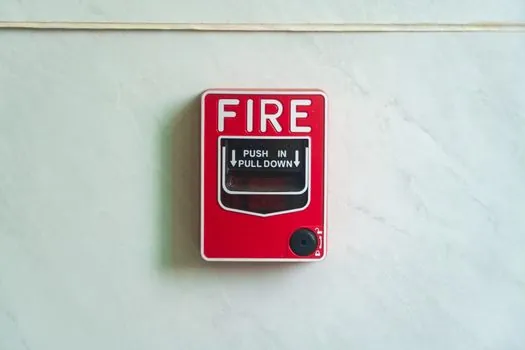
Conventional 2-wire ROR heads are wired to an FACP initiating device circuit just like a pull station: the head needs no separate power, the panel supplies the supervision current through the zone, and an alarm shorts the loop. Four-wire and addressable variants need a compatible zone module or addressable base, and a 12 VDC-only head cannot be dropped onto a 24 VDC loop without a regulated supply or the matching 24 VDC SKU [S1]. Wireless heads like the 5809SS sit on a 345 MHz / 2GIG or Honeywell transmitter, pairing 135°F fixed and 15°F/min ROR into a single coin-cell-powered device that talks to the panel without a home run [S5].
For a heat detector, the term to keep handy is a heat detector reference page covering set-point and ROR channel selection across fixed, combination, and linear-wire types. In a broader fire-alarm layout, the lighting equipment and electric lamps reference is irrelevant to sensing but often co-specified in the same commissioning package as visible notification appliances that pair with these initiating devices. For testing, the public-recipe test is a hair dryer or heat gun sweeping warm air across the head, stopping the instant the ROR trips so the fixed element stays intact, then letting the disc cool back below 130°F before re-arming [S1][S6].
Sourcing, Standards, and Trackable Signals
U.S. combination ROR + fixed heads ship under UL 521 (the product standard for heat detectors for fire-protective signalling systems), and any head on a commercial panel must carry the UL 521 listing for the rated set point. NFPA 72 governs placement, spacing, and test intervals, and references the 135°F ROR baseline that dominates the residential and light-commercial market [S4]. Specifiers writing submittals should call out the listed set point, the listed ROR rate, the contact rating, and the operating temperature window: 250°F (120°C) upper and -20°F (-30°C) lower for the CR-165W is a typical envelope, with 24 VDC nominal on the wireless 5809SS loop [S2][S5].
Trackable next signals: (1) AHJ enforcement of UL 521 rev cycles on existing commercial heads, since older analog-addressable ROR devices with set points below 135°F are common retrofit candidates; (2) the steady migration from conventional 2-wire ROR loops to addressable SLCs in Class B commercial retrofits, which usually requires head replacement anyway; and (3) growing demand for 165-200°F ROR heads in unconditioned attics, garage lofts, and process spaces where 135°F heads nuisance-trip on summer peaks. For related industrial fire-protection spend, the private fire hydrant annual maintenance cost breakdown tracks what site owners pay to keep the suppression side healthy alongside the detection side covered here.
For component-level specifications, see heat treatment furnace.