A reach truck needs roughly 2,600 to 2,900 mm of clear stacking aisle to handle a Euro pallet (800x1200 mm) loaded lengthways, compared with 3,400 to 3,900 mm for a typical electric counterbalance forklift on the same load, which is why a reach-truck retrofit is usually cheaper than a building extension when storage density is the constraint [S1][S2].
For procurement and layout teams, the figure that matters is not the truck's turning radius but the stacking aisle width (Ast): the dimension that lets the machine rotate 90 degrees, square up, and place a pallet flush against a rack upright without scrubbing the load. Get Ast wrong and the truck either will not physically fit the aisle or will not clear pallet-loaders' safety margins under OSHA 1910.176 aisle-clearance rules [S1].
The Planning Formula: Wa + x + L + C
For any forklift, the aisle width needed to right-angle stack equals turning radius (Wa) plus load distance from the front axle to the fork face (x) plus load depth along the forks (L) plus a 200 mm safety clearance (C), giving Ast = Wa + x + L + C as the standard planning expression [S1]. Working through a 2-ton EFL201 example with Wa = 2,078 mm, x = 405 mm, L = 1,000 mm (a Euro pallet loaded lengthways) and C = 200 mm, the formula returns Ast = 3,683 mm, which matches the manufacturer's published value exactly [S1]. Rotating the same Euro pallet crossways (L = 1,200 mm) raises Ast to 3,883 mm, demonstrating that orientation alone adds 200 mm of aisle demand per pallet [S1].
The same logic governs reach-truck specifications, though the absolute numbers are smaller because reach trucks do not carry a deep load out in front of the chassis; the forks retract over the drive unit during travel, so load distance x collapses and Wa shrinks. A reach truck spec for Euro-pallet block stacking typically lands near 2,800 mm of stacking aisle for 1.4 to 2.5 tonne load classes, while a pedestrian stacker can compress the same aisle to roughly 2,200 to 2,500 mm because there is no standing operator envelope to clear [S2].
Reach Truck vs Counterbalance vs Pallet Stacker on the Same Pallet
Lining up the three main narrow-aisle candidates for a Euro 800x1200 mm load on a 1,000 mm fork engagement: a reach truck with 1.4 to 2.5 t capacity typically requires 2,600 to 2,900 mm of stacking aisle and can lift to 8.5 to 13 m [S2][S3]; a standard electric counterbalance on the same pallet demands 3,400 to 3,900 mm of Ast but handles outdoor loading and trailer work [S1][S3]; a powered pallet stacker further compresses the aisle to roughly 2,200 to 2,500 mm, at the cost of lift height and a much smaller capacity envelope [S2].
The decision hinges on three criteria, not on the aisle number alone: (1) lift height required (reach trucks reach 8.5 to 13 m vs 4 to 6 m for stackers) [S2]; (2) drive speed and travel distance, where counterbalance machines dominate for outdoor yards and dock work and reach trucks win for long indoor runs with 14 km/h high-speed options on top-tier models [S2]; and (3) operator duty cycle, since reach trucks assume a trained, seated operator while walkie stackers throttle productivity. When high-rack storage beyond 6 m is the goal and aisles already exist below 3,000 mm, a reach truck is the only machine that satisfies both constraints together [S2][S3].
Standard Pallet Loads: Euro, GMA, and What Actually Fits
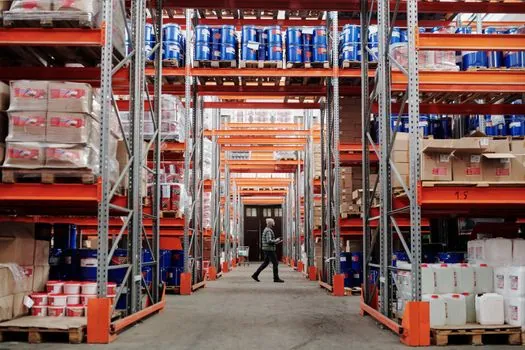
Most reach-truck applications are built around the Euro 800x1200 mm pallet loaded from the short side (1,200 mm dimension parallel to the forks when stored lengthways) or the GMA 48x40 inch (1,219x1,016 mm) pallet common in US operations, which has a 1,219 mm load depth and therefore drives Ast roughly 219 mm wider than the Euro case at the same clearance [S2][S1].
A useful rule of thumb taken from forklift aisle planning: the minimum aisle width starts from the standard pallet length (48 in / 1,219 mm for GMA, 1,200 mm for Euro) plus the truck's turning radius and a 12 in / 305 mm safety buffer, and that figure should be treated as a floor, not a final design value [S4]. Overhang is the silent killer: a 1,200 mm pallet with a 50 mm product overhang on each end requires L = 1,300 mm in the formula, adding 100 mm of aisle to the Ast result that the datasheet will not show [S1].
When the Reach Truck is the Wrong Choice
Reach trucks fail on three predictable patterns. First, outdoor work: the drive-unit geometry and mast reach assume smooth, level indoor floors, so cross-dock, yard loading, and trailer unload work belongs to a counterbalance or rough-terrain machine [S3]. Second, mixed load sizes: when pallet depths vary by more than 200 mm across SKUs, the Ast you sized for the largest load forces every smaller pallet to traverse an over-wide aisle and lose cycle time. Third, very narrow aisles: articulated (Bendi-style) or swing-mast VNA trucks can drop Ast to 2,000 to 2,400 mm in double-deep configurations, beating a conventional reach truck by 400 to 800 mm in dedicated VNA installations [S5].
Reach trucks also underperform when a substantial share of cycle time is spent loading and unloading trailers at ground level, since the reach mechanism that defines the machine adds nothing to ground-level productivity and the operator must still enter and exit the cab frequently [S5]. For a facility that is genuinely VNA-bound, the planning choice is between a conventional reach truck at roughly 2,800 mm and an articulated VNA truck at 2,000 to 2,400 mm; the latter costs more and demands disciplined operator training, but recovers 30 to 50 percent more pallet positions in the same building footprint [S5].
Standards, Clearances, and What Auditors Check
OSHA 1910.176(c) requires sufficient safe clearances for aisles, doorways, and turns wherever mechanical handling equipment operates, and that is the rule most often cited in North American warehouse audits; the European equivalent sits in EN ISO 3691-1, which governs industrial truck safety and prescribes minimum clearances for pedestrian-truck interactions in the same aisle [S1]. These standards do not fix a specific millimeter value for Ast; instead, they require a documented calculation and a verified safe clearance for the chosen truck-load combination, which is why the Ast formula above exists in the first place.
Specimen for a compliant layout: take the published Wa from the truck's CE/UL datasheet, add the published load distance x, add measured pallet depth including overhang, add the 200 mm clearance, then add any extra pedestrian or rack-deflection buffer. For a 1.6 t reach truck on Euro pallets, that calculation typically yields 2,650 to 2,800 mm of Ast, and that is the figure to mark on the layout drawing, not the marketing "minimum aisle" number on the truck brochure. Operators in a UK facility should also account for BITA and CE guidance that discourages intrusive stacking practices, which effectively rules out some of the tighter US-style reach-truck operating modes that you sometimes see in North American data [S5].
Lithium-Ion and Total Cost of Operation
Lithium-ion battery packs are now standard on most reach-truck OEM catalogues, including the Toyota BT Reflex R/E/N/O series, where they deliver up to 5,000 charge cycles versus roughly 1,500 for lead-acid and support opportunity charging for multi-shift work [S2]. For two- and three-shift warehouse operations, the energy side of the equation is now largely settled: lithium-ion is the default, and the procurement conversation has moved to charger placement, battery management, and fire-suppression interfaces rather than to chemistry selection.
For a deeper look at how pallet-stacking equipment compares to other narrow-aisle solutions, see our stacker vs reach truck layout decision guide; for the receiving-end mechanics behind pallet handling, the pallet rack system specification reference covers upright and beam sizing that determines the actual rack-to-rack clear dimension you feed into the Ast formula. Operators who want to spec the supporting hardware should also review pallet jack ground-clearance limits and plastic pallet dimensional tolerances before locking the Ast number, because a 5 mm tolerance drift on the pallet can move Ast by 5 mm and force a layout redraw.
Next step for spec teams: pull Wa and x from the shortlisted truck's CE-marked datasheet, lock the pallet footprint (including overhang) from the actual receiving samples, run Ast = Wa + x + L + C with C = 200 mm, then add 100 to 150 mm of pedestrian buffer for any aisle a person will walk through; the figure that survives that sequence is the Ast to design the rack layout around, and the rest of the warehouse (dock doors, column spacing, fire-aisle widths) must be measured against it. Trackable signal: a clean Ast below 2,600 mm for a 1.6 t class reach truck usually indicates a manufacturer's spec sheet was lifted from a different chassis variant, so re-check Wa and x against the actual serial-number datasheet before sign-off.