
Reach trucks specified for chemical processing must be engineered for Zone 1/Zone 2 hazardous atmospheres, corrosive vapour exposure, and 1,400–2,500 kg pallet handling in racked bulk-storage aisles [S1].
Unlike a standard warehouse reach truck, units deployed in a chemical plant are subject to ATEX 2014/34/EU and IECEx certification, plus corrosion-resistant surface treatment, and operator-cab air-filtration retrofits to dilute solvent vapour exposure. Generic warehouse units that work in a dry-goods DC will be flagged as non-conforming the first time the plant safety officer walks the floor.
Hazardous-Area Classification Drives the Reach Truck Build
ATEX 2014/34/EU Category 2 (Zone 1) and Category 3 (Zone 2) reach trucks use brushless AC drive motors, encapsulated control electronics, and surface-temperature limits below the auto-ignition temperature of the surrounding gas group — typically T4 (135 °C) for solvents and ammonia, or T3 (200 °C) where heavier hydrocarbons dominate the area classification [S4].
Cold-rolled steel frames are not acceptable in corrosive-ambient chemical aisles; stainless-steel chassis (AISI 304L for milder atmospheres, 316L for chloride-bearing or acid wash-down zones) and zinc-nickel or epoxy-powder coated mast assemblies extend service life. Hot-dip galvanised mast channels remain a cost-effective compromise for dry chemical storage where chloride exposure is intermittent.
Load, Lift and Chassis Spec Bands for Chemical-Plant Duty
Three load bands dominate the chemical-plant reach-truck spec sheet: 1,400–1,600 kg for 7–9 m racking, 1,800–2,000 kg for 9–11 m high-bay chemical warehousing, and 2,200–2,500 kg for IBC and drum-rack applications [S1].
Mast lift heights run 4,800–11,750 mm depending on racking, with a 600–800 mm load-wheelbase baseline that determines the minimum right-angle stacking aisle width. Battery voltage scales with truck class: 48 V systems on 1,400–1,800 kg units, 80 V on 2,000–2,500 kg units — both using sealed lead-acid or lithium-ion packs that meet the same hazardous-area enclosure rules. A 1,800 kg 80 V truck with a 1,200 mm deep pantograph mast typically runs a 2,750–2,950 mm right-angle stacking aisle at 0 load.
Travelling speed with load on flat concrete is generally 10–14 km/h; lift speed with full load is 0.30–0.45 m/s; lower-speed on-ramp profiles (1.5 m/s² max accel) are common in chemical plants to prevent drum-stack toppling in the mast envelope.
Materials, Seals and Surface Protection Comparison
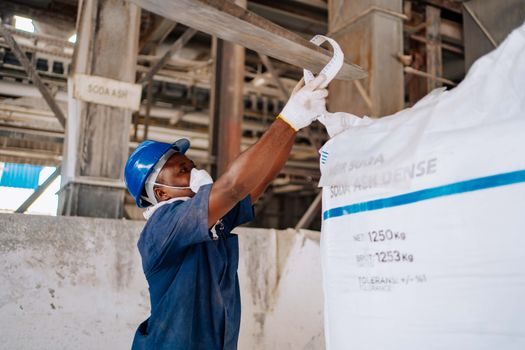
Material selection governs service interval in a chemical plant, and the gap between options is wide: [S1]
1. Standard warehouse reach truck (painted carbon steel, open battery tray): unsuitable — fails on vapour-tight electronics and corrosion in a single quarter of duty.
2. Hot-dip galvanised mast + zinc-nickel plated chassis (304 stainless fasteners): suitable for Zone 2, dry-chemical, non-chloride atmospheres; lowest incremental cost over a base warehouse truck.
3. 304L stainless chassis with epoxy-coated mast (common Zone 1 build): suitable for general solvent and acid vapour; mid cost band.
4. 316L stainless chassis, mast and forks with PTFE-sealed bearings and Viton hose jackets: the spec for chloride-bearing or bleach-line aisles; premium cost, longest service interval, and the only credible option for direct chemical wash-down.
Sealed operator cabs with over-pressure ventilation (≥30 Pa positive pressure relative to ambient) and a 100–150 m³/h filtered airflow are the standard operator-protection package in Zone 1 areas; the cab over-pressure must be interlocked with truck motion to prevent drive-away in a depressurised state.
Power, Battery and Charging Layout in Chemical Plants
Lithium iron phosphate (LiFePO₄) battery packs are increasingly specified in chemical-plant reach trucks over flooded lead-acid because they eliminate the open-cell watering point, hydrogen off-gassing risk during equalise charge, and the acid-spill containment trench required beneath lead-acid charging racks [S1].
A 48 V / 600 Ah LiFePO₄ pack delivers roughly 28.8 kWh of usable energy — sufficient for a two-shift chemical-warehouse duty cycle on a single opportunity charge. Opportunity charging requires a charger located in a non-classified charging bay or a charger rated to the same Zone classification as the truck, with a 30–60 A continuous output for 30–45 min top-ups between shifts. Lead-acid remains in the fleet where battery capital cost dominates the spec; the trade-off is a dedicated ventilated charging room with eyewash, neutralising spill kit, and a 1 m exclusion zone around the cell vent stack.
Tire, Floor Interface and Drum/IBC Handling
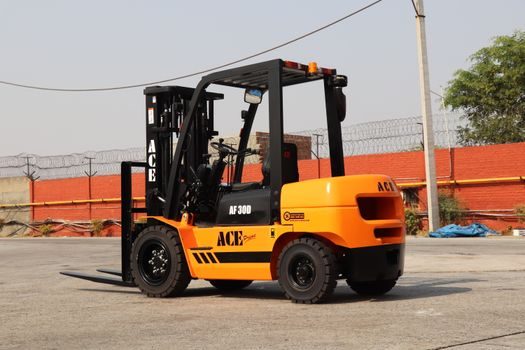
Polyurethane tires (load-bearing) and Vulkollan drive tires are the chemical-plant default over rubber because they resist solvent absorption and have a Shore A 92–95 hardness profile that protects resin-coated concrete floors from scuffing [S4].
Anti-static conductive polyurethane compounds (≤10⁶ Ω resistance) are mandatory in Zone 1 to dissipate static charge away from the truck chassis; standard non-conductive PU wheels can build up 5–15 kV under heavy drive cycles and will spark at the wheel/floor interface. Floor surface resistivity must be ≤10⁸ Ω to close the static-dissipation path — a property that requires the floor to be tested annually per IEC 60079-32-1 guidance.
Reach-truck attachments for chemical-plant use include drum-handling carriages (single or double drum, 200–400 L), IBC tilter/spreader frames for 1,000 L composite IBCs, and load-stabiliser sideshifters rated to 1,800 kg at 600 mm load centre. The IBC attachment typically uses a captive-saddle design that wraps the composite cage to prevent flex when forks are retracted.
Sourcing, Standards Map and What to Verify on the Datasheet
Every chemical-plant reach truck on the spec sheet must be traceable to ATEX 2014/34/EU or IECEx certification, with the certificate number, gas group (IIA/IIB/IIC), and temperature class (T1–T6) printed on the truck nameplate and matching the data sheet [S1].
The spec checklist operators should run before signing the PO: ATEX/IECEx certificate number, gas group and temperature class; chassis material grade (304L vs 316L confirmed on the mill cert); battery type, voltage and Ah; mast lift height, free lift and lowered height; load capacity at 600 mm load centre; right-angle stacking aisle width; tire compound and conductivity rating; cab over-pressure interlock test result; and a 12-month or 2,000-hour warranty. A 316L stainless truck specified for bleach-line duty that ships with a standard 304 chassis (a common OEM substitution) is a documented failure mode — verify the chassis on the mill cert, not the brochure.
For chassis selection, fleet managers often cross-reference the reach truck spec bands against their aisle width, racking height and Zone map to lock the build before tendering. Where the chemical plant shares a dock with a road tanker area, the same chemical anchor layout that secures the truck bay drives the truck wheel-chock and parking-brake interlock spec. Cold-storage or outdoor winter operation shifts the spec toward chemical reagent handling cabinets on the cab and heated battery boxes rated to the same Zone.
For a fleet that handles both palletised raw material and finished drum goods, a 2,000 kg ATEX reach truck with a 316L chassis, 80 V LiFePO₄ pack and Vulkollan conductive tires typically lands in the mid-upper cost band — and will outlast a generic 304L warehouse truck by 3–5 years in continuous chemical-plant service. To extend the spec to a material-handling fleet that includes dump truck bay feeders and a truck scale interface, coordinate the reach-truck payload with the bay-door pallet staging and the weighbridge axle limits. Reach trucks assigned to outdoor drum-fill platforms often need an aerial work truck partner for tank-top access — the two fleets share a common operator-certification and Zone map.
For related coverage, see Automatic Molding Line Spec Bands for Power Generation Castings.