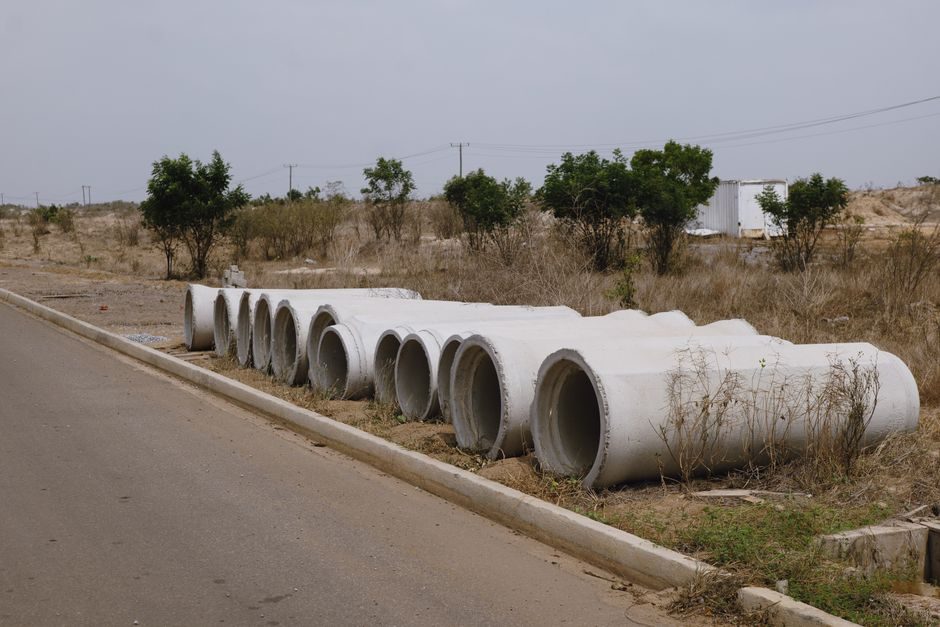
Ready-mix concrete is a factory-batched blend of cement, water, sand and coarse aggregate mixed to a specified design and delivered to site in agitating trucks, with order volume calculated as (length × width × depth in feet) divided by 27 cubic feet to convert to cubic yards [S2].
For Central Oregon and similar U.S. markets, plants such as Sunwest Redi-Mix (La Pine, OR) and Kansas Sand & Concrete (Topeka, KS) hold NRMCA-compliant operations and supply both commercial and residential pours [S2][S4]; installation work proceeds as ordering, subgrade prep, placement, consolidation, finishing and curing.
Defining Ready-Mix and the Standard Mix Envelope
Ready-mix is defined in general English usage as a commercial preparation containing most of the ingredients pre-combined so the end user only adds water or pours directly [S1][S3]. For concrete, that means a factory-batched cementitious-aggregate-water blend (plus chemical concrete admixtures for slump, set time and air content) that arrives on site within a 90-minute discharge window under ASTM C94 transport rules.
Standard residential mixes in U.S. practice sit at 2500–3000 psi 28-day compressive strength, 4–6 in. slump for slabs and 3–4 in. for walls; freeze-thaw climates call for 4–6% air entrainment on exterior flatwork [S2]. A typical 1-cubic-yard pour covers 81 sq ft at 4 in. thickness, and trucks commonly carry 9–11 cu yd per load.
Ordering Logic: Cubic Yards, Slump, Strength, Aggregates
Calculate yardage by multiplying length × width (feet) × depth (feet), dividing by 27, then adding 10% for waste and over-excavation [S2]. A 24 × 30 ft driveway at 5 in. depth = (24 × 30 × 0.4167) / 27 ≈ 11.1 cu yd, so spec 12 cu yd on the order.
Match the mix design to the element: 3000–3500 psi with 5–6 in. slump for driveways and slabs, 4000 psi with 3–5 in. slump and water-reducing admixtures for foundations, and 5000 psi for structural beams. For slab reinforcement, contractors pair rebar with concrete fiber blends where shrinkage control is critical.
Site Prep, Formwork and Delivery Coordination

Subgrade must be compacted to 95% Standard Proctor, moistened to prevent rapid water loss from the mix, and formed with oiled lumber or modular panels braced against hydrostatic pressure (≈150 lb/ft³ liquid head). Formwork release agent, plastic vapour barrier (10 mil) and #4 rebar on 18 in. centers are typical driveway specs. [S1]
Schedule delivery for continuous placement — a 10 cu yd load discharges in 30–45 minutes, and ASTM C94 limits on-site time to 90 minutes from batching in normal weather (30 minutes in >85 °F heat) [S2]. Pours below 40 °F require cold-weather admixtures and insulated blankets; pours above 90 °F demand ice-water batching, retarders and concrete vibrator use within 15 minutes of discharge.
Placement, Consolidation and Finishing Sequence
Place concrete directly from chute or via pump boom within the discharge window, then consolidate with an immersion vibrator at 6–8 in. insertions to remove entrapped air; over-vibration segregates aggregate and is the most common field failure mode. Strike off with a screed, bull-float to close the surface, then wait for bleed water to evaporate before trowelling. [S2]
For a broom finish on exterior slabs, drag a stiff-bristle broom across the surface once it firms but still permits a thumbprint. Control joints must be cut at 24–30× slab-thickness spacing (e.g. 10–12.5 ft for a 5 in. slab) and at 1/4 slab depth, typically within 6–18 hours of pour using a soft-cut saw.
Mix-Selection Comparison: When to Use What

Decide on the mix by four criteria — strength, slump, exposure and finish method — using this comparison: [S3]
Standard 2500–3000 psi 4–6 in. slump 4–6% air-entrainment: residential slabs and patios, broom finish; cost $130–$160/cu yd delivered in many U.S. regions [S2]. 3500–4000 psi 3–5 in. slump with water-reducer: foundations, garage floors, exposed driveways; cost $150–$180/cu yd. 5000+ psi 2–3 in. slump with superplasticiser: structural beams, columns, post-tension slabs; cost $180–$220/cu yd.
For most mid-size commercial pours, a ready-mix concrete order of 12–30 cu yd with 3000–4000 psi, 4 in. slump, 5% air and 1–2 in. aggregate is the practical default, sized to one full truck load to avoid short-load fees and partial-batch water-addition errors.
Curing, Common Failure Modes and Inspection Criteria
Begin curing as soon as the surface resists marring — typically 2–4 hours after final trowel for warm weather, longer in cool conditions — using wet burlap, curing compound (acrylic or wax at 200 sq ft/gal) or 7-day water ponding; moisture retention drives the 28-day strength gain, and premature drying halves surface abrasion resistance. [S4]
Watch for the four standard field defects: plastic shrinkage cracking (curing delay), scaling from freeze-thaw on under-air-entrained mixes, dusting from over-finning bleed water, and honeycombing from inadequate vibration. Slump tests must be run on the first truck and on every 10th truck thereafter; air content is verified with a pressure meter on the same schedule, and cylinders are cast for 7- and 28-day break tests per ASTM C39.
Sourcing Map: Regional Plants, Lead Time and Logistics
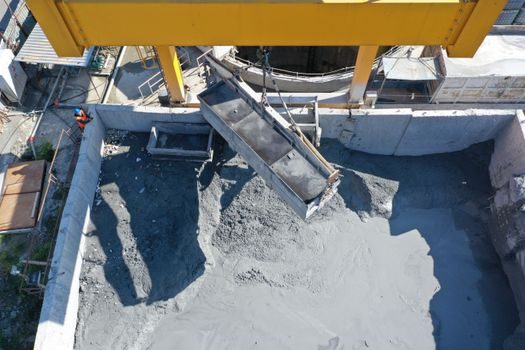
Regional ready-mix plants typically serve a 30-mile delivery radius, with surcharge zones of $5–$15 per loaded mile beyond that; lead time in non-peak seasons runs 2–3 business days, while spring/summer pours often book out 1–2 weeks. Plants such as Sunwest Redi-Mix (La Pine, OR, est. 1996, now under the DreamCon family since 2022) and Mar-con Products (founded 1975) supply both commercial projects and residential driveways, with auxiliary materials — rebar, forms, sand and gravel — bundled onto the delivery ticket [S2][S4][S5].
Verifiable next nodes for spec development: confirm local NRMCA Plant Certification status before order, request the mix-design sheet showing cement content, w/c ratio and admixture dosage, and require batch tickets with load time, water-additions and arrival slump on delivery. Trackable signals include cylinder break results at 7 and 28 days, ambient temperature log for the first 24 hours after pour, and the curing method applied — these three records resolve roughly 90% of post-pour disputes on commercial jobs.
For related coverage, see Spiral Duct Price & Cost Guide 2026: Diameter, Gauge and Sourcing Map.