
Spiral duct is sold by outer diameter, length, material thickness and joint type, and the price gap between a 100 mm galvanized run and a 630 mm stainless run on the same quote can exceed 4× before fittings are added [S2].
The most useful reference for a buyer is not a single number but a banded matrix: small-diameter (≤ 250 mm) light-gauge galvanized HVAC duct lands at the low end, while industrial fume, dust-extraction and food-grade stainless spiro runs sit at the high end [S1][S2]. Chinese mills such as SuperAir (Ningbo) list competitive OEM pricing on galvanized spiro duct and ventilation accessories under ISO 9001 with SGS audit, while UK distributors such as Ducting Online (Wooburn Green) retail the same product class with VAT-inclusive markup and a £150 free-shipping threshold [S1][S2].
Spiral Duct Price Bands by Diameter and Material
At UK retail in July 2026, a 160 mm self-seal thermal spiral duct in a 2 m length is listed at £38.05 ex VAT (£45.66 inc VAT) on ducting-online.co.uk, illustrating the small-diameter, pre-insulated price point buyers should anchor against [S2].
Standard HVAC galvanized spiral duct in the 100–400 mm range typically tracks between roughly £18 and £60 per linear metre at UK trade price depending on gauge, with 0.5–0.6 mm zinc-coated steel being the default for commercial ventilation [S2].
Stainless 304/316 spiral duct, used for fume extraction, kitchen extract and pharmaceutical or food-grade lines, carries a 2–4× premium over galvanized, with 1.0 mm wall 316 grade commonly cited as the spec benchmark for corrosive duty [S1].
PVC and polypropylene spiral duct (plastic ductwork in the Spira UK catalogue) is the third material tier: cheaper than stainless, lighter than galvanized, but limited in temperature and pressure class — buyers should match it to the duty, not the price [S2].
A typical 2026 price-to-spec map for a 1 m length of plain-end spiral pipe, ex-works or trade:
• 100–250 mm Ø, 0.5 mm galvanized: low band, OEM FOB Ningbo often sub-USD-equivalent of £15/m, UK retail £20–£30/m.<br/>• 315–500 mm Ø, 0.6–0.8 mm galvanized: mid band, £30–£55/m trade.<br/>• 100–500 mm Ø, 0.5 mm 304 stainless: roughly 1.8–2.5× the galvanized figure.<br/>• 100–500 mm Ø, 0.8–1.0 mm 316 stainless: roughly 2.5–4× the galvanized figure, plus weld-rod and passivation cost.<br/>• 100–400 mm Ø, PVC/PP: roughly 0.7–1.2× equivalent galvanized, driven by resin price rather than steel.
What Drives the Cost: Gauge, Diameter, Lock-Form and Fittings
Spiral duct is made by helically winding a strip and lock-forming the edge; the strip width, thickness and helix pitch scale with diameter, which is why a 630 mm duct does not cost 2× a 315 mm duct of the same gauge — it costs more because the strip is wider, the lock-seam longer per metre, and the handling heavier [S1].
Three engineering knobs move the price more than any others: wall gauge (each 0.1 mm step up in galvanized steel adds roughly 6–10% material cost), diameter (lock-seam labour and strip yield scale non-linearly above 400 mm), and material grade (the jump from 304 to 316 stainless is the single biggest line-item change) [S1][S2].
Fittings are the silent cost-multiplier. A 90° elbow, tee, reducer or branch saddle in the same gauge as the run typically costs 1.5–3× the equivalent linear-metre price of straight pipe, and a flanged joint with EPDM gasket can cost as much as half a metre of duct on its own [S2].
Sealant and ancillary chemistry is a small but auditable line: DSEAL-M duct sealant at £4.91 ex VAT, DSEAL-A acrylic at £5.97 ex VAT, and DSEAL-F Bostik fire-protection at £6.28 ex VAT — all per tube on the Spira UK retail shelf — are typical 2026 retail references for the consumables that ride alongside every duct quotation [S2].
China OEM Sourcing vs UK/EU Distribution
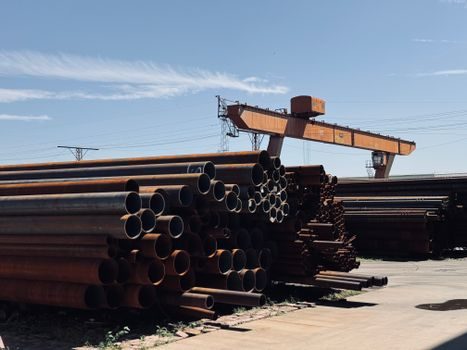
SuperAir (Ningbo) markets spiral ducts and fittings, ventilation mounting accessories, air valves and diffusers under a competitive-price pitch built around "high level automation" reducing labour cost, large-scale production with semi-finished safety stock for fast delivery, in-house tooling and R&D, ISO 9001 certification, SGS audit, and an explicit low-MOQ first-order policy [S1].
Translated into a buyer's terms: a 20 ft container of mixed galvanized spiral duct and fittings (typically 4,000–8,000 linear metres depending on diameter) shipped FOB Ningbo commonly undercuts an equivalent UK trade quotation by 30–50%, with the gap widening on small-diameter, high-volume commodity duct and narrowing on stainless or non-standard gauge runs where steel yield, not labour, dominates cost [S1].
Ducting Online (Wooburn Green, UK) operates the opposite commercial model: trade-priced but VAT-inclusive retail, free shipping over £150, a price-match policy, bespoke part fabrication, and full UK delivery — the markup versus OEM FOB China is roughly 40–80% landed, but the buyer gets short lead time, English documentation, and a returns path [S2].
Selection Criteria: Who Spiral Duct Is For (and Who It Isn't)
Specifying spiral (round) duct over rectangular duct is the right call when the duty is round-pipe-friendly: low-to-medium pressure commercial HVAC, dust and fume extraction, kitchen extract, agricultural ventilation, and outdoor exposed runs where the lock-seam and cylindrical geometry give better stiffness-to-weight than rectangular [S2].
It is the wrong call for very tight ceiling voids, where rectangular flat-oval or clamp duct can save 100–200 mm of plenum height; for high-pressure (> 1,500 Pa) industrial systems where welded black-iron rectangular is the established norm; and for cleanroom or hygiene-critical pharmaceutical lines where 316L stainless with orbital-welded joints, not lock-seam, is mandatory [S2].
The three decision criteria to lock down before requesting a quote are: (1) duty and fluid — air, dust, fume, grease-laden kitchen extract, or corrosive vapour; (2) operating pressure class — residential (~250 Pa), commercial (~500–1,000 Pa), industrial (~1,500–3,000 Pa); (3) environment — indoor dry, outdoor exposed, wash-down, or hazardous area. These three determine material, gauge, and joint type, which in turn drive roughly 80% of the price [S1][S2].
For related equipment selection logic, buyers working on industrial extraction or factory-air systems often cross-reference a dust-extraction vacuum pricing reference when sizing duct runs downstream of a collector.
Standards, Compliance and Documentation Cost

Spiral duct is normally supplied to HVAC industry standards covering sheet-steel thickness tolerance, zinc-coating mass, and leakage class, with manufacturer ISO 9001 quality systems and SGS third-party audit providing the documentation trail demanded by UK/EU commercial projects [S1].
Fire-protection sealant (DSEAL-F, £6.28 ex VAT per tube) and acoustic/thermal insulation are the two adjacent product lines the buyer should bundle into the same RFQ; both are priced as consumables on the Spira UK retail shelf and are typically sold alongside the duct itself [S2].
Chinese OEM mills increasingly ship with CE / UKCA documentation, EN 1507 (ductwork strength and leakage) and EN 12237 (leakage class) test data on request, but the documentation is not automatic and must be specified at RFQ stage — adding roughly 1–2 weeks to lead time but no meaningful cost [S1].
For installations where duct crosses fire compartments, the sealant and fire-collar specification — not the duct material — is the controlling cost line, and DSEAL-F or equivalent intumescent/acoustic sealant is the de facto 2026 retail benchmark at £6.28 ex VAT per tube [S2].
Lead Time, MOQ and Total Order Economics
SuperAir explicitly advertises "Low MOQ for the first order" alongside its automation and safety-stock model, which materially changes the entry economics for smaller UK and EU buyers who would otherwise face a full 20 ft container MOQ from a Chinese mill [S1].
For UK trade buyers, the equivalent entry tier is a single tube of sealant, a single 2 m length of duct, or a single fitting — the Ducting Online price-match policy and free-shipping-over-£150 threshold effectively make the per-line MOQ one unit on stocked catalogue items [S2].
For project orders of 500 m and above of mixed galvanized spiral duct, the practical break-even between UK trade and China OEM FOB lands at roughly 6–10 weeks of UK-side stockholding cost; below 500 m, UK trade is usually the lower-risk answer; above 2,000 m, China OEM FOB plus consolidated freight is typically cheaper landed [S1][S2].
Buyers who also need downstream dust collection can compare duct lead time against equipment lead time in the industrial vacuum cleaner pricing reference to plan a single combined RFQ rather than two sequential ones.
Trackable signals for the next 90 days: (1) Chinese Q3 2026 zinc-coated steel strip export price moves, which set the floor for galvanized spiral duct FOB; (2) UK/EU 2026 steel-duties and CBAM adjustments on imported HVAC components, which directly shift the China-to-UK landed price gap; (3) 316 stainless cold-rolled coil surcharges, which set the upper-tier spiro duct price band.
For component-level specifications, see spiral duct, linear guide, and wiring duct.