
Across the Sigma-Aldrich Redi-Dri product line, free-flowing hygroscopic reagents ship in standardised unit sizes of 100 g, 500 g, 1 kg, 2.5 kg, 12 kg, and 25 kg, so a 25 g pack and a 2.5 kg drum are both standard catalog options [S2].
Stating the math directly: per-gram price = total price divided by pack mass in grams, and per-kilogram price = total price divided by (mass in grams divided by 1000) [S1]. A 1 USD/g figure equals 1000 USD/kg on a strict unit conversion, so any 2.5 kg purchase that beats the 25 g price by 30 percent or more represents a real saving once hazard shipping and shelf-life are factored in [S4].
Why 25 g Bottles Cost More Per Gram Than 2.5 kg Drums
Per-gram price for laboratory reagents scales inversely with pack mass because fixed costs (bottle, cap, label, QC certificate, hazard documentation, and air-freight surcharge for small parcels) are amortised over a much smaller mass at the 25 g tier [S1]. A Redi-Dri 25 g bottle and a 2.5 kg pail share the same analytical-grade chemistry, but the 25 g pack carries roughly 10x more packaging overhead per gram, since 2500 g of the same product spreads that overhead across 100x more reagent [S2].
The 2.5 kg pack is also the standard take-off size for pilot-plant and bench-scale process chemists, so distributors stock it deeper and rotate it faster, which trims the warehouse and capital-carrying component of the price. The 25 g bottle, by contrast, is a safety-size and R&D convenience SKU: it limits single-user exposure to hygroscopic or toxic solids and keeps the opened shelf-life under control, which is why the format is not designed as the lowest unit-cost option [S2].
Per-Grame Calculation Worked Example Across Pack Tiers
Worked example: a 25 g bottle at 42 USD, a 500 g bottle at 360 USD, a 2.5 kg drum at 1500 USD, and a 25 kg drum at 12 000 USD give per-gram prices of 1.68, 0.72, 0.60, and 0.48 USD/g respectively, a 3.5x gap between the smallest and largest pack [S1][S4]. The same conversion expressed per kilogram shows 1680, 720, 600, and 480 USD/kg, so each tenfold jump in pack mass delivers a 20 to 57 percent per-gram saving in this curve, with diminishing returns past 2.5 kg [S4].
For consistency, the unit-price method used here is the same as in the retail and procurement literature: divide the listed price by the pack mass, then convert across mass units using 1 USD/g = 1000 USD/kg [S4]. Procurement teams comparing 25 g vs 2.5 kg offers should always recompute on a USD/kg basis, because vendors often list small packs in USD/each and bulk drums in USD/kg, which hides the actual gap until normalised [S5].
Pack-Size Decision Matrix for Reagent Procurement

Four decision criteria line the main options up cleanly: per-gram cost, single-user exposure risk, opened-bottle shelf-life, and dead-stock risk. A 25 g pack scores worst on cost, best on exposure and shelf-life, and best on dead-stock risk for low-throughput users; a 2.5 kg drum flips all three: best on cost, worst on exposure per opened container, and worst on dead-stock risk for occasional users [S2].
Per-gram cost aside, a 2.5 kg drum only makes sense when annual consumption crosses roughly 1 to 2 kg per user, otherwise the opened-container shelf-life of a hygroscopic reagent expires before the drum empties, and the saving is wiped out by disposal. A 25 g bottle fits users consuming under 100 g per year, bench-scale method development, and any application where the opened bottle would face repeated humid-air transfers [S2].
Industrial Leaching Math: Why Bulk Pricing Wins at Process Scale
In gold-ore leaching, bulk reagent pricing is non-negotiable because consumption scales with ore tonnage: a 500 t/day plant running at 200 g reagent per ton uses 100 kg/day, and at 3 USD/kg the daily bill is 300 USD before any ore-mineralogy penalty is applied [S3]. On pyrite, arsenopyrite, or carbonaceous ore, consumption rises past 500 g/t and 3x to 4x respectively, so a 25 g catalog price becomes irrelevant; the real procurement question is the full-pallet or full-drum contract on the 25 kg tier [S3][S2].
High-copper and carbonaceous ores are the worst case for reagent economy because dissolved copper and preg-robbing carbon consume the leach chemical before it contacts gold, which is why bulk contracts typically include bottle-roll test data to set the dosage before locking in 25 kg or 12 kg drum pricing [S3]. For more on instrumenting the lab-to-plant handoff, see the selection spec guide on documenting vs non-documenting multifunction calibrators, which applies the same per-unit cost logic to calibration hardware.
When the 25 g Pack Is the Right Spec
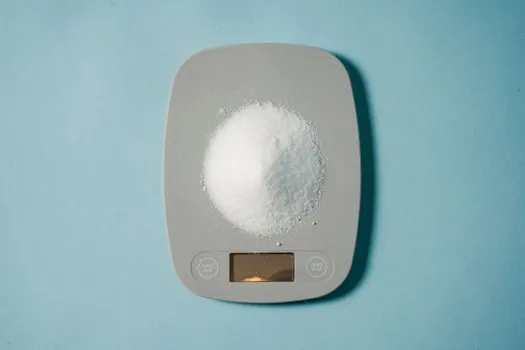
Specify the 25 g pack when the reagent is acutely hygroscopic, light- or air-sensitive, or carries a GHS category 1 to 2 hazard pictogram, because the 2.5 kg drum forces the user to break the seal many times and accelerates both degradation and operator exposure [S2]. Standard Redi-Dri SKUs already solve the hygroscopic problem at 500 g to 25 kg by using a free-flowing format, so for non-hazardous, non-hygroscopic salts the 2.5 kg tier is almost always the lower-cost-per-gram choice [S2].
For a broader cross-reference on small-pack cost premiums in industrial consumables, the PCE vs naphthalene superplasticizer selection specs and the plasticizer vs superplasticizer dosage rates articles apply the same per-kilogram normalisation to admixture SKUs, where 25 kg vs 250 kg packs show a similar 30 to 60 percent per-kg gap. The general background on chemical-reagent pack formats and hazard classification is covered in the chemical reagent reference page.
Procurement Checklist and Trackable Signals
Three trackable signals confirm whether the bulk-tier saving is real on the next reorder: (1) record opened-bottle shelf-life vs actual drawdown rate, (2) compute per-gram price on every quote using the 1 USD/g = 1000 USD/kg rule, and (3) request a 2.5 kg drum quote alongside the 25 g bottle quote to expose the per-gram delta directly [S1][S4]. Watch for vendors moving the 2.5 kg tier to a different hazard-shipping class (UN-coded freight surcharge) because that surcharge can erase 5 to 15 percent of the per-gram saving in transcontinental air freight. Next node: any Q4 2026 catalog refresh that re-prices the 12 kg and 25 kg Redi-Dri SKUs will shift the per-gram optimum upward and should trigger a re-run of the 25 g vs 2.5 kg comparison [S2].
For component-level specifications, see measurement test 2, and electronic test measurement 2.