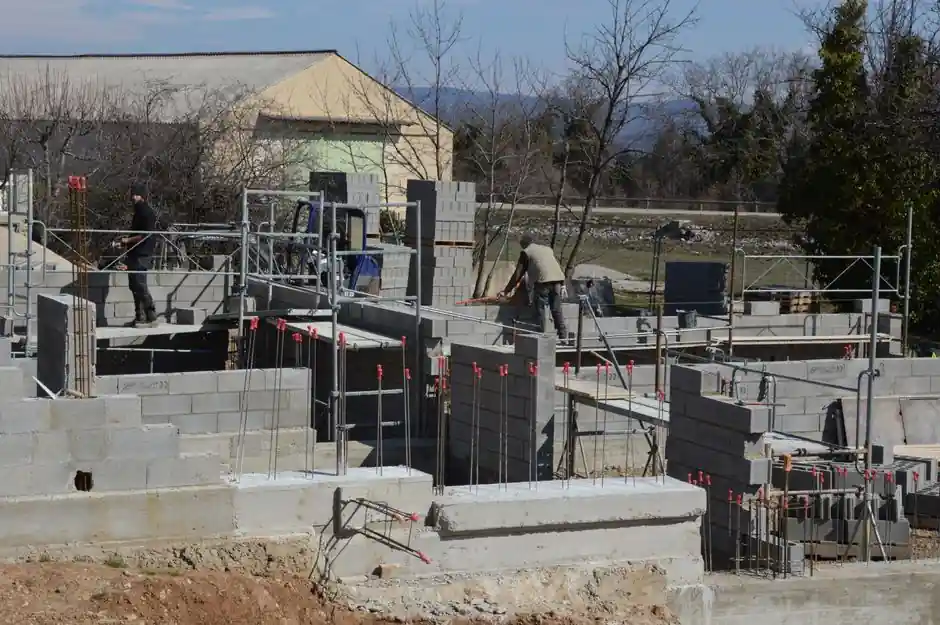
A portable electric rebar bender that handles 1" (#8) grade 60 stock and runs on standard 110 V supply covers the bulk of masonry reinforcement work, with 180 lb carry weight and a single-knob bend-angle setting as the dominant 2026 shop-and-jobsite pattern [S1].
Masonry projects draw on a narrower rebar diameter range than heavy civil work, but the bend-angle, capacity, and power-class gates still control which machine belongs on the wall, and which is overspec or underspec [S1][S3].
Capacity envelope: which bar size the bender must cover
The FR-800 Rotary Rebar Bender will bend up to 1" (#8) grade 60 rebar, and that same 1" (#8) grade 60 ceiling is met by the FC-800 cutter and the FR-800-C combo machine [S1]. Below that envelope, the FS-600 Rebar Cutter Bender combo caps out at 3/4" (#6) grade 60, while the FRH-850 Solid Bar Bender is positioned for solid stock rather than standard deformed rebar [S1]. For masonry cells, vertical cells, and bond beams, #4 (1/2") through #5 (5/8") rebar dominates; stirrups and tie bars are typically #3 (3/8") to #4 (1/2"), which is well inside any 1" (#8) machine's working envelope [S1]. Masonry that uses #6 (3/4") bar for horizontal joint reinforcement on tall walls or seismic retrofits needs at least a 3/4" rated machine, and a 1" rated machine gives headroom for the occasional off-spec bar [S1].
Power class, voltage, and portability gates
The 110 V standard outlet is the dominant 2026 jobsite gateway, with generator compatibility explicitly listed for the FS-600 combo at 180 lb carry weight designed for two-person lift [S1]. Optional 220 Volt configurations exist on the 800 series for shop use where single-phase 220 V is wired, and a foot pedal control is sold as an accessory across the line [S1]. For masonry work on staging or scaffold, the 180 lb weight bracket and 110 V plug-and-play operation matches the work envelope better than heavier three-phase industrial benders, which would require a dedicated feeder and a hoisting plan on upper floors [S1].
Combo cutter-bender vs dedicated bender
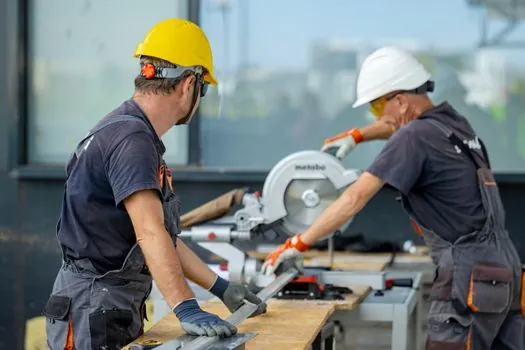
The trade space resolves cleanly: combo machines sacrifice 1 bar size of bending capacity to gain a 2" high cutting blade that can shear three 1/2" (#4) bars in one stroke, while dedicated benders keep the full 1" (#8) ceiling and pair with a separate shear [S1]. For masonry crews doing high-volume #4 and #5 work, the combo's multi-bar shear and one-knob bend-angle repeatability pays back fast; for crews routinely bending #6 through #8 for foundations or grade beams, the dedicated bender plus a separate cutter is the working combination [S1]. Maintenance surface area tracks the design choice: the FS-600 has one main moving part with one grease fitting, which is a meaningful field-service advantage over multi-pump dedicated benders [S1].
Bend-angle repeatability and reference fixturing
A simple control knob sets the bending angle, and once set, all bends will be uniform and accurate, with an optional reference fence giving the operator a physical material stop so cutting or bending dimensions are accurately repeated [S1]. Reference fences are model-specific, with separate SKUs listed for the FS-600, FR-800-C, FC-800, and the FR-800/FRH-850 shared pattern, so substitution between series is not a field option [S1]. Programmable angle control is offered as a higher-end accessory on the same family, useful for production runs of identical stirrups and column ties [S1].
Sourcing and after-sales: stock, spares, and repair
Distributor stock depth is a 2026 buying gate equal in weight to spec: CNB Machinery and Steel Corporation operates as the exclusive distributor of TAEYEON B&C bar benders and bar cutters from South Korea in the Philippines, with electric rebar bender and cutter capacity from 10 mm up to 42 mm and full spare parts held in the local warehouse [S3]. The same distributor pattern is visible on the manufacturing side, with PROSPER (Hangzhou) Technology and Qixing Engineering Machinery in Zhejiang, China listing rebar benders, pipe benders, and rebar cutters among their main export lines to North and South America [S4][S5]. Field repair paths at the specialist-distributor level include online consultation, on-site service for minor faults, and warehouse pull-through for severe damage, which sets the service-tier expectation against general tool vendors who only resell [S3].
Who this fits, and who it does not
Portable 110 V electric rebar benders in the 180 lb class with 1" (#8) grade 60 capacity are built for masonry and light foundations, residential footings, and small commercial walls where rebar sizes stay at or below #6 on the bending side and cutting stays in the #4 multi-bar range [S1][S2]. They are not the right tool for bridge girders, mat foundations, or heavy civil piers where #9 through #11 bar appears routinely, where a three-phase industrial bender with a 36 mm or larger rated capacity and a higher-tonnage shear is the working baseline [S3]. Spec-driven choice on the smaller end comes down to four decision criteria: capacity ceiling, voltage and phase, weight and lift path, and bend-angle repeatability with reference fixturing, all of which can be lined up against any catalog entry before purchase [S1][S3].
Trackable signals to watch before purchase: whether the 220 V option is in stock for shop use, whether the model-specific reference fence is bundled or sold separately, and whether the distributor holds the model-specific cutting blade SKU on the shelf rather than shipping it from the factory [S1]. For related capacity-class work, see this rebar bender selection guide for interior finishing tasks and the rebar bender reference page for the full machine-class breakdown.
Spec-level background on the components involved: masonry insulation, and rebar.