Plumbing-installation crews running rebar for thrust blocks, manhole bases, wet-well walls, and pipe bedding reinforcement need a portable electric rebar bender that delivers repeatable 0-180 degree bends on #4 to #6 (13 mm to 19 mm) Grade 60 deformed bar without an on-site generator cart [S4].
For typical water and sewer plant scopes, 70+ year veteran contractors pair an electric rebar cutter and bender combo to keep the bend angle, leg length, and stirrup geometry consistent across long pipe runs and tank walls [S1][S2].
Bending Capacity and Bar Diameter Envelope
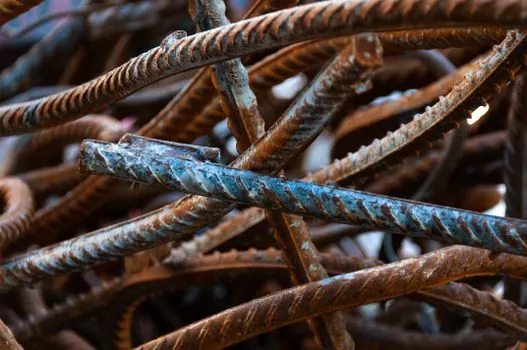
The bending envelope is the first gate: most plumbing-scope rebar is #3 (3/8 in / 10 mm) stirrups up to #6 (3/4 in / 19 mm) main bars in Grade 60 (60,000 psi / 414 MPa yield) per ASTM A615 [S4]. A bench-style electric bender rated for #10 (1.25 in) round bar (for example the California Concrete Tool RB-321A at 2,399 USD) can comfortably cover the upper end of this plumbing range while leaving headroom for occasional #7 or #8 work on pump-station mats [S4]. Smaller 1.5-1.8 kW portable benders typically cap at #5 (5/8 in / 16 mm) Grade 60, and that limit is enforced by the central-pin shear instead of motor wattage alone [S3]. Going below the rated diameter is harmless; going one bar size over the published maximum is the usual cause of central-pin shear failure and oil leaks from the gearbox seal [S3].
Power Supply, Footprint, and Site Logistics
Plumbing-installation sites (manholes, lift stations, treatment plant slabs) rarely have 480 V three-phase at the bending station, so single-phase 110 V / 220 V benders in the 1.5-2.5 kW range dominate the procurement lists seen on equipment-supplier storefronts [S4]. A 1.8-2.2 kW unit on 110 V at 50/60 Hz is the most flexible compromise: it can be fed from a small inverter generator or a 20 A site outlet and still bend #5 Grade 60 in roughly 4-5 seconds per 90-degree bend [S3][S4]. Weight sits between 38 kg (compact single-bench head) and 95 kg (cutter-bender combo) for the portable class; beyond 100 kg, a forklift becomes mandatory and the tool stops being "plumbing-crew portable" [S3].
Hydraulic vs Mechanical Gearbox Drive
For plumbing-scope rebar, the two realistic options are mechanical (gear-and-lever) and low-pressure hydraulic benders, with electric-hydraulic and electric-mechanical variants of each [S3]. Mechanical units are lighter, cheaper (1,800-2,400 USD bracket), and tolerate dirty site conditions because there is no hydraulic seal to leak; hydraulic units push higher bar sizes with less operator effort and add roughly 30-50% to the purchase price [S3][S4]. The right pick depends on bar size: for a water-treatment plant dominated by #4 and #5 stirrups and ties, a mechanical 1.8 kW bender is the cost-effective default. For a pump-station mat with #7 and #8 main bars at tight radii, a 2.5-3.0 kW hydraulic unit reduces operator fatigue and avoids the gearbox stalling that shows up as scorched motor windings on mechanically over-rated machines [S3].
Bend Angle Accuracy, Pin Sets, and Common Failure Modes
Plumbing-installation drawings typically call out 90-degree and 135-degree hook bends with +/-2 degree tolerance; achieving that requires a calibrated angle-stop pin and at least two interchangeable central-pin diameters matched to the bar being bent [S4]. The most common field failure on a portable bender is a worn or mismatched central pin, which shows up as flat spots on the inside radius, hairline cracks at the bend, and bar spring-back past the stop. The corrective action is to swap the central pin to the next size up (so the bend radius meets the ACI 318 minimum 4-bar-diameter inside bend) and re-torque the pin retainer; if cracks are visible on more than 1-2% of bends, replace the pin set rather than chase individual bars [S3]. The second failure mode is oil starvation in hydraulic units run on long extension cords: voltage drop below 200 V on a 220 V motor causes the pump to cavitate, the relief valve to chatter, and the gearbox to overheat within an hour of continuous duty. Move the generator closer, upsize the cord to 10 AWG for runs over 15 m, or step down to a mechanical unit on under-sized sites [S3][S4].
Sourcing Channels, Lead Time, and Standards Check
For plumbing-installation rebar contractors, three sourcing channels appear most often in 2026 procurement records: regional rebar-installation subcontractors (who may bundle bending labour with rebar coupler and placing services), equipment-supplier storefronts stocking portable electric units in the 2,000-3,500 USD range, and direct-from-factory orders from Chinese machinery manufacturers in the 1,500-2,500 USD range for 1.5-2.5 kW units [S3][S4]. Standard compliance to verify before purchase includes ASTM A615 / A706 for the bar stock itself, the local plumbing code for cover and splice length, and any agency listing (UL, CE, CSA) on the bender's electrical panel; some water-utility specs also require a 30 mA GFCI on the bender's supply circuit when used inside confined wet-well excavations [S1][S2][S3].
Trackable signals to watch over the next 90 days: any 2026 updates to the rebar tool accessory ecosystem (digital angle gauges, Bluetooth cycle counters) and any rebar-supplier post on standardising #4-#6 Grade 60 bend protocols across water and sewer plant scopes. For crews cross-staffed onto highway or road-maintenance work, the selection logic overlaps with road-maintenance rebar bender sizing on the same #3-#6 envelope.