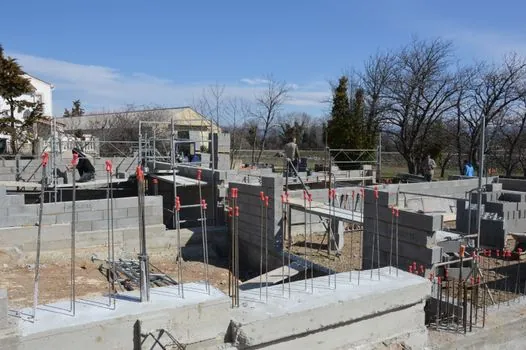
Mechanical equipment pads, generator plinths, cooling-tower piers, and roof-curb reinforcement cages are cast-in-place structures that rely on rebar couplers rather than lap splices when congestion, bar length, or seismic detailing rules out overlapping bars.
Selection is driven by three facts at once: the rebar grade and diameter (typically #4 through #11 in HVAC work, in ASTM A615 Grade 60 or ASTM A706), the structural role (tension splice in a tie-beam vs. column starter at an equipment pier), and the installation environment (cast-in-place slab on grade vs. rooftop curb with limited cover). The catalog splits for the HVAC audience are parallel-threaded standard couplers, upset-end parallel-threaded couplers, pressed-sleeve (cold-swage) couplers, and transition couplers for mixed-diameter cages [S4].
Standard, Positional, and Transition Couplers
Standard parallel-threaded couplers for ASTM A615 Grade 60 bar cover the bulk of HVAC equipment-pad splices, with full-size bodies machined from 40Cr or 45# carbon steel, while positional couplers (often called "positional" or "half-coupler" sets) accept bars that cannot be rotated and aligned, which is the common case inside a rebar cage at a generator base [S4]. Transition couplers join two different bar diameters, useful at the interface between a thicker equipment-pier column starter and a thinner mat of slab-on-grade rebar [S4].
A spec-first comparison for HVAC pads: standard threaded couplers are the cheapest per piece (catalog rates from an Indian supplier on go4worldbusiness listed rebar couplers at USD 0.50 to USD 5.90 per piece as of 2026-02-25) and reach the published Type 2 splice strength of the parent bar, but require a rebar threading machine on site, accurate bar-end preparation, and a torque-controlled wrench; positional couplers trade cost for installation flexibility; pressed-sleeve couplers eliminate threading entirely, using a rebar cutter and a portable hydraulic press, with sleeves typically supplied in 20# or 16Mn steel [S3][S4].
Upset-End Couplers for High-Grade Bar
Upset-end (or "upset parallel-thread") couplers are specified when the rebar grade is HRB500/Grade 80 or higher, because cold-rolling threads on a small bar cross-section can strip under proof load; the upset enlarges the bar end before threading, restoring section lost to thread cutting [S4].
For rooftop HVAC curbs and seismic-zone equipment piers where the engineer calls for Grade 80 continuity through a tension splice, the upset-end pattern is the safe default. The same approach is documented in adjacent infrastructure work: in a companion read on specifying rebar couplers in electrical installation concrete, the upset-end pattern is used where the engineer of record tightens the splice-strength factor above the standard parallel-thread baseline, and the same logic carries over to high-grade HVAC plinth rebar.
Pressed-Sleeve Couplers and Field Repair
Cold-pressed sleeves (also called "pressing sleeve couplers" or swage couplers) are the answer when no threading is feasible: bar ends are square-cut, inserted into a seamless steel sleeve, and the sleeve is radially compressed with a portable hydraulic press supplied as a manual coupler pressing machine [S4].
Catalog descriptions specifically call out the pressed-sleeve pattern as suited to "construction repair" work, where existing rebar in an aged HVAC mechanical room cannot be rotated or threaded, and the same gear set is sold as a manual coupler pressing machine that needs no specially trained operator [S4]. The acceptance criterion after pressing is a permanent plastic deformation of the sleeve, and the achieved tensile strength is typically higher than the parent bar, with the sleeve body in 20# steel or 16Mn raw material [S4]. For tight retrofit work, the cold-pressed pattern lets a two-person crew splice #5 and #6 bars in a confined ceiling cavity without a rebar bender or threading lathe on site [S4].
Thread Preparation, Equipment, and Quality Control
Thread quality is the failure mode most often traced back to the HVAC site: a rolled or cut thread that is short, shallow, or contaminated drops the splice below the required Type 2 strength, and the symptom is bar pull-out under proof load rather than coupler rupture. A rebar straightener is used upstream to remove coil-set before any thread is cut, so the bar sits square in the threading chuck. [S4]
Equipment choices for the HVAC contractor fleet: rebar thread rolling machines at 100-300 mm thread length cover the full #4 to #11 range typically used in equipment pads, and a rebar thread cutting machine is a cheaper option for low-volume repair work where thread quality is acceptable at cut-thread tolerance [S4]. Auto and manual rebar upsetting machines prepare HRB500 bar ends for the upset-end couplers described above [S4]. A plastic thread cover is sold alongside the couplers to keep concrete slurry and site dust off finished threads before the splice is made, a low-cost QA step that is easy to skip on a fast-paced HVAC slab pour [S4].
Selection Checklist for HVAC Scope

A practical HVAC pre-pour checklist: (1) confirm rebar grade from the structural drawing (A615 Gr. 60 is the U.S. default for equipment pads; A706 if welding is also specified; HRB500 in some Chinese-supplied plant equipment); (2) match coupler body material to the rebar (40Cr/45# standard, 20#/16Mn sleeve); (3) decide between standard, positional, transition, upset-end, or pressed-sleeve by bar-diameter mix and bar-fixity; (4) verify that the threading machine, upsetting machine, or pressing machine is on the contractor's tool list before mobilization; (5) require plastic thread covers and a torque-controlled wrench for the final splice [S4].
For typical 4-6 ton rooftop unit curbs and small generator pads, the cost driver is almost never the coupler itself (USD 0.50 to USD 5.90 per piece on the Indian export market as of 2026-02-25) but the threading/pressing equipment, the QA labor, and the rework if threads are damaged on a crowded site [S3]. When the structural engineer allows either threaded or pressed-sleeve, the pressed-sleeve option is the lower-risk pick for retrofit and repair because it removes the thread-damage failure mode entirely [S4].
Limits, Failure Modes, and When to Escalate
Couplers do not relax the structural rules: they still must develop the full tensile capacity of the parent bar at the splice location, they still require the same cover and spacing, and they still need to be detailed on the shop drawing as a separate symbol so the inspector can verify bar-end prep [S4]. A common HVAC failure mode is using a standard threaded coupler on HRB500 bar without the upset, which threads too deep into the bar cross-section and slips under load; another is mixing imperial and metric threads on a project with imported couplers and domestic rebar [S4].
Escalate to the structural engineer of record, not the field fix, when the as-built bar diameter is outside the coupler spec, when the rebar grade on site is higher than the drawing shows, or when seismic detailing requires a mechanical splice that meets a specific ACI 318 Chapter 18 type. For routine HVAC pads, the parallel-threaded standard coupler, properly upset on Grade 80 bar and tightened with a calibrated wrench, is the workhorse pattern, with pressed-sleeve reserved for repair and confined-space work [S4].
Two trackable signals for the next spec cycle: (a) watch for coupler suppliers publishing matched bar-grade tables that include HRB500 and ASTM A706 in the same row, which removes the manual cross-check; (b) watch for HVAC equipment-pad detail libraries in Revit/CATIA distributing coupler families that carry the threading-machine and upsetting-machine spec as a parametric constraint, similar to the Revit API discussion of rebar-coupler geometry over a linked model [S5][S7].