
For diameter ranges of 12-40 mm, parallel-thread mechanical rebar couplers are quoted at US$0.12-2.00 per piece with a 1,000-piece MOQ and a Tianjin, China export port [S2]; the locked-series bolted variant from a separate Chinese supplier is listed on the same Made-in-China platform with quick-install hardware and no special installation equipment required [S3]. Electroslag pressure welding is a different physical process — molten slag heats the bar ends, filler wire is added, and a copper retaining shoe contains the weld pool until it solidifies — and is typically performed with a dedicated electroslag pressure welder on vertical column rebar in high-rise and bridge-pier work.
This comparison is sized for the procurement engineer, rebar detailer and QA manager who has to pick one joining method for a given pour and write the spec note. The two products live in the same supply chain and frequently compete for the same column-splice line item, but their installation, inspection and quality-control envelopes are not equivalent.
Process Definition and Where Each Method Sits on Site
Mechanical rebar couplers are a cold-joining product: a cylindrical steel sleeve is threaded, swaged, or grout-filled to transmit axial load between two rebar ends without heat input, per the typical supplier literature for parallel-thread couplers covering diameters 12-40 mm [S2]. Bolted couplers extend that family to a hand-tightened variant that does not need a bar-prep machine on site, which the supplier lists as a primary advantage [S3]. For more on the product family see the rebar coupler reference page and the base rebar entry for material context.
Electroslag pressure welding is a fusion process: a copper shoe retains a molten slag bath that melts the bar ends, an auto-fed wire adds filler, and the pool freezes into a vertical-column splice. It is associated with high-tensile rebar column splicing in seismic zones and heavy-pier work, and is run on a dedicated welder, not a general-purpose arc welder. The two methods do not share consumables, fixtures, operator qualification or weld-procedure qualification, which is the root cause of most spec disputes on site.
Selection Criteria: Bar Size, Strength Class, Power and Inspection
Bar size is the first filter. The 12-40 mm diameter range is the standard catalog band for Chinese parallel-thread coupler suppliers, with a 1,000-piece MOQ and a 50,000-piece-per-day production rate cited on one Made-in-China product page [S2]. Electroslag pressure welders are typically used on 16-32 mm vertical column bars; outside that band the slag-pool geometry becomes harder to control, which is why the two products rarely overlap on the same diameter.
Strength class is the second filter. Mechanical splices are graded as "Type 1" (50% of bar ultimate, service condition) or "Type 2" (100% of bar ultimate, full tension/compression) under the major international rebar-splice codes; couplers sold as "high strength" by Chinese OEM CABR Technology [S1] and ZRD Rebar Couplers [S4] are typically tested to the higher Type 2 envelope. Electroslag welds, when qualified, can also develop full bar ultimate, but the qualification is per procedure, per diameter, per operator — a non-trivial QA cost.
Power and crew is the third filter. A bolted coupler install uses a torque wrench and visual thread engagement check [S3]. A parallel-thread coupler install needs a rebar threading machine (cutting the cold-rolled thread on the bar end) — see the rebar threading machine 2026 buying guide for the upstream cycle. An electroslag pressure welder needs 380-415 V three-phase power, a water-cooling loop for the copper shoe, and a certified welder. Sites that run on generator power or have limited three-phase distribution rule out the welder early.
Inspection regime is the fourth filter. Mechanical couplers are checked with a torque test on the locking element and a visual thread-engagement check. Electroslag welds require ultrasonic or radiographic NDT on a sampling basis plus macro-etch on the first-of-shift sample — that cost is recurring, not one-off.
Criteria-Based Comparison: Coupler vs Electroslag Weld
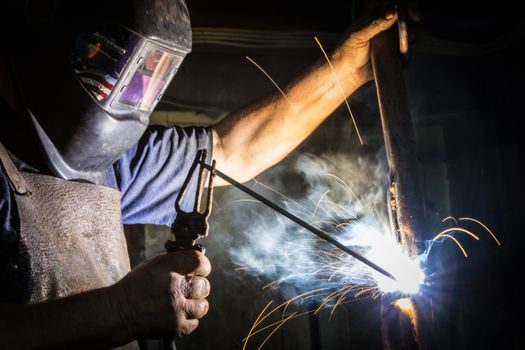
Against four decision criteria, the two methods line up as follows. (1) On-site equipment: a coupler install needs bar-prep (parallel thread) or a torque wrench (bolted); an electroslag weld needs a dedicated welder, copper shoes, filler wire and three-phase power. (2) Per-joint material cost: a 12-40 mm mechanical coupler is quoted at US$0.12-2.00 per piece at 1,000-piece MOQ [S2]; an electroslag weld has minimal consumable cost (filler wire + shoe) but high equipment amortisation per joint. (3) Operator qualification: coupler install is a low-skill task after a short familiarisation; electroslag welds require a coded welder plus WPQR/PQR paperwork per ISO 3834 or equivalent. (4) Inspection cost: couplers are torque-checked and visually inspected; electroslag welds need UT/RT NDT on a sample basis plus a daily macro-etch coupon.
The trade is therefore: couplers win on equipment capital, operator skill and inspection overhead; electroslag welds win on raw material cost per joint, on-site cycle time per column splice, and on the visual cleanliness of a continuous rebar run. Buyers running more than a few hundred column splices per tower should always run a per-joint cost model that includes equipment amortisation, welder day rate, and NDT sampling — not just the consumable price.
Who Mechanical Couplers Are For, and Who They Are Not For
Mechanical couplers are the right call when the splice is in a horizontal slab or beam, when on-site power is constrained, when welder certification is unavailable, when the diameter is below 16 mm or above 32 mm, or when the QA regime cannot support recurring NDT. They are also the right call when the project bans hot work in certain zones (e.g. near fuel storage, in operating hospitals, or in some petrochemical yards), because a bolted or parallel-thread install generates no arc, no slag and no fume [S3]. They are the wrong call when the design specifies a continuous full-tension Type 2 splice on a 20-32 mm vertical column at high cadence, where the welder's per-joint cycle time pulls ahead.
Bolted couplers specifically are a good fit for small-batch repair work and for sites with no bar-prep machine, because the supplier's own literature lists "no special installation equipment" as a primary advantage [S3]. Parallel-thread couplers are a better fit for high-volume production pours, where the upstream rebar threading machine cycle becomes the bottleneck and the thread quality is controlled in a single fixed station rather than per joint on the deck.
Limitations, Failure Modes and Sourcing Reality
Coupler failure modes are well known and concentrated at the thread engagement: under-torque gives slip; over-torque splits the sleeve; mismatched thread pitch (e.g. metric on one end, imperial on the other) gives a non-engaged joint that looks correct. The fix is bar-prep discipline and a calibrated torque wrench. Bolted couplers shift the failure mode to the locking bolt, which is a wear item on re-use. [S1]
Electroslag failure modes are also concentrated at the weld: insufficient slag-pool temperature gives lack of fusion, excessive current gives burn-through, and shoe leakage gives a voided weld that fails UT. The fix is per-shift macro-etch and procedure-qualification monitoring, both of which are recurring costs. Welder fatigue is a real factor on a 200-splice pour.
On sourcing: the dominant Chinese OEM CABR Technology sits on a Beijing address and exports from China under a sales-marketing channel [S1]; ZRD Rebar Couplers is a manufacturer/factory with ISO 9001:2015, ISO 45001:2018 and ISO 14001 management certifications, and ships from a separate Chinese base [S4]. Both are credible for export orders, and the 1,000-piece MOQ on a 12-40 mm parallel-thread unit at US$0.12-2.00 [S2] is the realistic price band for FOB Tianjin in mid-2026. For a fuller view of the upstream bar-prep cycle that feeds threaded couplers, the rebar threading machine 2026 buying guide and the rebar straightener price 2026 reference cover the surrounding equipment chain.
Decision Rule and Trackable Signals
Default to mechanical couplers when bar diameter is below 16 mm or above 32 mm, when on-site three-phase power is unreliable, when welder certification is absent, or when hot work is restricted. Default to electroslag pressure welding when the splice is a 20-32 mm vertical column, when per-joint cycle time matters more than per-joint material cost, and when a coded welder plus NDT regime is already on the project. For mixed scopes, run the per-joint cost model including equipment amortisation and NDT sampling before locking the spec note. [S2]
Two trackable signals to watch: (1) Chinese OEM price movement on the US$0.12-2.00 / 1,000-piece MOQ band, which is a useful leading indicator for global coupler landed cost; (2) any tightening of welder-qualification or WPQR/PQR enforcement in the destination market, which shifts the cost balance back toward couplers on regulated sites. Both can be checked against the electroslag pressure welder and rebar coupler reference pages as the spec baseline.