
On a bridge site running an 8-hour shift cutting 32–40 mm rebar, blades typically need replacement every 3–6 months, with most operators logging 40,000–80,000 cuts per blade set before edge degradation forces a change [S4].
Hydraulic electric rebar cutters are the practical default for bridge pier, cap, and deck reinforcement because they pair the cut force needed for grade 60 bar with repeatable cycle times that manual hacksaws cannot match [S1][S3].
Hydraulic System: Oil Level, Viscosity, and Warm-Up
Check the hydraulic oil level before every shift and top up to the manufacturer’s mark; if ambient temperature is low, run the cutter idle for 30 seconds to 1 minute to warm the oil so it reaches working viscosity before any bar is cut [S1]. Cold oil raises internal pressure spikes and accelerates seal wear, which is the single most common failure path on portable hydraulic units.
For bridge work in shoulder seasons (early spring, late autumn) where night temperatures drop below 5 °C, a cold-start warm-up is non-negotiable; cutting without it risks blowing a rod seal and contaminating the reservoir with metal fines. Reference the unit’s service manual, such as the Multiquip HBC service document, for the exact oil grade (typically ISO VG 32 or 46 hydraulic oil) and replacement interval [S1][S6].
Blade and Shear Life: Tracking Cuts, Not Calendar Time
Track cut count rather than calendar weeks: a 32–40 mm bar at 8 hours/day reaches the 40,000–80,000-cut window in roughly 3–6 months, and pushing past it produces burr-heavy cuts that damage tie wire and slow downstream cage assembly [S4]. The same source notes that 32 mm and 40 mm bars define the upper bound for typical heavy-duty electric cutters; anything above 40 mm requires a higher-rated machine or a different cutting method.
For bridge deck work where most bar is 12–25 mm, blade life stretches significantly and the dominant wear pattern is chipping from contact with embedded rebar stamps or rust scale rather than gross abrasion. Inspect blades every 1,000 cuts for nicks, and re-grind or replace when the cut face shows a burr over 0.5 mm; this also protects the hydraulic pump from shock loading caused by a dull blade stalling mid-stroke [S3][S4].
Hydraulic Hoses, Seals, and Electrical Checks

Inspect hydraulic hoses for abrasion, kinks, and weep marks at every shift change; a hose rupture on a bridge deck is both a contamination event and a slip hazard from sudden oil release [S3]. Check that quick-disconnect couplings are fully seated, and confirm that the return-line filter is clean; a restricted filter causes the pump to cavitate, which is audible as a high-pitched whine and shows up as overheating at the reservoir.
On the electrical side, verify cord insulation, ground pin integrity, and that the cutter is fed from a GFCI-protected outlet; cutting rebar that is damp, in the rain, or with wet hands creates a direct electrocution path through the conductive bar to the operator [S2]. For sites without GFCI distribution, a portable inline GFCI is the minimum field fix. The broader category of construction tools used on bridge projects shares this GFCI expectation across the corded fleet.
Clamping, Setup, and Cutting Geometry
Rebar of any diameter must be clamped in a vise, C-clamp, or rebar holder; never hold the cutting area with bare hands, and the rule hardens at diameters ≥12 mm where spring-back can snap a finger [S3]. Place the bar so the cut point sits at the shear’s designed throat, not at the jaw edge, where off-axis loading bends the blade.
Keep the workbench rated to at least 50 kg with a non-slip mat, and maintain a 5 m clear radius around the cut zone free of solvents, paint, and wood scraps; a 2 kg dry-powder fire extinguisher should be within arm’s reach for spark-driven fires [S3]. Never cut on a scaffold plank or temporary support, because the reaction force of a 32 mm cut will walk an unanchored setup toward the operator. On bridge decks this typically means staging cuts at a fixed rebar laydown yard rather than at the placement face.
PPE, Tool Selection, and the 12-Inch Short-Piece Rule
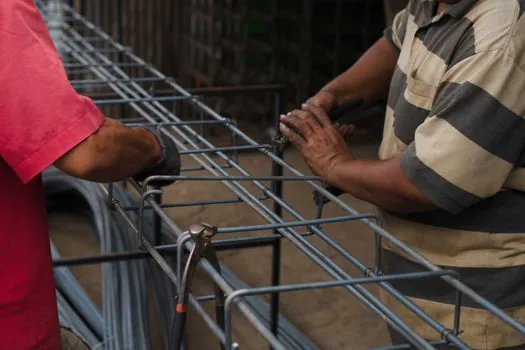
Always wear impact-rated eye protection, cut-resistant (Kevlar) gloves, hearing protection above 85 dB, steel-toe boots, and snug cotton clothing; avoid synthetics that ignite from sparks [S3]. The eye-protection rule is non-negotiable because short cut pieces (≤12 inches / 305 mm) can expel from the jaw at high speed when the cut is completed [S2].
Match the tool to the bar: hacksaws and manual bolt cutters stay below 10 mm, portable hydraulic electric units cover the 12–40 mm range that dominates bridge pier and cap cages, and metal band saws or chop saws handle heavy batch cutting in the fab yard [S3]. Never lock a saw or cutter trigger in the ON position; the kickback or expulsion risk on a stalled cut is the difference between a clean stop and a hand injury [S2]. Refer to the rebar cutter encyclopedia entry for the full tool-class breakdown by power source and capacity.
Comparison: Manual vs. Electric Hydraulic vs. Heavy-Duty Stationary
Three tool classes cover bridge-site rebar work, and the decision pivots on bar diameter, cut volume, and tolerance for hand labor: manual (hacksaw, manual shear) for ≤10 mm and emergency cuts, portable electric hydraulic for the 12–40 mm range that makes up roughly 80% of bridge reinforcement, and stationary heavy-duty electric units (band saw, chop saw) for fab-yard batch production above 40 mm or where burr-free ends are required for mechanical couplers [S3][S4]. Manual tools are cheap and quiet but run 5–8 minutes per 10 mm cut; portable hydraulic units cut a 32 mm bar in 3–5 seconds and dominate site productivity, which is why construction machinery and equipment fleets on bridges standardize on them.
For bridge projects specifically, the planning checklist before deploying any cutter should include: bar diameter range expected, daily cut count target, power availability (generator vs. grid), GFCI provision, oil and seal spares on hand, and a documented blade-replacement trigger tied to cut count rather than wall-clock time. Where deck rebar is 16–20 mm and cut counts are moderate, a single portable hydraulic unit typically covers 2–3 placing crews; below that throughput, manual tools are more economical. Operators also cross-reference adjacent specs such as those used for marble cutter selection, since the bench-tool clamping and dust-control logic overlaps on finishing stations.
When to Repair Versus Replace the Cutter

Repair when the failure is consumable: blades, seals, hoses, quick-connects, and the hydraulic oil itself. These are field-serviceable on most portable units and represent the bulk of operating cost over a bridge project’s 12–24 month duration. Replace the unit when the pump loses pressure under no-load (internal bypass), when the cylinder weeps continuously after a seal change, or when replacement blades for the model are no longer stocked; all three signal end-of-economic-life rather than a maintenance event [S6].
Escalate to a certified service center when electrical faults appear (intermittent GFCI trip, motor overheating) or when the unit has been submerged; water in the hydraulic reservoir or motor windings is not a field repair. For bridge owners writing maintenance procedures, the enforceable signal is: log cut count and oil-change intervals, lock out the unit when blade condition is unknown, and retire the machine once two pump-seal replacements occur within a 12-month window. As a cross-check on adjacent tooling fleets, see the procedure-driven approach used in mechanical seal installation, which applies the same spec-anchored, log-driven logic to rotating equipment.
For 2026 bridge programs, watch two signals: tighter cut-count logging on heavy-duty electric units (OEMs are pushing toward 50,000-cut baseline warranties for 32 mm bar) and broader adoption of cordless hydraulic cutters as 54 V battery platforms reach the torque range previously reserved for corded units. Both will shift the spares kit from hoses and seals toward battery management and brushless-motor service.