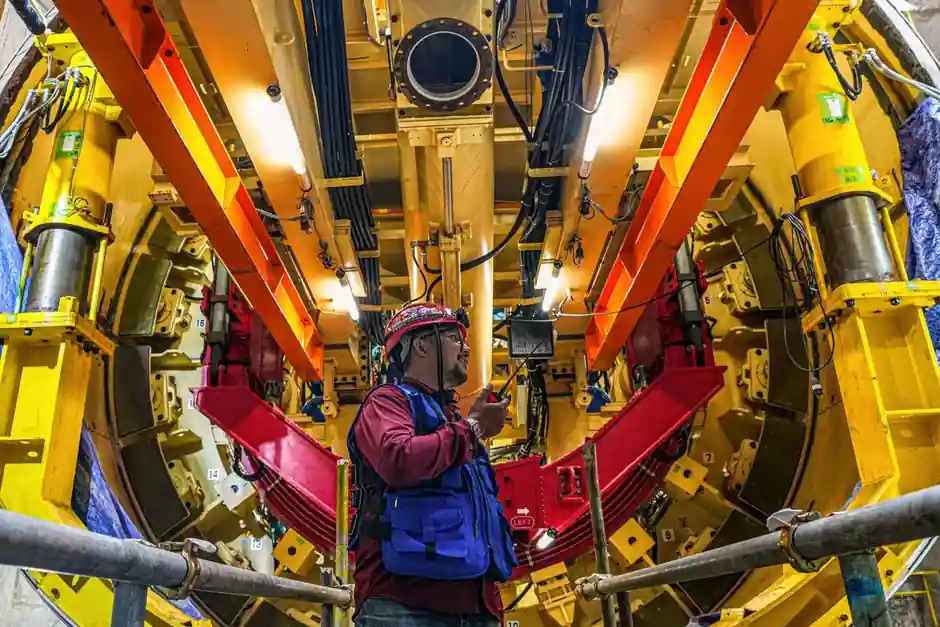
Shield tunnel segment rebar cages operate in a measured stress window of -80 to 50 MPa across normal jacking and shield-attitude deflection conditions, per a 2008 3D FE study in the Journal of Zhejiang University-SCIENCE A [S3], which directly defines the fatigue and overload envelope any bender must survive in service.
Tunnel work splits into two bender-relevant workflows: precast segment yard (factory cage fabrication, high repeatability, fixed bend schedule) and cut-and-cover or mined-tunnel in-situ work (variable diameters, tighter radii, intermittent cycle), and the right machine class for each differs in motor size, mandrel reach, and bend-angle table.
Segment-Cage Geometry and Bend Schedule
Shield tunnel segments are typically reinforced with bars in the 12-25 mm diameter range (B500B/B500C grade is common in metro work) formed into a closed ring cage with stirrups, main longitudinals, and curved corner bars at 90 and 135 degree angles [S3]. A rebar bender for cage production must therefore deliver repeatable 90 and 135 degree bends across a 12-25 mm envelope, with a mandrel radius that prevents the inner rebar face from cracking at the bend tangent.
Selection gate one is bend-angle repeatability under continuous duty: a CNC or NC bender with encoder feedback holds angle tolerance to roughly +/- 1 degree over a full shift, while a manual hand-bender drifts as the operator tires, and a 0.5 degree drift across 200 bends per cage visibly opens the segment cover dimension. Selection gate two is minimum bend radius relative to bar diameter; mainstream spec practice on Grade B500B is a mandrel diameter of 4d to 6d for 90 degree bends and 6d to 8d for 135 degree stirrup hooks, which a catalog bender must publish as a chart, not a single number, because the rule is bar-diameter dependent.
Power Class, Motor, and Cycle-Time Targets
For a 16-22 mm cage bar, single-phase 220 V benders cap out around 2.2-3.0 kW and are limited to light intermittent duty, while three-phase 380 V units in the 4.0-7.5 kW band cover the segment yard's continuous-shift cycle at 6-10 seconds per 90 degree bend on 20 mm bar. Three-phase hydraulic benders above 7.5 kW handle 25-32 mm bar and are the right class for main longitudinal bends on heavy rail or immersed-tube segment cages. [S2]
Cycle-time budgeting is the practical lever: a 9-ring FE model with jacking, grouting, and soil-pressure loads implies one cage per ring, and a metro drive advancing 8-12 rings per day therefore needs the bender to clear 8-12 cages per day just to keep pace, which is a hard throughput gate for any rebar bender specified for the segment yard. For projects where power is single-phase only, plan on 16-20 mm as the practical ceiling; above that, the motor stalls before the bend completes, and operators compensate by heating the bar, which destroys the B500B temper.
Application Split: Precast Yard vs In-Situ Tunnel
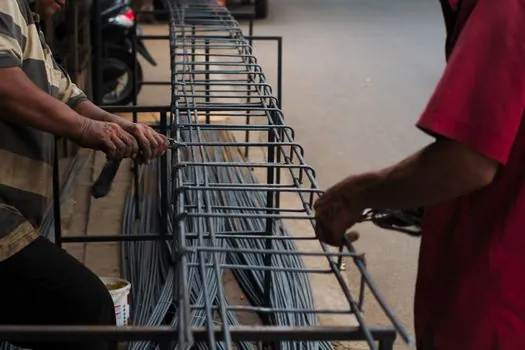
Precast segment yards favour stationary or bench-mounted NC benders with multi-pin mandrels and preset angle tables, because the same cage geometry repeats across hundreds of rings and the labour saving on a single setup pays back within weeks. In-situ work (cross-passages, mined-tunnel portals, cut-and-cover base slabs) favours portable electric benders in the 1.5-3.0 kW band that one technician can carry to the heading, with a battery or 110 V single-phase option for sites without three-phase feed. [S2]
Demolition-adjacent work in tunnel rehab, where bent bars must be cut and re-bent on the spot, is closer to the demolition crew specification profile than to the segment yard profile, and the two workflows should not be merged on one bender class. A related power-class comparison for low-diameter landscaping cages is in landscaping rebar bender selection, which shares the bend-angle repeatability gate but differs on the diameter ceiling.
Selection Criteria: Benders Lined Up Against the Gates
Four machine families compete for tunnel-segment work, and the choice narrows once the gate is written down. Manual hand benders cover up to 16 mm at 90 degrees with a 4d mandrel, but cycle time is operator-limited and angle drift exceeds 2 degrees across a shift, which fails the segment-cage tolerance gate. Portable electric single-phase benders in the 1.5-3.0 kW band cover 10-20 mm with +/- 1.5 degree repeatability and a 4d-6d mandrel range, suiting in-situ heading work but marginal on continuous-shift segment-yard duty. Stationary three-phase CNC benders in the 4.0-7.5 kW band cover 12-25 mm at +/- 0.5-1.0 degree repeatability with programmable angle tables, which is the segment-yard default. Hydraulic benders above 7.5 kW cover 25-32 mm+ for main longitudinals and heavy-rail cages, with longer cycle (10-15 s per bend) but no practical diameter ceiling. [S3]
Gate summary: portable electric (1.5-3.0 kW) for in-situ heading and cross-passage, stationary CNC (4.0-7.5 kW) for segment yard 12-25 mm cages, hydraulic (>7.5 kW) for 25-32 mm main bars. Picking a class one rung below the workload gates is the single most common spec error on tunnel projects, because the bend passes QC at the bench and then cracks at the segment's inner curvature once jacking loads arrive.
Constraints, Failure Modes, and What to Reject

The FE analysis on a 9-ring model shows that even with cracks on the concrete segment face, the rebar stress stays in the -80 to 50 MPa elastic range, but only because the bar was bent within the mandrel-ratio rules [S3]. A bar bent cold over a too-small mandrel enters the plastic zone at the bend tangent, drops ductility, and the next jacking cycle propagates a fatigue crack at the bend root. The visible failure mode is a longitudinal split along the bend tangent, not a bend-angle error, and the only fix is a larger mandrel and more kW at the bender.
Second, derate the bender for ambient heat and altitude: most catalogs rate continuous duty at 25 degrees C and sea level, and a tunnel yard in a hot climate (or a deep shaft with poor ventilation) loses 10-15% of cycle rate before the bend quality changes. Third, reject any bender that ships without a published mandrel-diameter chart, because the 4d-8d rule is bar-diameter dependent and a single "min bend radius" number in the brochure is almost always wrong for one of the diameters on the segment schedule. For projects that also need a matched rebar cutter on the same line, match the cut-and-bend throughput gates so the cutter does not bottleneck the bender.
Sourcing, Standards, and Where the Spec Numbers Live
Two anchors hold the tunnel-segment bender spec: the mandrel-ratio rule for cold bending of Grade B500B/B500C bars (published as a chart in the bar producer's datasheet and re-stated in the project rebar bending schedule) and the segment geometry table from the segment supplier, which fixes every angle and radius on the cage drawing. Tunnel construction methods themselves, including cut-and-cover, NATM, and TBM shield, are surveyed in standard reference material [S1], and project-execution practice for TBM drives is documented in current Coursera lecture material [S2].
For the construction-tools ecosystem beyond bending, the broader construction tools and rebar reference pages map the adjacent categories (cutters, straighteners, couplers) that show up in the same procurement lot. On 2026-08-10, the verifiable selection signals to track are: (1) the segment supplier's bend schedule and mandrel-ratio chart, which fix the bender's angle table and mandrel inventory; (2) site power availability (single-phase 220 V vs three-phase 380 V), which fixes the motor class; (3) cycle-time target in cages per shift, which fixes whether a 3 kW portable, a 5.5 kW CNC, or a 7.5 kW+ hydraulic unit is the correct spec, and any of these three changing forces a re-spec.