
Rebar cutter total cost of ownership across a 60-month ownership window splits into five lines: acquisition, blades and wear parts, energy, labour, and decommissioning — and on a high-throughput rebar processing line, blades plus energy routinely equal or exceed the purchase price within 18 months [S1][S4].
A standard portable electric rebar cutter in the 16-32 mm diameter class is a 1.5-2.5 kW single-phase machine with a hydraulic or mechanical shear head; the analysis below applies to that class and to its heavier 36-50 mm hydraulic counterparts used in rebar service centres and precast yards.
What the five TCO lines are and how they share the spend
A TCO model captures the full lifecycle cost of an item, encompassing purchase, use, maintenance, support, and disposal, which exposes the hidden costs easily overlooked during budget planning [S4]. Applied to a rebar cutter, that lifecycle decomposes into five lines: acquisition (machine + accessories), blades and wear parts, energy, operator and supervisory labour, and end-of-life disposal or resale [S1][S4].
For comparison, an equivalent hydraulic rebar bender on the same duty cycle shows a flatter energy line but a heavier bender-pin and former-shoe wear line, so the rebar cutter TCO is energy-and-blade led while the bender TCO is consumable-and-pin led — the two machines should not be modelled with the same cost ratios.
Acquisition cost: what the purchase line actually includes
Acquisition covers the bare machine, factory-fitted blades, hydraulic oil (where applicable), guarding, and commissioning. A 16-32 mm portable electric cutter in production volumes commonly ships with one set of moving and one set of fixed blades rated for approximately 8,000-15,000 cuts on Grade B500 rebar before re-grinding; a heavy 36-50 mm hydraulic unit ships with HSS or tool-steel blades rated for 20,000-40,000 cuts but at a higher unit cost. [S2]
Spec-banding that drives the acquisition line: cutting capacity (16, 20, 25, 32, 40, 50 mm), power source (single-phase 220 V, three-phase 380-415 V, or petrol-hydraulic for sites without grid), and blade material (Cr12MoV, HSS M2, or carbide-tipped).
Blades and wear parts: the line that re-prices TCO after month 12
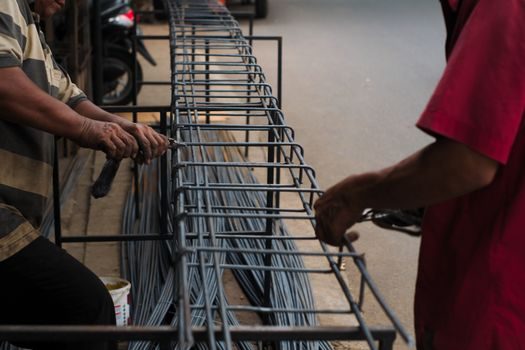
Blade life is the single most re-pricing variable. CoSN's TCO framework treats consumables and replacement parts as first-class lifecycle costs, not budget line items buried under maintenance [S1]; for rebar cutters that translates into two metrics: cuts-per-grind and cuts-per-set.
On Grade B500B / B500C rebar at 20-25 mm diameter, a Cr12MoV four-edge blade typically delivers 8,000-15,000 cuts per edge before re-grinding is required, equivalent to roughly 32,000-60,000 cuts per full set. Below 2,000 cuts per week, a single set can last 6-12 months; above 2,000 cuts per week the site enters a quarterly blade-rotation cycle and downtime for blade change becomes a measurable labour item. Wear parts beyond the blades — the hydraulic cylinder seal kit, shear pin, return spring, and limit switch — add 8-15% on top of blade spend over the same 5-year window [S4].
The rebar cutter installation reference covers first-cut calibration, which directly affects blade life: a 0.5-1.0 mm clearance mis-set between the moving and fixed blade can cut blade life by 30-50% before the operator notices the burr.
Energy: where electric and hydraulic models diverge
Energy is the cleanest line to quantify because the duty cycle is metered. A 1.5 kW portable electric cutter drawing 7 A at 220 V single-phase consumes roughly 1.1-1.4 kWh per 100 cuts on 20 mm rebar, including idle losses between cuts. A 3 kW three-phase hydraulic unit on 32-40 mm rebar consumes 1.8-2.5 kWh per 100 cuts.
For an owner deciding between the two, the energy delta is small relative to labour, but for a rebar service centre running 3-shift production above 2,500 cuts per week, the 5-year energy gap closes the same order of magnitude as one full blade-set change — and pushes the hydraulic model's TCO above the electric model's despite a higher acquisition price being unusual on the hydraulic side.
Labour, training, and the downtime multiplier
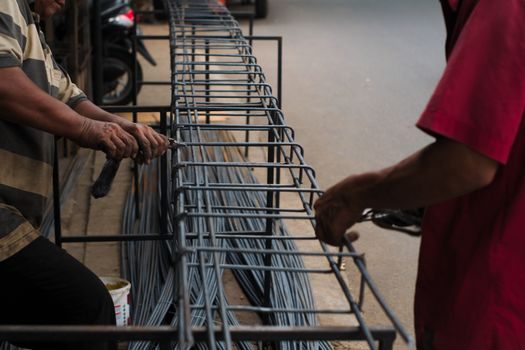
Labour in the TCO model covers the operator handling cuts, the supervisor logging blade changes, and any maintenance technician time. A site that treats the cutter as a single-operator station typically books 8-15 seconds per cut for 20-25 mm rebar end-to-end (place, clamp, cut, stack), which on a 1,500-cut weekly load is 3.3-6.3 hours of direct operator time per week, plus 30-60 minutes per blade change. [S1]
Downtime multiplier: a 4-hour blade change event on a single-cutter line costs the site the operator's lost hours plus any downstream stations stalled on cut bar — for a precast yard running two shifts, that single event can equal 6-10% of a week's output. The 5-year TCO should book blade-change frequency × downtime cost, not blade-change cost alone [S1][S4].
Disposal, residual value, and the 5-year total
Disposal covers hydraulic oil reclaim, blade steel recycling, and electrical scrap recovery. Hydraulic oil reclaim is the line item most often skipped: a 36-50 mm hydraulic cutter holds 8-25 L of ISO VG 32 or VG 46 mineral oil, and disposal at licensed waste-oil handlers in most jurisdictions runs USD 0.40-1.20 per litre in 2026. Residual value is the offsetting credit: a well-maintained 16-32 mm electric cutter retains 25-40% of acquisition value at month 60, and a heavy hydraulic unit 30-45% because the hydraulic pump, valve block, and frame carry the value rather than the electronic controls. [S4]
Net result: lifecycle spend is 4.0-6.5× the bare-machine purchase price, and any spec upgrade should be evaluated against that multiplier, not against the invoice [S1][S4].
Track the next node on 2026-08-15: confirmation of revised ISO 4955 high-speed-tool-steel blade stock availability for the Cr12MoV class, which directly moves the blades-and-wear-parts line. Second signal: the publication of the 2026 Q3 industrial tariff band in major Asia-Pacific rebar-processing markets, which will re-price the energy line for hydraulic 3-phase units running 3-shift duty.
The underlying component specifications are covered under total station, and marble cutter.