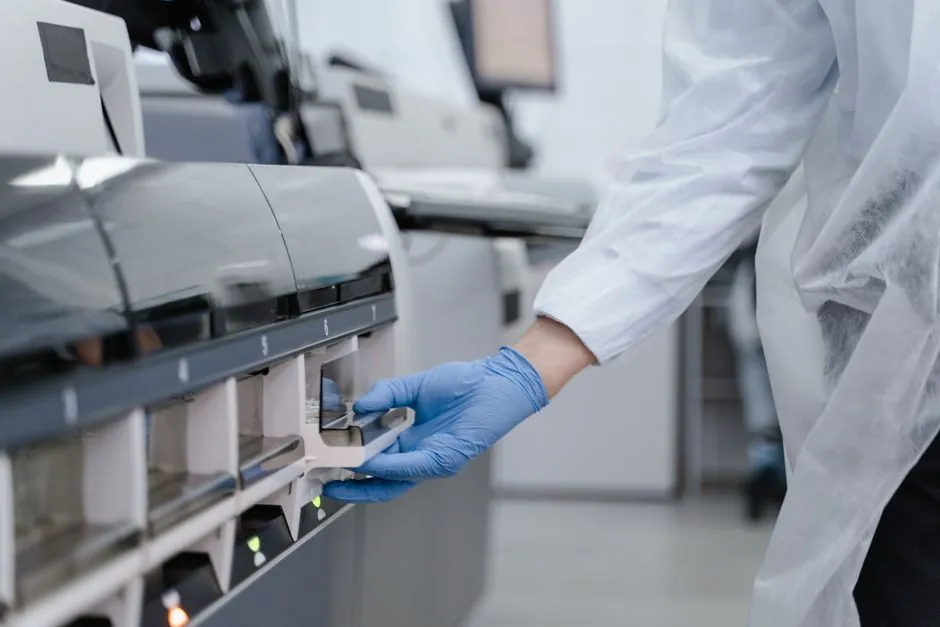
Professionally refurbished analytical and support equipment typically sells for 30–70% below new list price [S8].
The comparison applies to standalone GCs and coupled GC/MS systems, but purchase price alone is incomplete: installation, training, validation, service, downtime and residual value determine total cost of ownership [S2][S4].
Price ranges and savings by instrument class
A GC/MS example places a new system with installation and warranty above $130,000 against $55,000–$80,000 for validated refurbished systems, although configuration and refurbishment scope differ [S4].
These figures are not a universal price list. A GC without a mass spectrometer may cost much less than a GC/MS, while detector type, injector configuration, software, columns, gas-delivery hardware, interface, and validation scope materially affect the quote [S1][S5][S6]. Refurbished standalone GC listings as low as $9,999 illustrate market dispersion, not equivalence to a fully qualified GC/MS [S7].
Compare the procurement options on four decision criteria
Across analytical and support equipment, professionally refurbished units typically sell for 30–70% below new list price [S8].
On configuration flexibility, a new instrument may be easier to standardize because it arrives with current components, manufacturer warranty availability and simpler financing arrangements [S1]. A refurbished unit can still fit an established workflow, but the buyer must verify model age, detector, inlet, software and available accessories.
On documented performance, a new instrument is not automatically method-ready. The procurement test is whether it has passed the laboratory's analyte panel, sensitivity targets and baseline-noise requirements; method-specific pre-delivery validation is therefore more meaningful than an age-based assumption [S3].
Define refurbished before comparing it with used
Refurbished does not mean merely cleaned and relisted. A defensible package should disclose inspection, servicing, repair, cleaning, component replacement, injection-system checks, detector and oven checks, software checks, performance testing and the exact work completed [S5].
Used and refurbished GC/MS systems are distinct procurement categories, and buyers should determine which option best meets their testing requirements [S1].
Match the instrument to the laboratory use case
Refurbished equipment fits laboratories needing environmental, chemical, pharmaceutical, food, petrochemical or quality-control testing capacity, especially where the required configuration already exists and methods are stable [S5]. It can also provide backup capacity, a new training station, or expansion without committing the full new-system capital cost.
New equipment is the stronger choice when a new method is being developed, multiple instrument families must be standardized, manufacturer support is a contractual requirement, or no installed base exists for transferring columns, methods and trained operators. S1 identifies an Agilent 7890A GC paired with a 5975C MS as generally serving the same needs as a 7890B GC paired with a 5977B MS unit, but the method must still be qualified.
Refurbished equipment is a poor choice for regulated release if the vendor cannot provide installation records, calibration results, service history, warranty terms and method validation. One instrument supplier states the decisive requirement directly: “does the instrument meet your method requirements, and did the vendor validate it against your specific application before it shipped?” [S3].
Compare installation, warranty and service support

Warranty length, response time, parts source and whether service is OEM-backed must therefore be compared as contract terms rather than inferred from the word “refurbished.”
A new GC often has easier access to manufacturer maintenance agreements and financing, while refurbished systems can also be financed if the supplier and lender accept the asset and warranty structure [S1]. For laboratory planning, model the gas chromatograph and gas chromatographs selection around scheduled preventive maintenance, response time and the cost of unproductive instrument time.
Account for qualification and lifecycle risk
Qualification is the main technical risk because generic factory checks do not establish suitability for a laboratory's specific methods. A refurbished GC/MS can still fail because of an undetected vacuum leak, contamination or an unmet sensitivity requirement, just as a new system can [S3].
The acceptance plan should require test methods that match intended use, baseline criteria, sensitivity targets, analyte panels, carryover checks where relevant, and documented calibration status. For a new installation, these checks must still be performed because a new instrument is not automatically qualified for production [S3].
Downtime can erase the acquisition discount. Service costs may be the same over years 2–5 in the illustrated LC/MS/MS comparison, while reduced downtime depends on vendor support rather than refurbishment alone [S4]. A five-year business case should therefore include purchase, installation, calibration, warranty, preventive service, repairs, method transfer, operator training, downtime and resale value [S4].
Procurement checklist for a defensible quote
Request a line-item quote covering instrument model, detector, inlet, oven, carrier-gas controls, data system, interface, columns, regulators, standards, installation, training and validation [S1][S6]. For GC/MS, require the mass-spectrometer model, source and vacuum-system condition, tuning results, library and software versions, and leak-test documentation.
Require serial-number traceability, hours or usage history if available, service records, replaced-parts list, calibration certificate, OQ/PQ results, warranty exclusions, response commitments and ownership of test data [S1][S3][S5]. A vendor claiming compliance without naming the tested specifications or providing the records is offering an assertion, not qualification evidence.
Compare offers on a five-year basis. For a stable method with an existing platform, a validated refurbished system with OEM parts, documented qualification and at least six months of support can be the economic choice [S1][S3][S4]. For a new laboratory, an unsupported or lightly tested used system offers the least defensible combination, while a fully specified new instrument may cost more but reduce configuration and integration uncertainty [S1][S5].
The next procurement action is to issue one controlled specification to both new and refurbished vendors, then compare the responses for configuration equivalence, validation evidence, warranty and five-year total cost rather than accepting headline price alone [S3][S4][S6].