
Sanding-belt failures in industrial metalworking and woodworking follow seven repeatable patterns, and the failure visible on the belt almost always points to one specific, correctable parameter in the grinding setup [S4].
The seven modes documented for 2026 production environments are loading, glazing, tracking drift, stretch, tearing, burning, and premature wear; each is governed by grain type, surface feet per minute, contact pressure, and backing weight [S4]. Sizing and selection sit inside a broader sander and abrasive-belt system, where the belt, the machine, and the workpiece form a coupled loop, so a fault in one element is rarely corrected by swapping another.
Failure Mode Comparison: Seven Patterns Against Four Decision Criteria
Loading (swarf packing) and glazing (grain dulling) are the two most common failures on soft non-ferrous and hardened steel workpieces respectively, and they are diagnostic opposites: loading fills the grain, glazing flattens it [S4].
The decision criteria are grain type (A vs ZA vs CE), coat construction (closed 100% vs open 50–70%), belt speed in SFPM, and contact pressure threshold for self-sharpening fracture; matching the wrong pair to the workpiece produces predictable failure within minutes [S4].
Loading: Causes, Fixes, and Why Open-Coat Is Mandatory for Aluminium
Loading occurs when swarf does not break away cleanly and packs into the grain interstices, which happens fastest on aluminium, copper, brass, soft plastics, and resinous wood species [S4].
Four root causes dominate: a workpiece too soft or gummy for the selected grain, peripheral belt speed below the SFPM window where centrifugal action throws swarf clear, closed-coat construction (100% grain coverage) that leaves no escape path for chips, and a feed rate so low that dwell heats the interface and welds swarf to the abrasive [S4]. The fix is matching, not media: switch to an open-coat belt (50–70% grain coverage), specify a stearate supersize anti-loading treatment, push belt speed to the upper end of the material's recommended SFPM range, and use a rubber belt-cleaning stick during operation to clear the surface without stopping the machine [S4]. On shop floors where construction and woodworking lines feed mouldings through, this single correction routinely doubles belt life on MDF and softwood profiles.
Glazing: Self-Sharpening Grains Need Pressure to Fracture
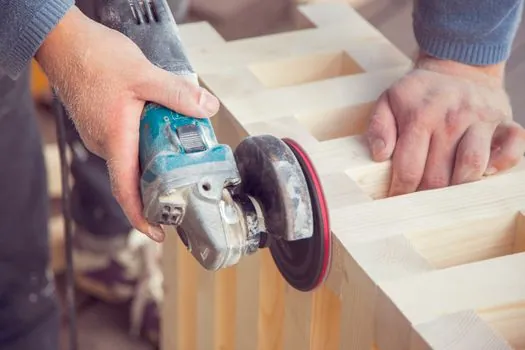
Glazing is the inverse of loading: there is no swarf in the grain, the abrasive points have dulled and smoothed over, and the workpiece shows burning or discolouration because the belt is now rubbing instead of cutting [S4].
Standard aluminum-oxide (A) grain cannot sustain its cutting edge on hardened tool steel or high-alloy stainless; the grain wears smooth rather than fracturing to expose a fresh facet [S4]. ZA and ceramic (CE) grains are designed to microfracture under load, but they have a minimum contact-pressure threshold below which the grain simply polishes, and a SFPM ceiling above which the grain skims the workpiece before it can penetrate [S4]. The corrective sequence is to step grain A→ZA for general steel, ZA→CE for hard alloys and stainless, raise contact pressure to the documented fracture threshold, and back off belt speed if glazing appears within the first seconds of a run [S4]. A persistently glazed belt on a stainless tube is almost always a pressure problem dressed up as a media problem.
Tracking, Stretch, and Tearing: Mechanical Failures Inside the Loop
Tracking drift, stretch, and tearing are mechanical failures rooted in the belt's path through the machine rather than in the abrasive grain itself; treating them as media problems wastes belts [S4].
Tracking drift (the belt walking off the pulley and producing scalloped edge wear) is corrected by re-squaring the tracking mechanism, replacing a worn or flat contact wheel with a crowned one, and recalibrating belt tension against the manufacturer's range [S4]. Stretch (loss of tension, joint slip, frayed edges) is driven by tensile load exceeding the backing-weight rating and by joint heat from an unrun belt; the standard remedy is stepping up backing weight (X-weight to Y-weight for heavier stock), shortening the splice, and running the belt through a controlled break-in cycle before production loading [S4]. Tearing (edge tear or splice snap) is usually a snag from a workpiece burr or a reverse-bend over a contact wheel that is too small in diameter for the belt's minimum bend radius; deburring the stock, increasing contact-wheel diameter, and inspecting the splice overlap are the matched fixes [S4].
Burn, Premature Wear, and Substrate-Side Coatings
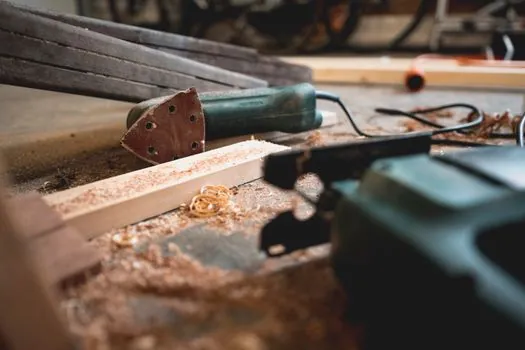
Burning (blueing on steel, smoke, resin volatiles on wood) is heat accumulation from excessive SFPM, excessive dwell, or excessive pressure on heat-sensitive stock; the standard levers are reducing SFPM, increasing feed rate, and switching to a heat-stable grain or backing formulation [S4].
Premature grain shed before rated life is a closed-coat/soft-material mismatch, a bond-hardness mismatch for the workpiece, or a contaminated stock surface; the fixes mirror those for loading, plus a softer bond for hardwoods and a clean/degrease step on the stock [S4]. Substrate-side failures on the workpiece (coating blistering, cracking, and delamination under polyurea and primer systems) sit in a different failure family entirely, where inadequate surface preparation, soluble-salt contamination, and out-of-window temperature/humidity trap moisture or solvent and lift the film [S3]. The takeaway for any cell that combines abrasive finishing with a downstream coating line is that the sanding step must leave a clean, dry, salt-free, profiled surface; otherwise the abrasive cell's belt life and the coating cell's adhesion both collapse together.
Selection Criteria, Constraints, and Standards Anchors
Sanding belts are a matched-component problem: a correctly paired belt, machine, and workpiece run a duty cycle defined by grain, grit, backing weight, SFPM, and contact pressure, and a single out-of-window parameter produces a named, recognisable failure mode within minutes [S4].
For shop-floor selection the four criteria are (1) grain family (A for mild steel and wood, ZA for general steel, CE for hardened alloys and stainless), (2) coat construction (open 50–70% for soft non-ferrous and resinous wood, closed 100% for hard ferrous), (3) backing weight (J-flex for contour work, X-weight for general metal, Y-weight for heavy stock removal), and (4) SFPM window per material (with the upper end used for soft loading-prone stock and the lower end used for hard heat-sensitive stock) [S4]. Failure-mode analysis as a discipline applies the same logic to metals, polymers, ceramics, and composites across impact, spalling, wear, brinelling, thermal shock, and radiation damage, and the conclusion is the same: failures are designed in by selection and matched out by parameter, not by reorder [S1]. For process engineers writing standard work, the practical anchor is a per-material SFPM/pressure/grain/coat table cross-referenced to the seven named failure modes, with the rule that no belt change is authorised without first checking the machine's tracking, tension, and contact-wheel condition.
Read alongside the truck-crane inspection checklist for hold-point and failure-trap practice and the industrial filter demand digest for cell-level maintenance signals, the same matching-not-replacing logic shows up across abrasive, mechanical, and filtration cells.
The underlying component specifications are covered under lamps and light fittings.