Respirators and safety shoes are two of the most commonly specified items in any OSHA-compliant PPE program, yet they sit at opposite ends of the body-exposure matrix: one guards the respiratory tract against airborne hazards, the other shields the feet against mechanical, electrical, and chemical contact [S1][S2].
OSHA defines personal protective equipment as "equipment worn to minimize exposure to hazards that cause serious workplace injuries and illnesses" from chemical, radiological, physical, electrical, mechanical, or other workplace sources, and explicitly lists both respirators and safety shoes in that inventory [S1]. A workplace PPE program is required to address hazard identification, selection, maintenance, training, and program monitoring whenever engineering or administrative controls cannot reduce risk to acceptable levels [S1][S2].
Defining the Two Equipment Families
Respirators are devices worn over the nose and mouth (or the entire face) to filter contaminated air or supply clean air from a separate source, and are categorized by OSHA as air-purifying or atmosphere-supplying, with tight- and loose-fitting facepiece options [S1][S3]. They are deployed only after a hazard assessment confirms inhalation exposure to particulates, gases, vapors, or oxygen deficiency that cannot be controlled at source [S1][S3].
Safety shoes are protective footwear with reinforced toes, puncture-resistant soles, and slip-resistant outsoles; the category includes steel-toe boots, metatarsal guards, dielectric footwear, and chemically resistant rubber boots selected by the foot hazard present [S2][S4]. OSHA requires that PPE "meet or be equivalent to standards developed by ANSI," and safety-toe footwear falls into that scope for general industry, maritime, and construction [S1][S2].
Selection Criteria and Standard Mapping
Respirator selection is driven by the airborne contaminant, its concentration, and the assigned protection factor (APF) needed; OSHA 29 CFR 1910 Subpart I and the related respiratory protection standard (29 CFR 1910.134) require that "the respirators provided must be appropriate for the intended work" and that fit-tested tight-fitting facepieces be used in immediately dangerous to life or health (IDLH) atmospheres, where a self-contained breathing apparatus (SCBA) is the typical choice [S3]. NIOSH certifies respirators under 42 CFR Part 84, and employers must select only NIOSH-certified devices [S3].
Safety shoe selection is driven by foot-hazard mapping: impact, compression, puncture, slip, electrical conductivity or resistance, static dissipation, and chemical contact each correspond to a different boot construction. ANSI/ISEA Z41 (legacy) and the current ANSI/ASTM standards define the impact and compression ratings (I-75/C-75 being a common Class 75 rating, with the metatarsal MT-75 rating added where toe-plus-top-of-foot protection is required) [S2][S4]. A welding safety shoe specification guide and a lab-focused F2413 ratings breakdown both illustrate how the same standard family resolves to different boot builds depending on the task.
Side-by-Side Comparison on Four Decision Criteria

On hazard class, respirators address airborne chemical, biological, and particulate exposure, while safety shoes address mechanical (impact, puncture, slip), electrical, and surface-chemical exposure; the two are complementary, not substitutable [S1][S2][S4]. On body region, respirators protect the respiratory tract (nose, mouth, lungs), whereas safety shoes protect the feet and, with metatarsal guards, the lower leg [S4].
On certification path, respirators must be NIOSH-certified under 42 CFR Part 84 and used inside a written respiratory protection program with medical evaluation, fit-testing, and training [S3]. Safety shoes must meet ANSI/ASTM consensus standards (impact/compression rating, puncture resistance, dielectric rating where applicable) and are generally exempt from the employer-paid rule only when the employer permits them off-site [S1][S2]. On failure mode, respirator failure typically means seal leakage, cartridge breakthrough, or oxygen depletion, and is mitigated by fit-testing and cartridge change-out schedules; safety shoe failure typically means sole penetration, toe-cap deformation, or chemical degradation of the upper, and is mitigated by inspection and replacement cycles [S1][S2][S3].
Who Respirators and Safety Shoes Are For
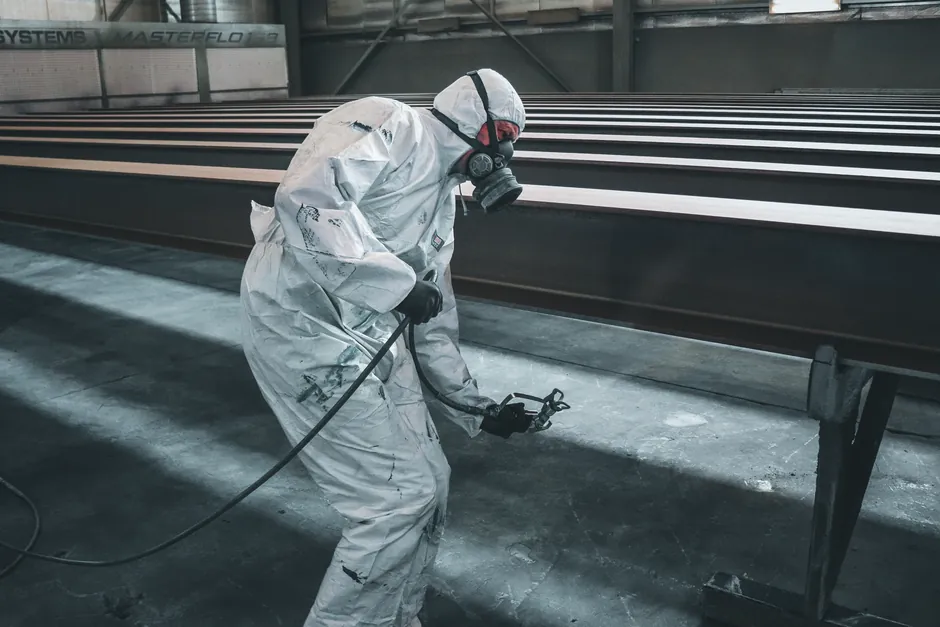
Respirators are required for workers in atmospheres where the OSHA permissible exposure limit (PEL) is exceeded for dust, fume, mist, gas, or vapor, where oxygen is below 19.5 percent, or where IDLH conditions may arise, such as confined-space entry, asbestos abatement, painting, welding fume control, and emergency response [S3]. Voluntary use of filtering facepiece respirators is permitted when the employee requests one and the device does not create a hazard, but tight-fitting respirators used voluntarily still require a medical evaluation and fit-test per 29 CFR 1910.134 [S2][S3].
Safety shoes are required for workers exposed to foot-impact hazards from falling or rolling objects, puncture hazards from below, electrical conductivity or static hazards, slip hazards on wet or oily surfaces, and chemical splash on the lower leg, such as construction, warehousing, foundry work, electrical work, food processing, and laboratory work [S2][S3]. OSHA's PPE-payment exception allows non-specialty safety-toe footwear (including steel-toe shoes/boots and logging boots) to be employee-provided only when the employer permits the item to be worn off the job site [S2].
Failure Modes, Limitations, and Common Mis-specifications
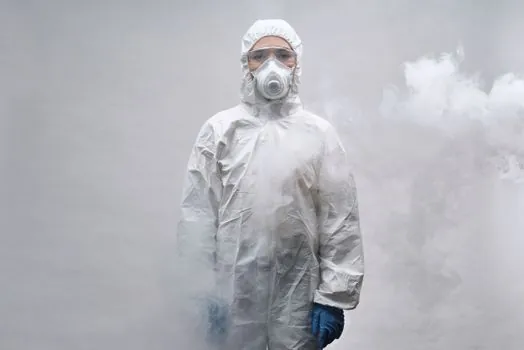
The most common respirator mis-specification is selecting a disposable N95 where a half-mask with combination cartridges, a powered air-purifying respirator (PAPR), or an SCBA is required by the assigned protection factor or the IDLH classification; a related failure is facial hair under a tight-fitting seal, which breaks the seal and reduces protection to near zero [S3]. Filter cartridges also have a service life, and OSHA requires a change-out schedule based on manufacturer guidance or objective data [S3].
The most common safety shoe mis-specification is choosing a standard steel-toe boot in a chemical plant where dielectric, static-dissipative, or chemical-resistant rubber is required, or in a wet kitchen or food-processing line where slip resistance (e.g., a documented coefficient of friction rating) is the binding criterion rather than toe rating alone [S2][S4]. Puncture-resistant midsoles and metatarsal guards are also frequently omitted on tasks that involve dropped loads or rolling stock, even though the warehouse safety shoe selection checklist flags toe, slip, and weight as the three primary decision axes for that environment.
Integration With the Broader PPE Program
Both respirators and safety shoes sit at the bottom of the OSHA hierarchy of controls, which ranks elimination, isolation, engineering controls, work practice controls, and administrative controls above PPE; PPE is the last line of defense and is required only when higher-order controls are not feasible or do not provide sufficient protection [S1][S2]. The employer must train each worker on when PPE is necessary, what kind is necessary, how to put it on, adjust, wear, and remove it, what its limitations are, and how to care for, maintain, and dispose of it; refresher training is required when PPE type changes or knowledge is shown to be inadequate [S1][S2].
Inspection of PPE before and after each use, communication of the selected PPE to each employee, and documentation of the hazard assessment that drove the selection are the three audit points most often cited in OSHA PPE citations across general industry, maritime, and construction [S1][S2]. For more on how the broader machine-safety and barrier pieces of a PPE program interface with foot and respiratory protection, the machine-safety selection reference and the safety-barrier spec reference cover the upstream controls, while the safety-certification overview maps consensus-standard coverage across PPE categories.
For buyers and specifiers, the next trackable signal is the 29 CFR 1910.134 fit-test record retention requirement and the ASTM F2413 (formerly ANSI Z41) impact/compression rating currently in production footwear; expect 2026 procurement specifications to pair F2413 toe and metatarsal ratings with explicit slip-resistance and chemical-resistance callouts in chemical, food, and pharma bids.