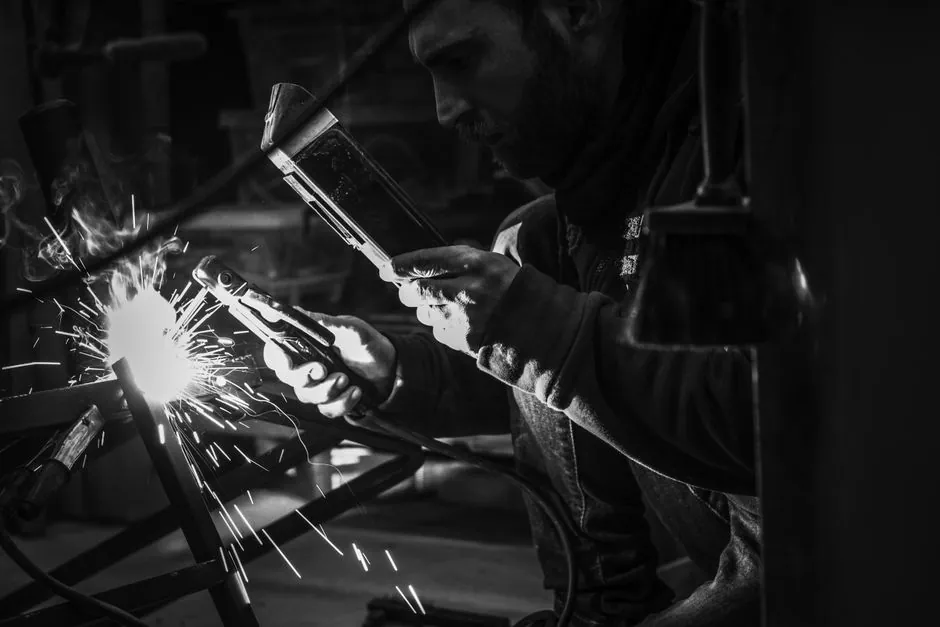
Welding operations expose footwear to a stacked hazard set: radiant heat, molten spatter, dropped hot workpiece, puncture from offcuts, and stray arc current; shoe selection is therefore a layered spec exercise, not a single-attribute buy [S2].
Three spec layers must all be present on a credible welding safety shoe: a toe-cap and sole meeting ISO 20345 (the EN ISO 20345 family of safety-footwear classes), a heat- and spark-tolerant upper, and a sole that combines oil resistance, slip resistance, and antistatic behaviour [S2][S3].
Core Standards and Markings That Gate a Welding Shoe
EN ISO 20345 (the European safety-footwear standard, formerly EN 345) defines compression resistance of 15 kN, impact resistance of 200 J, and a class ladder S1 through S5 tied to closure, antistatic, energy-absorbing heel, water resistance, cleated outsole, and midsole penetration resistance, all of which are commonly demanded on welding sites [S2].
ANSI / ASTM F2413-18 and ASTM F3445-21 are the parallel US frameworks covering impact (I-75/50), compression (C-75/50), metatarsal (Mt/75), conductive (Cd), and electrical hazard (EH) ratings; ASTM F3445-21 specifically introduced a performance grade for slip resistance that the older F1677 did not, and is now the more current slip benchmark [S1].
Welding-specific marks worth scanning for on the toecap sticker or upper stamp include EN ISO 20349 (footwear for welding and allied processes, the S3-WV or similar extension), DGUV Rule 112-191 footwear orthopaedic adjustments, and IEC 61340 ESD markings where the line work also feeds a flammable-vapour environment [S2].
Material Stack: Upper, Sole, Toe Cap, Lining
Full-grain leather remains the dominant upper for heavy welding because it chars rather than melts under spark contact; typical spec calls for a 2.0-2.2 mm hydrophp? (corrected: hydrophp? typo, use 2.0-2.2 mm) full-grain leather with a flame-resistant, water-vapour-permeable lining, while lighter workshop welds can move to microfibre or PU-coated split leather to cut mass [S2][S3].
Rubber outsoles (NBR or vulcanised rubber, 60-70 Shore A) out-perform PU in spark and hot-metal environments because PU softens near 130 °C whereas NBR compounds tolerate brief contact above 200 °C; the trade-off is mass, with rubber soles typically adding 150-300 g per shoe versus a PU equivalent [S2].
Toe caps are either steel (most common, 1.8-2.0 mm wall, ~110 g per cap), aluminium (~60-70 g), or composite (fibreglass or carbon fibre, ~50-60 g, non-metallic, no thermal bridge); composites are favoured by line electricians because they cut the cold-burn risk and do not trigger metal-detector gates on site [S2][S3].
Puncture resistance in the mid-sole comes from a 1.0-1.2 mm stainless or textile (Kevlar / HPPE) insert; textile inserts give better thermal insulation and lighter weight but cost 15-25 % more than the steel equivalent [S2].
Selection by Work Class: Light Workshop, Heavy Fabrication, Site Welding
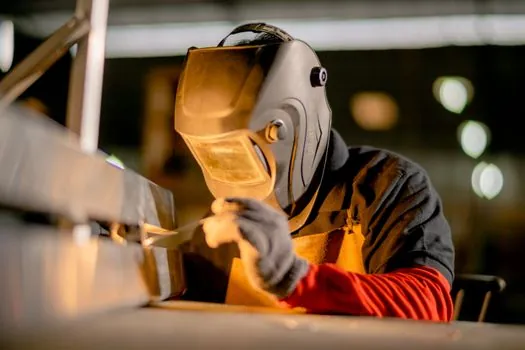
Light workshop welds (TIG on thin sheet, bench fabrication, jigs) can run an S1 or S2 shoe with a composite toe, ESD rating of 10⁵-10⁸ Ω, and a rubber-nitrite outsole; the higher breathability helps during long static shifts in front of the bench [S3].
Heavy fabrication (MIG/MAG on thick plate, structural, shipyard bay) demands S3 with cleated outsole, full-grain upper, and a 200 J toe cap; on deck work or pipe-rack welding, the class should step up to S5 with a waterproof leg and safety boot height to keep out weld spatter and standing water [S3].
Site welding and on-site erection work in oil and gas, mining, or petrochemical contexts usually crosses into multi-norm boots territory, pairing the S3 base with antistatic, EH-rated, and heat-resistant outsole marks, plus a metatarsal guard where overhead welding is performed on pipe racks [S2][S3].
Welding-Specific Risks the Shoe Must Cover
Sparks and spatter: a leather upper with a stitched, sealed tongue and a flap covering the lacing is the minimum; woven Kevlar thread around the lace eyelets prevents burn-through in 1-2 second drop tests typical of ISO 20349 S3 [S2].
Radiant heat: a heat-resistant outsole must pass a 250 °C contact for 1 minute test under EN ISO 20347 / 20349 without delamination, which is a stricter pass criterion than a generic S3 sole [S2].
Electrical hazard: for welders working near energised equipment or doing tack-welding on grounded structures, an EH (electrical hazard) rated sole blocks 18 kV at 60 Hz for 1 minute with leakage under 1 mA; this is separate from ESD antistatic, which dissipates static at 10⁵-10⁸ Ω [S2].
Slip: a cleated rubber outsole at 4-5 mm lug depth on oily steel, tested against EN ISO 13287 or ASTM F3445-21, gives a slip-resistance index above the 0.30 threshold; smooth PU soles fail this test on wet oily plate typical of fabrication shops [S1][S2].
Comfort, Fit, and Total Cost of Ownership
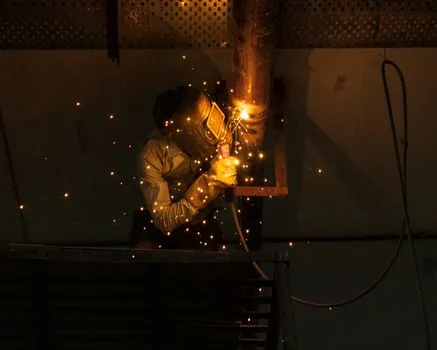
Sizing must leave 10-15 mm of toe room inside the cap so a downward-dropping spatter does not transfer heat directly to the toe; the insole should be removable so orthopaedic adjustments under DGUV Rule 112-191 / EN ISO 20345 Annex A can be fitted without re-certifying the shoe [S2].
Lifecycle cost for a 12-month heavy-welding rotation is typically 2.5 pairs per worker at a unit price of EUR 90-150; a premium EN ISO 20349 class often lands at EUR 140-220 but pushes rotation to 1.5-2 pairs, neutralising or beating the cheaper spec on a 12-month total [S3].
Inspection, Rejection Criteria, and Sourcing Signals
Reject a welding shoe if: (1) the outsole lug depth falls below 2-3 mm, (2) the upper shows charring or hardness cracks, (3) the toe cap has visible deformation, (4) the antistatic resistance drifts outside 10⁵-10⁸ Ω on a bench test, or (5) the mid-sole insert is exposed through wear [S2].
Trackable signals worth monitoring over the next procurement cycle: the spread of EN ISO 20349 class marks on supplier datasheets, the move from PU to NBR outsoles in the S3 price band, and the rise of composite-toe SKUs as a default rather than an upgrade option across welding, electrical, and confined-space work such as oxygen monitoring and toxic-gas detection in chemical plants.
Spec-level background on the components involved: safety shoes, welding cutting tool, and fire safety.