
Food processing lines push retaining rings into a hostile corner: hot washdowns, CIP chemicals (caustic, nitric, phosphoric), steam, and continuous moisture that drives galvanic and pitting corrosion on any unprotected ferrous part [S4].
For that environment the working baseline is a 302 or 316 stainless steel retaining ring in a passivated finish, sized to a clean machined groove on a 304/316 shaft or housing [S4][S5]. Standard sizes run from 1/4 in. to 16 in. (6 mm to 400 mm), so the food-machine envelope from small conveyor idlers up to mixer shafts is fully covered without custom tooling [S3].
Why carbon steel fails CIP and what to specify instead
Carbon spring steel retaining rings are rated to roughly 250°F and rely on an oil or phosphate finish for corrosion protection, which is not compatible with daily caustic washdown in a food plant [S4]. Once the phosphate or oil film is stripped, the ring flashes rust, sheds iron oxide into the product zone, and becomes a foreign-contamination finding in an audit [S4][S5].
302 stainless is the default food-service upgrade because it pairs general-purpose corrosion resistance with adequate spring strength and is non-magnetic in the annealed condition [S4][S5]. 316 stainless is the step-up grade for chloride-heavy zones (brine, salt rinses, cheese lines, seafood): its 2-3% molybdenum content lifts pitting resistance well above 302 in warm chloride solutions [S4][S5].
Most stainless retaining rings hold mechanical properties up to about 400°F, which covers saturated steam and most cook-in-kettle seals; if the application runs hotter, 17-7 PH stainless extends useful spring behaviour to roughly 650°F and is the typical elevated-temperature spec [S4].
Ring type vs. cleanability and thrust
For a food line the ring style is not just a strength choice, it is a hygiene choice: a lug, ear, or sharp edge is a place for product, biofilms, and cleaning chemistry to lodge. Basic external rings (with protruding lugs) and inverted rings are dimensionally interchangeable in the same groove but differ in how they shed water and how much shoulder they present [S1].
For most washdown stations a multiple-turn Spirolox-style flatwire ring, a constant-section snap ring, or a reinforced/heavy-duty ring gives higher groove engagement and 360° of retaining surface with no protruding ears to trap residue [S1][S3]. Light-duty single-turn rings (under one revolution) are acceptable only on small idlers, simple guides, and low-thrust positions where the hygienic risk is bounded [S3].
If a groove cannot be machined into a 304/316 shaft, the practical alternatives for food lines are limited: E-clips, C-clips, push-on retainers, and spiral rings all work without a groove, but they cap out at low to medium duty (under 50 lb light, 50-500 lb medium) and rely on friction or screw-on retention that is sensitive to surface finish and CIP chemistry [S5].
Groove and installation: the half designers skip
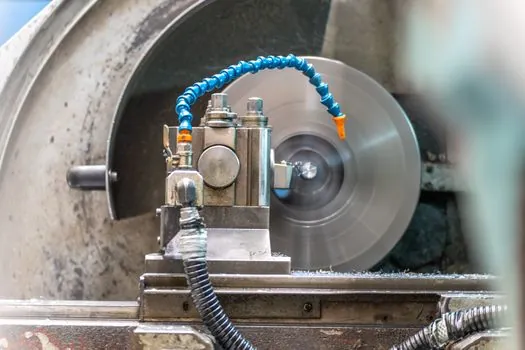
Groove walls must be parallel and perpendicular to the shaft axis, and groove depth plus bottom radii must land inside the ring maker's spec, because the depth and the groove bottom radii set the support the loaded groove wall actually delivers [S1]. Edge margin (the distance from the end of the shaft or housing to the groove) is calculated by the ring maker to keep the shaft from shearing under maximum load, so reusing a generic groove without checking the maker's table is the most common path to ring deflection failure [S1].
Retained part geometry matters as much as the groove: a part with sharp corners gives the ring full, even contact on its protruding portion, while a chamfered or radiused part contacts the ring only at the outer edge and creates a lever that deflects the ring under load, the textbook pre-failure pattern [S1]. In a washdown environment that deflection is also the start of a crevice where chemistry concentrates and pitting initiates.
For tool access on a sanitary line, internally retained rings need internal snap-ring pliers and externally retained rings need external pliers; for high-vibration conveyors, reinforced E-rings grip the groove bottom with 3-5 times the radial force of a standard E-ring, which is the spec to call out if the line runs cyclic loads from start/stop or reversing fillers [S1][S5].
Decision matrix: ring option vs. food-line criterion
Lining the main options against the criteria a food plant actually cares about gives a usable spec shortlist. Corrosion resistance in CIP favours 302/316 SS over carbon spring steel; cleanability favours multiple-turn or reinforced rings with no lugs over basic or inverted rings with protruding ears; thrust capacity favours heavy-duty or reinforced rings over single-turn and E-clip designs; and the ability to specify a stock size from 1/4 in. to 16 in. (6 mm to 400 mm) in stainless removes the need for a custom tool on most mixer, pump, and conveyor shafts [S3][S4][S5].
A practical selection rule: for any retained part that lives in a washdown zone, lives on a shaft under 3 in. diameter, and carries a real thrust load, specify a 302 or 316 stainless multiple-turn or constant-section retaining ring in a passivated finish, with groove machined to the ring maker's published diameter, width, depth, and edge-margin values; the only reason to step down to a carbon steel ring in a food plant is a dry zone behind a guard where the ring never sees water or chemistry [S1][S3][S4][S5].
Limits, failure modes, and where stainless is not enough
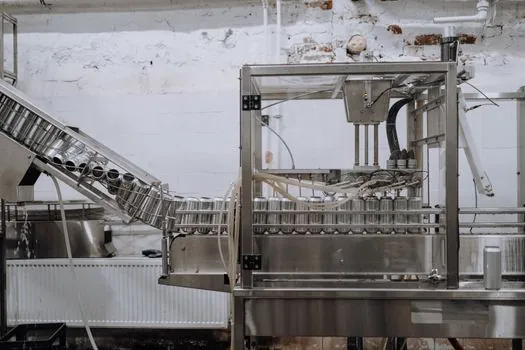
Stainless does not make a ring immortal: 302 SS will still pit in sustained chloride concentrations above its rating, and 316 SS loses margin above about 400°F in continuous service, so any high-temperature cook zone still needs 17-7 PH or a specialty alloy [S4]. Passivation is a finish, not a coating, and it is the difference between "stainless" and "stainless and clean" in a hygienic envelope; specifying 316 SS without specifying passivated finish is a common audit gap [S4][S5].
Ring failure in a food line almost always traces back to one of three things: a chamfered or radiused retained part that loads only the outer edge of the ring and drives deflection, an undersized edge margin that lets the shaft shear under cyclic CIP thermal cycling, or a carbon steel part that has been washed past its finish and is now bleeding iron into the product zone [S1]. A reinforced or heavy-duty ring is the documented fix for deflection and fatigue when geometry cannot be changed [S1].
For a deeper read on stainless spec rules in the same food envelope, see the food-grade shock absorber selection guide, which walks the matching washdown-and-316 logic for dampers. For retention on a related stainless-hygiene component, the shaft collar selection for food processing lines page covers the same 304/316 and finish discipline. For a retaining ring used outside the food envelope, where heat and scale dominate, see the retaining ring selection for steel mills reference; for a general primer on ring types and groove geometry, the retaining ring encyclopedia entry is the place to start.