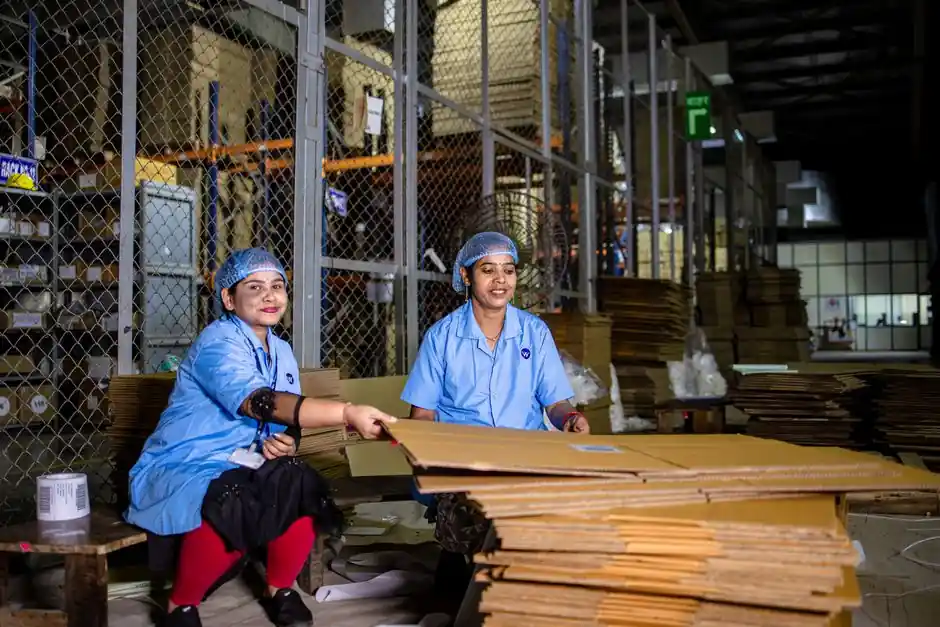
Packaging line shafts typically operate at 50-500 RPM with low to moderate thrust loads, making retaining rings a cost-effective alternative to threaded collars or set screws in many fitments and roller assemblies [S1][S2].
The selection path on a packaging line is narrower than in general machinery: most applications are either a shaft groove in a roll idler, a housing bore in a bearing pocket, or a self-locking ring on a small-diameter adjustment shaft 1 in. (25.4 mm) or under [S2][S8].
Packaging-Line Loads and Speeds Drive Ring Type
Axially-assembled rings transmit load around nearly the full groove circumference and are the right default for conveyor drive shafts, labeler cam followers, and filler turret indexing shafts where a defined thrust capacity is required [S2]. Radially-assembled rings rely on a smaller contact arc and accept less thrust, so they are reserved for light retention such as spacer location on idler rollers and small pulley take-ups [S2][S8].
For very low thrust applications, self-locking rings require no groove and are functional on shaft or housing diameters of 1 in. or less, which fits the cam, sensor, and encoder shafts scattered across a packaging line [S2]. Where end-play must be taken up to reduce chatter on a fast label applicator, bowed or beveled rings exert a continuous spring preload against the retained part [S2].
Internal vs External Groove in a Washdown Environment
Internal (housing) rings sit inside a bore groove and locate bearings, bushings, and seal carriers in gearbox housings and pump bodies; external (shaft) rings sit on the shaft OD and locate gears, sprockets, and rollers [S1][S2]. The choice is dictated purely by which face carries the thrust load in the assembly drawing.
In washdown and hygienic zones, an external ring on a motor output shaft often outperforms a set screw because the groove allows the shaft to be turned smooth for CIP spray contact, and the ring can be lifted off without a thread-cleaning step during disassembly [S4]. The Rotor Clip product range covers 1 mm to 1000 mm in inch, DIN, ANSI metric, and JIS standards with over 1000 part numbers and 50+ styles, which is the practical reason packaging OEMs standardize on one supplier across multiple machine platforms [S4].
Material Selection: Stainless, Carbon, and Specialty

Carbon spring steel (SAE 1070-1090) is the default for dry, indoor packaging equipment and gives the highest thrust capacity per dollar, but it will rust if exposed to condensation, bottle rinse water, or aggressive cleaners [S2]. 302/304 stainless retains the spring temper needed for groove snap-back and is the standard specification for washdown zones, outdoor conveyors, and any line exposed to food contact cleaners [S2][S4].
For specialized duty, 17-7 PH stainless covers elevated-temperature tunnels up to roughly 600 degF (315 degC) at the cost of more difficult forming, while beryllium copper and phosphor bronze are reserved for non-magnetic or electrical-contact grounding requirements [S2]. Plastic rings such as Delrin serve where the retained part (a coated roller, a polished sensor disc) must not be scratched; Thorlabs offers Delrin retaining rings specifically as the gentler-contact option for sensitive optical surfaces in the SM05 and SM1 thread families [S3].
Sizing to Shaft and Bore Standards
Retaining ring size is set by the shaft or housing diameter, and the part number is selected from the same standard as the rest of the line: inch (ANSI B27.7 / Whiteley), DIN 471 for external shafts, DIN 472 for internal bores, ANSI metric, or JIS [S2][S4][S8]. Mixing standards inside one machine is the single most common cause of a ring that fits the shaft but bottoms in the groove.
Manufacturers offering the full standard set simplify stocking: Rotor Clip produces a full line of inch, DIN, ANSI metric, and JIS retaining rings, which is why it is the single point of supply many packaging OEMs pull from [S4]. The constant-section (snap) and spiral (Spirolox) families cover most packaging-line groove geometries, with Smalley publishing a five-type white paper covering Single-Turn Spirolox, Multiple-Turn Spirolox, Constant Section (Snap), Hoopster, and WaveRing selections across light- to heavy-duty cases [S5].
Installation, Removal, and Maintenance Windows
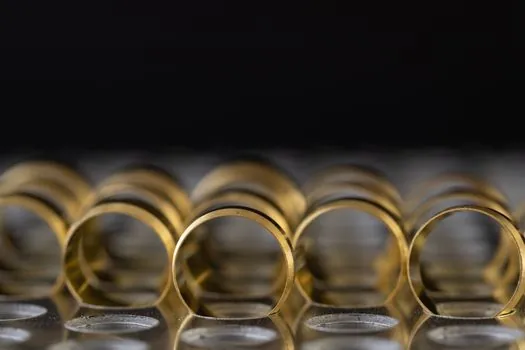
Axial rings carry lugs and lug holes that accept standard snap-ring pliers, so changeout on a packaging line is a 30-second job with a hand tool once the groove is exposed [S2]. Radially assembled rings are plier-installed along the radius of the bore and require tapered or specific radial pliers, which is worth specifying into the maintenance procedure to avoid field damage [S2].
Self-locking rings remove the groove-machining step entirely, which is a real win on small encoder and sensor shafts that already carry too many features; the trade-off is zero thrust capacity beyond the spring friction of the ring itself [S2]. Across all types, traceability back to the production lot is part of safety-critical documentation and is the third reason packaging OEMs consolidate vendors: lot traceability, certification paperwork, and on-time delivery are easier with one audited supplier [S4].
Comparison: Ring Types for Packaging-Line Use Cases
The decision matrix below matches ring geometry to the four selection criteria that matter on a packaging line: thrust capacity, diameter range, tooling requirement, and washdown suitability. [S4]
External shaft, axial (DIN 471) gives high thrust across 1-1000 mm diameters, uses standard axial pliers, and accepts stainless or carbon spring steel, making it the right call for conveyor drive shafts, filler turret shafts, and main labeler drive shafts [S1][S2][S4]. Internal housing, axial (DIN 472) gives the same thrust class for bearing pockets and seal carriers, requires the same axial pliers, and is the standard fit for motor housings and pump bodies inside the machine frame [S1][S2]. External shaft, radial gives lower thrust on small diameters below ~50 mm, needs radial pliers, and is the lighter option for idler rollers, spacer location, and small pulley take-ups [S2][S8]. Self-locking (no groove) gives minimal thrust on diameters of 1 in. (25.4 mm) or under, installs by hand or simple pliers, and is the right answer for sensor, encoder, and adjustment shafts where machining a groove is not practical [S2].
Failure Modes and Traceability Discipline
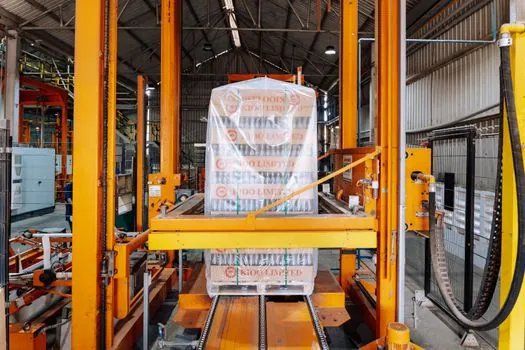
The three field failure modes seen in packaging-line retaining rings are ring pop-out from an undersized groove, groove-wall yield from an over-spec thrust load, and corrosion freeze on carbon steel in a washdown zone [S2][S8]. Each is preventable at the drawing stage: specify the ring standard, specify the groove width and depth against that standard, and specify the material against the cleaning chemistry.
For OEM builds, the supplier audit list is short: in-house metrology, vertical integration from wire rolling through heat treat, and certifications to IATF 16949, ISO 9001, ISO 14001, and AS9100, with documented lot traceability to the production batch [S4]. Custom geometry (round, oval, rectangular, square) in a specified material grade is available for non-standard packaging machine builds, which removes the temptation to machine a non-standard groove to fit a catalog part [S6].
Trackable next signals for spec writers are the groove standard revision (DIN 471 / 472) and the cleaner-chemistry compatibility list from the ring supplier, since both are the live variables that move a packaging-line retaining ring spec every 12-18 months. See the related write-up on shaft collars for packaging lines when the question is set-screw versus retaining-ring retention on the same shaft. For load and material trade-offs in a heavier industrial context, the retaining ring selection for mining article covers the high-thrust envelope that a packaging line never approaches.