Selecting the correct road roller class is a function of three independent variables: lift thickness after placement, material grain structure (cohesive clay vs granular aggregate vs bound asphalt), and target density expressed as a percentage of Proctor or Marshall reference.
Operating weight for ride-on rollers used on highway earthworks commonly spans 1.5 t for walk-behind units to 25 t for large single-drum compactors, with vibratory amplitude usually selectable in a 0.4 mm to 2.0 mm range across two settings [S1][S2].
Drum Configuration: Single-Drum vs Double-Drum vs Combination
Single-drum vibratory rollers carry the compaction energy in one steel drum plus pneumatic drive tyres, making them the default for embankment fill, sub-base, and granular layers above 300 mm loose lift [S1]. Double-drum tandem rollers apply vibration through both axles, producing flatter finished surfaces on bound layers between 40 mm and 150 mm compacted thickness. Combination rollers (steel front drum, pneumatic rear) bridge the two: the steel drum breaks down aggregate, while the rubber tyres knead the mat to close surface voids before final rolling.
Static three-wheel and tandem rollers without vibration are still specified where vibration could damage adjacent structures — bridge decks, utility trenches, and urban work within 30 m of heritage buildings [S2].
Static, Vibratory, and Oscillatory Compaction Modes
Vibratory energy is delivered at a fixed frequency (typically 30 Hz to 50 Hz) and a chosen amplitude; a higher amplitude at lower frequency drives deeper lifts, while lower amplitude at higher frequency suits thin asphalt layers. Oscillatory rollers replace vertical vibration with horizontal shearing motion, delivering comparable density at 5 dB to 10 dB lower noise and eliminating the risk of aggregate fracture in thin-lift asphalt — relevant on night-shift urban resurfacing. [S1]
Frequency is operator-selectable on most modern machines, with 67 Hz (4000 vpm) units now common for 25 mm to 50 mm asphalt lifts on motorways [S1].
Operating Weight, Amplitude, and Centrifugal Force Trade-Off

The dynamic force a vibratory roller applies is the product of eccentric mass, eccentricity, and angular velocity squared; doubling frequency from 30 Hz to 60 Hz roughly quadruples centrifugal force at the same amplitude. For a 12 t single-drum unit, nominal centrifugal force typically falls between 120 kN and 250 kN, with dual-amplitude or variable-amplitude drums available so the operator drops amplitude on rock fill to avoid crushing. [S1]
Manufacturers including Junma, Caterpillar, and Wirtgen list self-propelled single-drum and double-drum models in this weight class, with full hydraulic vibration drive as the default configuration [S1][S2].
Soil vs Asphalt: Matching Machine to Material
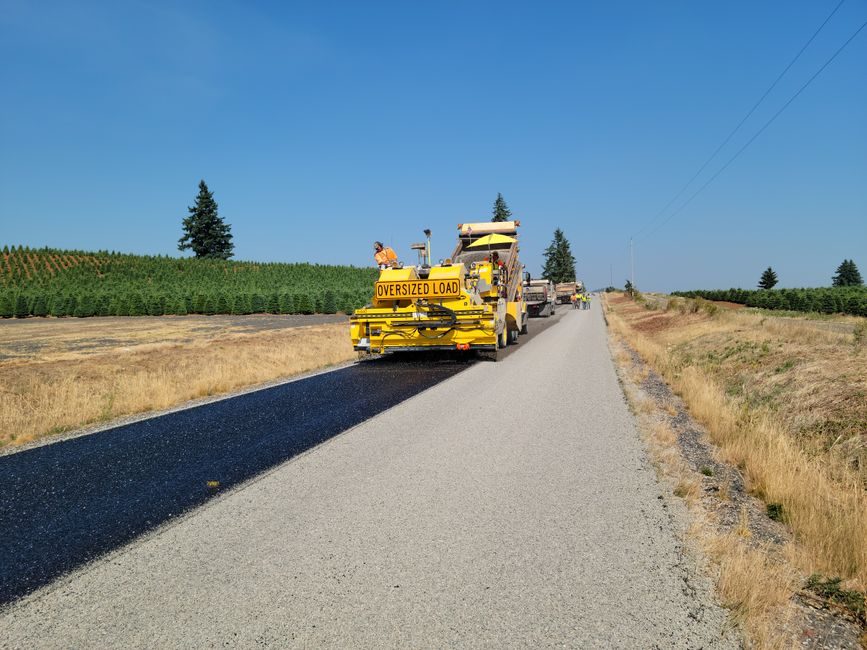
Cohesive soils (clay, silt) need higher amplitude at 28 Hz to 35 Hz to shear the layer; granular soils respond to higher frequency at lower amplitude because particle re-arrangement dominates over internal friction. For asphalt, a 9 t to 14 t tandem running at 50 Hz to 67 Hz in low amplitude delivers the 96% to 98% Marshall density spec on a 50 mm lift in four to six passes; pneumatic-tyre rollers between passes seal the mat against permeability. [S2]
Forestry motor grader selection covers an adjacent machine class with similar hydraulic-drive architecture but different blade and guarding specs.
Drive, Steering, and Gradeability
Full hydraulic vibratory rollers use hydrostatic travel drives with two speed ranges — typically 0 km/h to 6 km/h working and 0 km/h to 12 km/h roading — and articulated-frame steering giving ±35° oscillation and tight turning radii for shoulder work [S1]. Gradeability for a loaded 14 t single-drum unit sits around 55% to 60% with vibration engaged; switching vibration off raises that figure by 5 to 10 percentage points.
Diesel engine power is sized to 75 kW to 130 kW for the 12 t to 18 t class, with Stage V / EPA Tier 4f emissions aftertreatment now standard for units delivered into the EU and North America [S2].
Selection Criteria: A Side-by-Side View
Use this compact comparison to shortlist against your project envelope:
Single-drum vibratory (12 t to 25 t) — 120 kN to 350 kN centrifugal force, 1.0 mm to 2.0 mm dual amplitude, 30 Hz to 40 Hz — for embankment, sub-base, rockfill. Double-drum tandem (8 t to 14 t) — 60 kN to 130 kN per drum, 0.4 mm to 0.8 mm amplitude, 45 Hz to 67 Hz — for binder and wearing course asphalt. Pneumatic-tyre (10 t to 30 t) — 7 to 11 wheels, 30 t to 35 t wheel load with ballast, no vibration — for sealing, intermediate rolling, and chip-stone embedment. Static three-wheel (6 t to 12 t) — no vibration, narrow rolling width — for footpaths, trench reinstatement, and vibration-sensitive urban zones.
Cold chamber die casting machine selection for rail components covers another heavy-equipment class with comparable hydraulic and PLC architecture decisions.
Where Vibration Fails: Limitations and Failure Modes
Over-compaction of asphalt — typically beyond 8 to 10 passes on a 50 mm lift — fractures aggregate and drops air voids below the 3% minimum, inviting rutting. On saturated cohesive soils, vibration pumps water upward and softens the working platform; the operator must stop and let the layer dry or use static passes only. [S1]
Bridge abutment backfill within 1 m of wing walls is typically hand-compacted with walk-behind plates rather than ride-on rollers, to limit lateral stress on the structure [S2].
Standards, Testing, and In-Process QA
Compaction control on earthworks uses the nuclear density gauge or sand-replacement test referenced against the Proctor compaction curve; on asphalt, cores are extracted and compared to the job-mix Marshall or Gyratory reference. Roller-integrated compaction measurement (ICMV) systems now log stiffness in real time and flag under-compacted zones to the operator console, with GNSS-stamped records accepted on European motorway projects. [S3]
Trackable signals to watch: Stage V engine aftertreatment adoption among Chinese single-drum OEMs; widespread roll-out of GNSS-stamped ICMV on EU motorway lots; and continued displacement of static three-wheel machines by 3 t to 5 t articulated tandem rollers on urban street works through Q4 2026.
For the relevant spec sheets and selection criteria, see roller bearing, and roller chain.