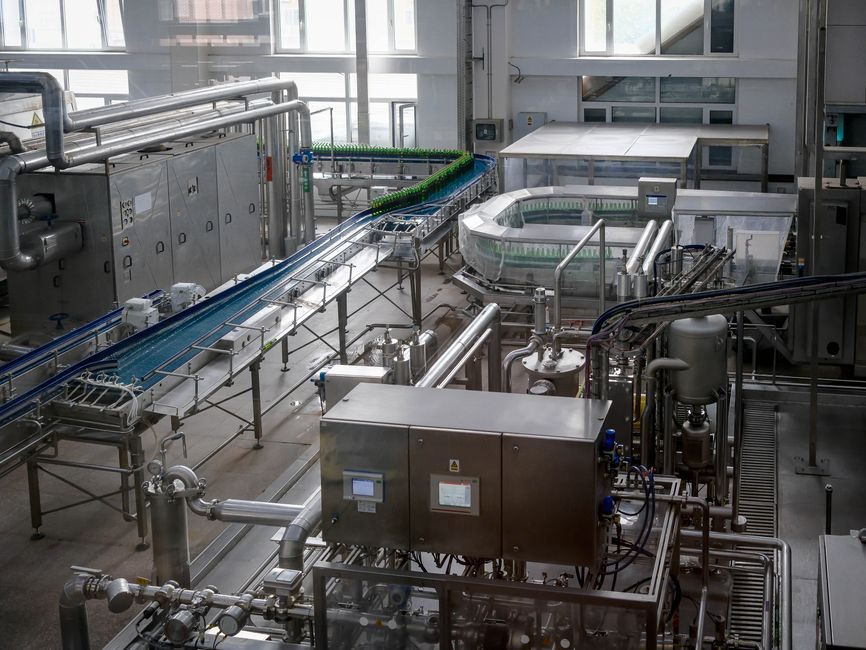
A robotic production line in 2026 is no longer scoped by the robot brochure but by a hard spec envelope: payload kg, reach mm, repeatability mm, degrees of freedom, and the offline-programming tool that proves the cycle time before a single foundation bolt is poured [S1]. ABB's RobotStudio runs on an exact copy of the real controller, so the same path, same I/O, and same event timing visible on the shop floor can be exercised on a desk PC [S1].
The reference architecture documented in the Springer 2021 case study couples a 4-DoF SCARA with a 5-DoF pick-and-place robot on a shared conveyor, validated through FEA for stress, strain, displacement, and buckling load before any prototype is built [S3]. That kinematic-and-FEA gate is the cheapest insurance a 2026 integrator can buy, and it scales to any of the molding line or automatic molding line cells that ride on the same dual-robot pattern.
Spec Envelope: Payload, Reach, Repeatability, DoF
The four numbers that gate any robotic cell are payload in kg, reach in mm, repeatability in mm (commonly ±0.02 to ±0.05 for industrial arms), and DoF count — and they are interdependent, not free variables. A 6-DoF arm trades reach and payload against each other; a 4-DoF SCARA like the one in the SASTRA study is faster on vertical pick-and-place but cannot reorient a part around an offset axis, which is why the case study pairs it with a 5-DoF pick-and-place for bolt-screwing [S3].
For 2026 line design, the budget rule is: lock repeatability first, then reach, then payload, then DoF. Repeatability below ±0.02 mm is reserved for electronics and medical assembly; ±0.05 mm covers most metal-forming, resin sand line demould, and palletising; ±0.1 mm is acceptable for packing and machine tending where upstream mechanical tolerances dominate. ABB's offline suite is built on the Virtual Controller, an exact replica of the production software, so the repeatability number validated in simulation is the same number the cell will hold on day one of production [S1].
Offline Programming as a Cycle-Time Gate
RobotStudio is described by ABB as the most used offline programming tool for robotics, and its value is that training, programming, and optimization happen on a PC without shutting down production [S1]. For 2026 builds, that means the cycle-time contract is signed in simulation, not on the integrator's bench.
The cloud extension is real: the SASTRA study explicitly frames the line as a candidate for cloud integration to improve performance parameters, with networked robots sharing trajectory data and vision feedback over IP [S3]. In practice this maps to OPC UA over TSN on the cell network, with the SCARA reporting torque, position, and I/O state to a line-level broker that the 5-DoF partner subscribes to. The minimum to spec isOPC UA companion spec for robotics, deterministic Ethernet, and a documented event model — not "Wi-Fi and a REST API."
Mechanical Validation Before Steel Is Cut
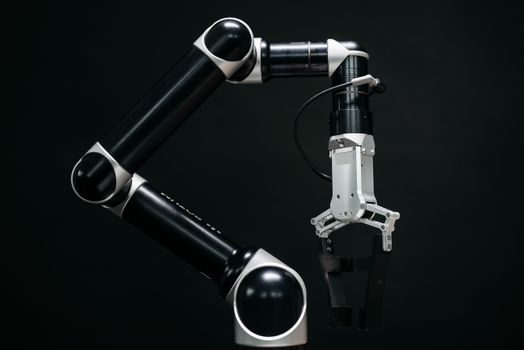
FEA on stress, strain, displacement, and buckling load is not optional paperwork; in the SASTRA reference line it was the gate that decided link cross-section, joint bearing size, and baseplate thickness before any aluminium was ordered [S3]. A link that survives 1.5× rated payload in simulation survives a 100% rated payload on the floor with the usual service-factor margin bolted on. The catch is that FEA is only as good as the load case: a pick-and-place arm sees shock loads at placement that are 2-3× the static payload, and a SCARA sees a peak torque at full horizontal extension that is invisible in a static load dump.
For a 2026 line build, the spec gate is a written FEA report with mesh density, boundary conditions, material grade, and a factor-of-safety table attached to the cell BoM — not a screenshot of a coloured stress plot. The same report feeds the lead screw installation guide check, because the linear axis that feeds the robots is itself a kinematic chain that has to land within the repeatability budget.
Comparing the Two Reference Architectures
The SASTRA reference line is a deliberate split: the 4-DoF SCARA handles the high-speed vertical approach to the bolt head, the 5-DoF pick-and-place handles the angled approach and the nut feed, and the conveyor paces the workpiece between them [S3]. On a side-by-side spec sheet the two are not interchangeable: the SCARA wins on cycle time and vertical stiffness, the 5-DoF arm wins on approach angle and part-orientation flexibility. The trade-off is footprint and cost, not capability.
A single 6-DoF arm can do the whole job, but its cycle time is longer because it has to swing through more joint space, and its controller has to coordinate a more complex path. A Cartesian gantry plus a SCARA is the third option: highest payload and largest working envelope, lowest dynamic performance, highest facility cost. The decision rule is to pick the architecture with the fewest DoF that still covers the approach-angle requirement, because every extra joint is an extra servo, an extra encoder, an extra failure mode, and an extra point in the FEA report. The v-process line cells that handle large flat castings, for example, almost always pick the gantry-plus-SCARA split because the part is too big for a single arm's reach.
Use Cases, Limits, and the 2026 Reality Check
The New Atlas robotics feed for 2026 is dominated by humanoid demos, but the production-line signal is narrower and more concrete: EngineAI's T800 is backed by 1-billion yuan in funding, carries modular batteries, and is scheduled for mass production in 2026 [S2]. Ubtech has launched what it calls the world's first mass-produced humanoid for the home, and the construction robot Charlotte is billed as autonomously building a 2,150-sq-ft home in a single day at roughly the speed of 100 bricklayers [S2]. These are deployment milestones, not production-line specs.
The honest limit for a 2026 integrator is that humanoids do not yet have a published repeatability, payload, or MTBF number that lets them drop into the spec envelope above. The cell that has to ship in Q4 2026 still has to be built on SCARA + articulated arm + conveyor, validated in RobotStudio, and stress-checked in FEA [S1][S3]. The humanoid is a 2027-to-2028 watch item, not a 2026 BoM line — see the broader robotics adoption spec gates for the plant-level view. The signal to track over the next two quarters is whether any humanoid OEM publishes a controller spec compatible with the Virtual Controller pattern, because that is the gate that lets a line designer drop the robot into the existing offline toolchain without rewriting the cell.