
Industry 4.0 — first framed at the 2013 Hannover Messe and now formalised across engineering curricula — defines the modern plant as a cyber-physical system in which industrial robots, IoT sensors, AI analytics, and cloud orchestration are coupled through a self-configuring control layer [S4][S6].
Robotics sits at the centre of that stack: a robot cell is no longer a standalone mechatronic island but a node that streams torque, current, and vision data into a digital twin, while accepting motion commands from a PLC over EtherCAT, PROFINET, or OPC UA Pub/Sub [S3][S4].
Where robotics actually sits inside the Industry 4.0 stack
Industry 4.0 implementation rests on a small set of converging building blocks: Cyber-Physical Systems (CPS), Industrial IoT, big-data analytics, AI, additive manufacturing, RFID-tracked logistics, and AR-assisted service [S1][S4]. Of those, industrial robots are the physical actuators that convert digital models into welded, painted, picked, or assembled parts, which is why robot density has become the headline metric for "smart factory" maturity [S1][S2].
The Chinese implementation, driven by the Made in China 2025 strategy, has produced the world's largest installed base of industrial robots and the highest annual vehicle production volume tied to robotic assembly lines [S1]. The Springer analysis also documents a steep upward trend in Industry 4.0 patent filings inside Chinese manufacturing over the last decade, which is consistent with the installed-base number [S1].
European and North American plants take a different cut: cobots (collaborative robots) replace fenced cells, and the value moves from raw throughput to flexibility — mixed-model assembly, short runs, and human-robot handover stations [S2]. Examples cited in the literature include the KUKA LBR iiwa torque-sensing arm and the Bosch APAS family, both engineered for safe torque control and power-and-force limiting around human workers [S2].
Spec-first selection map: what to gate before you sign the PO
Buying a "robot" without defining the control and safety envelope is the most common path to a stalled Industry 4.0 project; spec it as a system, not a manipulator. A defensible 2026 cell spec should fix at least four parameters up front, and here is the comparison engineers can lift directly into an RFQ: [S2]
Decision criterion 1 — Safety class: power-and-force-limiting cobot (ISO/TS 15066 collaborative operation) vs traditional industrial robot behind fencing (ISO 10218-1/2). Cobots cut floor space and guarding cost; fenced cells still win on cycle time, payload above ~35 kg, and any process that generates spatter or sharp debris.
Decision criterion 2 — Control interface: hard-wired I/O plus fieldbus (PROFINET, EtherCAT) vs ROS 2 / OPC UA Pub/Sub for cloud-side orchestration. Plants that already standardise on Siemens or Rockwell PLCs and want IIoT data into Azure/AWS typically specify OPC UA over TSN; greenfield MES-linked lines may justify a ROS 2 + DDS layer on top [S3][S4].
Decision criterion 3 — Data and analytics: bare controller vs controller with edge analytics (vibration FFT, current signature) feeding a predictive-maintenance model. The 2026 buying trend is the latter, because robot mean-time-between-failure is the hidden cost driver in a 24/7 cell; sensorless software options are now common on the major industrial lines [S2].
Decision criterion 4 — Integration with plant equipment: standalone robot vs integrated workcell that interlocks with a servo motor conveyor, flow meter on the process line, and pressure transmitter on the hydraulic or pneumatic supply. The Industry 4.0 promise only materialises when all of these publish live data to the same historian [S1][S4].
Reference control architecture and intelligent-paradigm layer
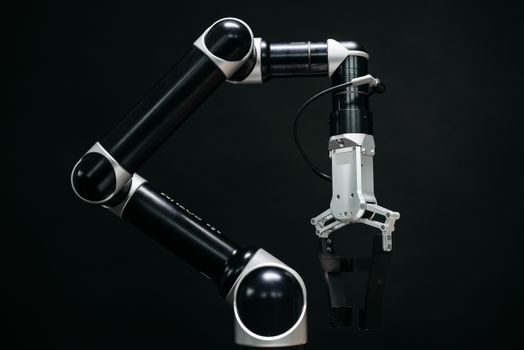
The Kravets volume on intelligent control paradigms formalises the Industry 4.0 robot stack as three nested layers: the field layer (drives, sensors, industrial valves and actuators), the control layer (PLC, robot controller, multi-agent coordination), and the cloud layer (analytics, digital twin, MES) [S3]. Multi-agent system theory is the academic frame for letting fleets of robots self-allocate tasks and self-recover from cell faults without supervisor intervention [S3].
Practical lessons published from real deployments highlight three pain points engineers should budget for: network jitter above ~1 ms breaks coordinated motion, brown-outs on the 24 VDC control bus corrupt teach-pendant firmware, and deep-learning vision models trained on one lighting fixture transfer poorly across plants [S3]. The remedy is the same in each case — keep the real-time loop on a deterministic fieldbus and push the learning layer off to the edge or cloud [S3][S4].
Who Industry 4.0 robotics is — and is not — for
It is for plants with at least 50 robots, mixed-model production, an MES in place, and a maintenance team that can read Python notebooks; under those conditions the capex premium of 15-30% over a conventional line is recovered in 24-36 months via OEE gains and predictive-maintenance savings [S1][S2].
It is not for low-mix, high-volume commodity lines where a hard-automated transfer line still beats a flexible robotic cell on cost per part, nor for job shops whose order book cannot sustain the integration engineering hours — typically 1500-3000 engineering hours per cell for a CPS-grade integration [S2][S3].
Standards, sourcing, and traceability
Specifying an Industry 4.0 robot cell without naming the relevant standards is malpractice. The minimum stack to cite in a 2026 RFQ is ISO 10218-1/2 for industrial robot safety, ISO/TS 15066 for collaborative operation, IEC 61131-3 for PLC programming, and OPC UA / IEC 62541 for the IIoT data spine; cybersecurity on the cell side typically references IEC 62443 [S3][S4].
Procurement teams should also require the controller's data dictionary in open format (OPC UA companion specifications or the vendor's published I4.0AS), because proprietary data silos are the single most common reason "Industry 4.0" pilots fail to scale [S3][S4]. Patents and academic references collected in the Karabegović work on Chinese robot implementation provide a reasonable proxy for which sub-technologies — RFID-tracked logistics, machine vision, and AI-based quality control — are reaching production maturity in mid-2026 [S1].
Plants that have already moved server-grade compute onto the shop floor for AI inference should cross-reference their cell spec against general-purpose IT infrastructure guides; the server hardware production line spec gates for 2026 build-outs piece maps similar power, thermal, and IEC 62368-1 considerations that apply to any on-prem edge node feeding a robot cell. Plants modernising arc-welding or paint cells should also review hazardous-area selection maps such as the flame detector vs gas detector spec-first selection map, because cobot welding brings a fresh detector-siting problem.
Trackable signals for the next planning cycle: IFR's annual World Robotics report on industrial robot density per 10,000 workers, the next ISO/TS 15066 revision cycle for collaborative robot limits, and the rollout cadence of OPC UA companion specifications for the major robot OEMs.