
Robotics production capacity planning maps to three nested layers — Resource Requirements Planning (RRP), Rough Cut Capacity Planning (RCCP), and Capacity Requirements Planning (CRP) — feeding off the Master Production Schedule (MPS) or Material Requirements Planning (MRP) run [S2].
For a robot assembly line, the same logic resolves into critical work centers (welding cells, paint booths, end-of-line test rigs), available hours per shift, and the question of whether the existing takt time supports the planned volume or whether additional PLC-controlled cells must be scheduled [S2].
Three Planning Layers vs Robot Cell Build-Out
RRP answers the long-range question: does the line need a new cell, a new building, or a third shift? Planning horizon runs 12 months to 3 years, product-family granularity, used to validate capital-expenditure allotments against the strategic business plan [S2]. For a robotics line, RRP would size the number of new servo motor-driven cells to be commissioned across 2026-2028 before any engineering kick-off is signed.
RCCP identifies capacity constraints at the critical work-center level — the bottleneck cell where queue time eats the available hours. RCCP runs against the master schedule and flags over- or under-utilized work centers, typically expressed as a utilization ratio against the planned shift hours [S2].
CRP is the closed-loop check: it matches available personnel and equipment hours to MRP-generated load, and tells planners to either revise the material plan or add resources [S2]. On a robot line CRP is where the industrial valve test cell or the harness-assembly cell either keeps its 7.5 hr/shift budget or gets re-allocated.
Capacity Planning Factors vs Robot Line Inputs
Hardware-side factors that swing a robot cell's required capacity: number of concurrent programs, SSL/OPC-UA traffic, network bandwidth to the cell controller, database load for traceability, and whether the line is clustered for migration failover [S1]. WebLogic-style capacity guidance notes that tunneling a stateful protocol over HTTP runs roughly 15% worse than native transport, a rule that translates directly to PROFINet vs OPC-UA-over-HTTPS paths on a robot cell network [S1].
Application-side factors on a robotics line: are the trajectories tuned (low-jitter motion profiles are the equivalent of "well-tuned WebLogic"), how many welds or picks must run in parallel, what fraction of the cell's cycle is spent in I/O wait versus servo motion, and whether the cell is a stand-alone station or part of a migrated cluster [S1]. The pressure sensor feedback loop on a hydraulic press cell, for instance, samples at a fixed rate that becomes a hard floor on cycle time.
For server-style reference data, the same Oracle capacity table factors in cluster configuration, server-migration support, RMI vs HTTP traffic mix, and concurrent session count [S1]. A robot line's analogue is the cell-controller cluster, the number of concurrent motion programs, the flow meter telemetry channels per cell, and the safety-rated I/O scan rate.
Decision Criteria: When to Add a Cell vs Add a Shift
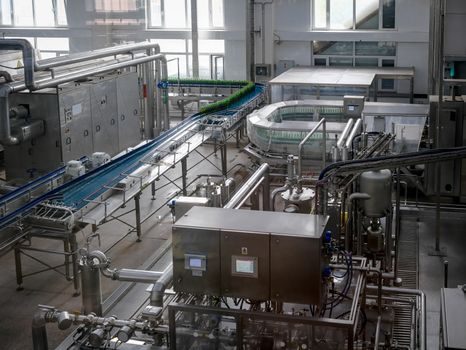
Manufacturing must first decide whether the production plan is supportable as-is, or whether additional future resources are required — additional skilled labor, new machinery, or new facilities / additional real estate [S2]. For a robotics cell, the equivalent fork is: add a second shift, add a robot, or build a new line in a new bay.
Comparison across the three options on a robot line: (1) Second shift — lowest capex, requires welders/operators trained to the cell's safety category, lead time 1-3 months; (2) New robot in existing cell — moderate capex for the manipulator and pressure transmitter fixtures, lead time 3-6 months for integration, no new floor space; (3) New line in a new bay — highest capex, lead time 9-18 months, requires RCCP-level re-planning of work-center hours [S2].
If capacity is insufficient, the planner must alter the plan (smooth the schedule, re-shelve low-priority SKUs) or alter the capacity (add shifts, add machines, add floor space) [S2]. On a robot line, altering the plan usually means re-sequencing the MPS; altering the capacity usually means a CAPEX request routed through RRP.
Use Cases: Where the Three-Layer Logic Applies
Long-range planning cases flagged by RRP: expanding existing facilities, acquiring new facilities, staffing loads, determining capital expenditures for equipment [S2]. On a robotics build-out, RRP answers: do we need a second 5000 m² bay by 2028 to hold 12 new welding cells?
Work-center-level cases flagged by RCCP: identify which critical work center — the painting cell, the EOL test rig, the assembly cell with six-axis arms — is the bottleneck at the planned takt time. RCCP is also where the planner sees whether a flow meter calibration cell is sitting at 35% utilization while a welding cell is at 110%.
Closed-loop cases handled by CRP: confirm that the personnel and equipment hours available match MRP load, or trigger a plan revision vs a resource increase [S2]. The CRP output — a per-work-center hours ledger — feeds the next MPS run and closes the planning loop.
Failure Modes and Sourcing

Common planning failure: treating demand forecast as the actual plan. The demand forecast is input for the plan, not the plan itself; RRP takes the forecast and converts it into time-and-resource estimates that the strategic plan can be validated against [S2]. On a robot line, conflating "we forecast 50,000 units next year" with "we will build 50,000 units next year" without RRP re-sizing is the most common source of over- or under-built capacity.
Data discipline: The Resource Requirements Planning program (P3380) generates a capacity plan by critical work center; current capacity and the requirements to support the planned workload are the two inputs that must be reconciled [S2]. A robot line needs the same two-input reconciliation per cell before any capex is committed.
Standards to anchor robot-cell capacity numbers: ISO 9283 for manipulator repeatability and pose accuracy, ISO 10218-1 for industrial robot safety requirements, and ISO/TS 15066 for collaborative robot spacing. Capacity numbers in hours/shift should be derived from measured cycle-time variance on the actual cell, not from catalog-rated takt. For related buyer-side spec context on robotics-adjacent hardware, see the CNC Controller Supply Chain 2026 breakdown and the Die casting die installation: field-grade steps for HPDC cells walkthrough, both of which apply the same RCCP/CRP discipline to robotic work cells.