
Robotics manufacturing quality standards are still being assembled piece by piece: a 2016 Shenzhen incident in which the service robot "Little Chubby" sent a bystander to hospital prompted the Shenzhen Institute of Advanced Technology's Fan Jianping to publicly state that "there are no specific regulations to tackle problems and hazards created by robots" [S1].
As of the 2026-07-27 reference window, the practical quality envelope for industrial robots rests on three pillars: collaborative-robot safety functions (ISO/TS 15066 power-and-force-limiting), repeatable end-of-arm positioning tolerance (commonly ±0.02 mm for SCARA-class assembly cells), and integration of vision systems for in-line quality control of the process stream rather than the air stream itself [S2][S3].
Why a single global robotics-manufacturing standard does not yet exist
The Chinese robotics industry scale in Shenzhen alone was projected to reach 30 to 50 billion RMB within the decade following the 2016 call for standards, which is why Fan framed the country as "still in an exploratory stage" without dedicated robotics safety regulation [S1]. Western buyers face a similar patchwork: ISO 10218-1/-2 covers industrial robot safety, ISO/TS 15066 fills the collaborative-robot gap, and ANSI/RIA R15.06 mirrors ISO 10218 in the U.S. — three documents, not one, govern a single cell. The absence of a single mandatory quality standard means most procurement specs are written as a stack of these documents plus integrator-defined acceptance tests. Buyers should treat the pressure transmitter ecosystem as a useful analogue: process instrumentation that touches people, fluids, and hazardous area classifications is governed by overlapping IEC, ATEX, and ASME codes, and robotics safety is converging on the same model rather than on a single document.
Spec envelope a process engineer should anchor on
Modern assembly-line robotics is defined less by a single "robot standard" than by four measurable spec bands. Reach: 500–1300 mm for bench-top cobots, 2000–3000 mm for full automotive cells [S2]. Repeatability: ±0.02 mm for SCARA and small six-axis assembly arms, ±0.05 mm for general-purpose six-axis, ±0.1 mm for heavy-payload (≥100 kg) units. Payload: 3–35 kg for cobot class, up to 800–1000 kg for body-in-white welding. Cycle time: 0.3–0.5 s for high-speed pick-and-place, 1.5–3 s for spot welds. Each of these bands drives a different test in the buyer's acceptance protocol, and the same logic of stacking measurable specs rather than trusting a single certificate is what makes flow meter procurement auditable on a process skid.
Cobots vs. industrial robots vs. mobile manipulators: who each is for
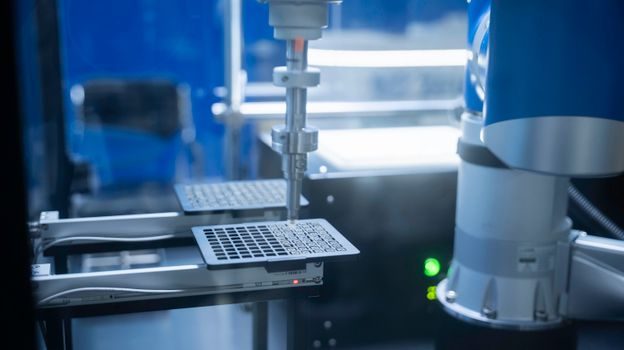
Collaborative robots (cobots) are designed to share workspace with humans and are governed by ISO/TS 15066 power-and-force-limiting values — typically ≤150 N quasi-static contact force on the hand [S2]. They fit SMEs and mixed-product cells where a single robot must be redeployed weekly. Traditional industrial robots run behind light curtains and interlocks per ISO 10218-1 and dominate high-throughput automotive and electronics lines. Mobile manipulators such as PAL Robotics' TIAGo and TIAGo Pro combine an omnidirectional base with a six-axis arm and are aimed at intralogistics, RFID stock-counting, and research cells where the robot must traverse a plant floor rather than sit in a fenced cell [S3]. For buyers, the same selection logic used to pick an industrial valve — duty, fluid media, actuation, certification stack — applies: define the operating envelope first, then pick the standard family that audits it.
Quality control and the vision-sensor stack
Robotic quality control is no longer a downstream gate; it is integrated into the same cycle that performs the work. The modern assembly cell layers 2D and 3D vision for part localisation, torque/force feedback for insertion verification, and inline traceability scans at the end-of-arm tool. This is consistent with the AZoRobotics framing that assembly robots "are integrated with other manufacturing technologies, such as conveyor systems and quality control mechanisms, to create seamless production processes" [S2]. PAL Robotics similarly groups material handling, equipment-monitoring patrolling, and RFID-based stock verification under one additive manufacturing material-adjacent digital thread for the cell [S3]. Buyers should write the acceptance protocol around three measurable outcomes: defect escape rate (ppm), first-pass yield, and mean time between false rejects — not around a generic "robot is accurate" claim.
Workforce, integrators, and the missing QA layer
The U.S. robotics-manufacturing workforce picture as of 2026-07-26 emphasises that "most jobs don't require a bachelor's degree" and that thousands of openings span technicians, specialists, and integrators [S4]. That pipeline is the soft layer behind the hard spec layer: without certified integrators who can sign off on a risk assessment per ISO 12100 and ISO 10218, the same hardware that passes factory acceptance can fail site acceptance. A second related procurement lens, server hardware for Industry 4.0 (Server Hardware for Industry 4.0: 2026 Spec Map), shares the same risk: a capable PLC, vision server, or robot controller is only as good as the integrator who validates it. Buyers who separate the hardware spec from the integrator-qualification spec tend to absorb the cost in field failures.
Verifiable next nodes and trackable signals
Two signals are worth tracking. First, watch for revisions to ISO/TS 15066 collaborative-robot threshold values and to ISO 10218-1/-2 — these are the documents procurement specs cite most often, and any tightening of contact-force or speed-and-separation values will ripple into every cobot cell. Second, watch whether Chinese national robotics standards catch up to the Shenzhen roadmap that Fan Jianping outlined in 2016 [S1]; a published GB standard for service-robot safety would be the first concrete data point that the "exploratory stage" framing has ended. For a parallel buyer reference, the same cost-driver thinking behind Die Casting Die TCO: Cost Driver Stack, Hidden Levers, and 10-Year Buy Math applies: a robot cell's 10-year TCO is dominated by integration hours, safety retrofits, and vision upgrades rather than the arm's sticker price.