
Robotic welding and machine-tending cell investment in 2026 spans a broad engineering range: the global robotic welding cell market is valued at USD 4.35 billion in 2026 and is projected to reach USD 7.08 billion by 2030 at a 12.9% CAGR [S7].
The market covers collaborative robotic welders, fenced industrial welding cells and machine-tending systems for automated part handling, with system prices ranging from $85,000 to more than $350,000 for common configurations [S3].
Market Size and Adoption Drivers
The wider robotic welding market was valued at approximately USD 7.2 billion in 2025, with a projection to USD 11.8 billion by 2030 and CAGR above 10% [S2]. A separate market estimate placed the 2025 robotic welding market at USD 8–10 billion and projected approximately USD 22–26 billion over its forecast horizon [S4].
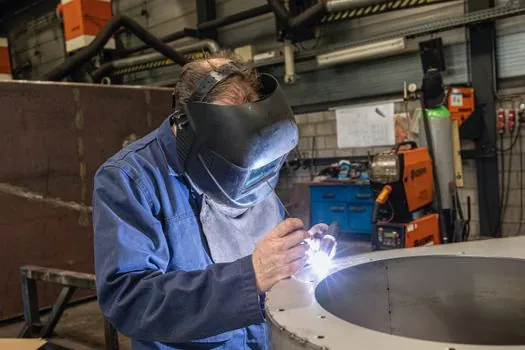
Robotic welding uses programmable industrial robots with welding torches for arc, spot and laser welding, delivering 30–50% higher throughput, defect rates below 1% in properly calibrated systems and typical payback within 12–24 months compared with manual welding [S2]. The American Welding Society estimate cited in the same guide places the United States welder deficit at more than 360,000 by 2027 [S2].
Welding and Machine-Tending Cell Configurations
Robotic arc-welding systems divide into collaborative and conventional industrial configurations [S5]. Collaborative systems use power- and force-limited arms, welding power sources and torches on carts or pallets, with hand-guided teaching; conventional cells combine industrial arms, positioners and fixed safeguarding for production volume [S5].
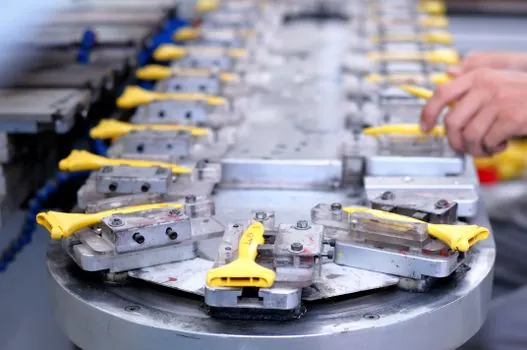
The standard configuration includes the robot, welding power source, weld package, safety guarding and interlocks, engineered fixturing, programming, path development and weld-parameter tuning [S3]. A machine-tending cell adds the robotic transfer interface, but the package still has to include guarding, interlocks, fixturing and programming rather than treating the arm as a stand-alone product [S3][S8].
Vention’s Click & Customize approach offered six starter designs for building welding and machine-tending work cells, with the objective of faster deployment for job shops [S6]. This modular route is relevant where geometry and guarding are already defined; a custom engineered cell offers more control where part access, fixture complexity or weld geometry requires a dedicated layout [S3].
Process Selection and Performance Limits
Cost, Throughput and Integration Risk
Robotic welding systems typically cost $85,000 to $350,000+, depending on whether you choose a pre-engineered cell or a custom-engineered solution [S3]. The biggest cost drivers are robot size, tooling, fixturing, weld-process requirements and part presentation [S3].
A cell’s quoted price is therefore not comparable until the robot, welder, tooling, fixture, process development and safety scope are aligned [S3][S8].
Turnkey automation should be assessed on production fit and implementation risk rather than purchase price alone, because integration extends beyond the robot and welder [S8]. For high-volume production with repeatable geometry, a conventional industrial cell provides fixed safeguarding and repeatable motion; for lower-volume or variable parts, a collaborative system can reduce installation space and simplify hand-guided programming [S5].
Fit-Up Variation, Vision and Adaptive Control
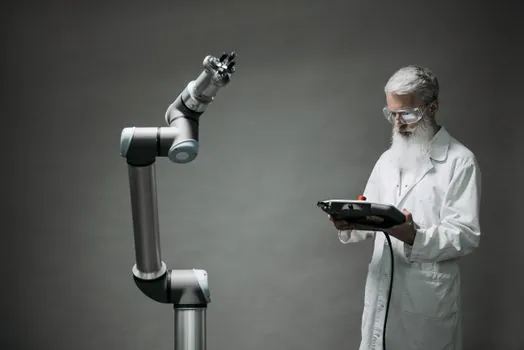
Machine vision and adaptive control are being added so robots can weld parts that do not repeat in exactly the same position [S5]. Lincoln Electric, Miller, Novarc and Path Robotics announced or expanded adaptive systems during 2026, but product availability and order status must be confirmed before comparing specifications [S5].
Path Robotics markets an intelligent welding cell under a subscription model for large, variable weldments, while Novarc’s spool-welding robot targets pipe and pressure vessels [S5]. NovAI software runs on ABB and Yaskawa robots and within Miller’s Copilot Builder with Blue iQ, showing that the control layer can span multiple arm platforms rather than being confined to one robot model [S5].
Adaptive control does not remove fixture design, process qualification or weld-quality requirements. Inspection, traceability and consistent penetration remain production requirements for automotive OEMs, pressure-vessel manufacturers and structural-steel fabricators [S2]. A machine-tending arrangement adds another failure mode: transfer alignment, gripper repeatability and fixture location must remain stable enough for the welding program to achieve the intended joint path [S3].
Safety, Standards and Supplier Evaluation
ANSI/A3 R15.06-2025 and AWS D16.1M/D16.1:2026 were used as consensus references in an October 2026 comparison of robotic arc-welding systems, while OSHA welding requirements in 29 CFR 1910 Subpart Q govern the installed application [S5]. Collaboration is treated as a property of the application and its risk assessment, not merely the robot arm [S5].
The quoted installation sequence for the safety standard requires project-specific verification: Yaskawa recommends the 2012 edition for existing systems and systems being designed or built, and the 2025 edition for systems installed after March 31, 2027 [S5]. Arc, spatter and fume remain hazards in collaborative welding, and power- and force-limited equipment does not by itself establish that full perimeter fencing is unnecessary [S5].
Supplier evaluation must cover what ships in the cell, including the arm, power source, wire feeder, torch, table and safeguarding, as well as programming method, supported materials and processes, fit-up handling, fume extraction, warranty and service [S5]. Buyer comparisons should also establish whether vision, adaptive control and software are available, supported and commercially orderable rather than treating announced features as equivalent to production deployment [S5].
Decision Criteria by Production Model
Conventional fenced cells fit repeatable, high-volume weldments when cycle time, fixed positioning and guarding justify a $200,000–$350,000+ custom configuration [S3][S5]. Pre-engineered cells suit constrained budgets, standard part sizes and straightforward weld access, with typical investment of $85,000–$180,000 [S3].
Collaborative cells fit short-run fabrication, low-volume production and applications where hand-guided teaching and reduced physical footprint outweigh the lower throughput of a conventional production cell [S5]. They are not the default for every variable-part task because vision, adaptive control, part presentation and cycle time still determine output [S5].
Machine tending is suitable when repeat loading, unloading or machine attendance creates a stable automation case and the workpiece can be presented reliably [S6]. It is a poor fit when parts vary beyond the fixture and sensor architecture’s repeatable envelope, or when downstream equipment synchronization remains undefined [S8]. The governing calculation is total cost per qualified part, not robot price, cycle time or utilization in isolation [S3][S8].
The trackable signals for buyer qualification are orderable configuration evidence, installed-cell validation of defect rate and cycle time, and confirmed production support for any announced adaptive-control feature [S5]. Vendors should also provide a complete bill of materials covering the robot, power source, wire feeder, torch, fixture, positioner, guarding, interlocks, programming and fume extraction [S3][S5].