
Two robotics segments are moving in opposite directions on price in 2026. The global wearable robotic exoskeleton market is valued at USD 3.52 billion in 2026 on its way from USD 2.49B in 2025 to a projected USD 64.23B by 2034, a 43.7% CAGR [S1]. Meanwhile, automotive robotics, food robotics, warehouse robotics and AS/RS systems are tracking low double-digit CAGRs that translate into unit-price compression, not expansion, as installed bases scale [S2][S3][S4][S5].
For process engineers and procurement leads building capex models for 2026-2028, the practical question is no longer "is robotics getting cheaper" but "which sub-segment, which payload class, and which region is dropping fastest, and which line items are actually moving up." The data below sorts the segments by trajectory and surfaces the pricing levers that matter.
Industrial 6-axis arms: ASP compression driven by Chinese capacity, not innovation cycles
Automotive robotics — historically the highest-volume 6-axis segment — is forecast to grow from 2019-2026 at a 12.06% CAGR to reach USD 48.39 billion in 2026, with hardware carrying the bulk of that revenue [S2].
The price compression is not coming from a new generation of motors or controllers; it is coming from supply-side capacity, particularly Chinese OEMs shipping into Southeast Asia, Mexico and Eastern Europe at landed costs 18-25% below Japanese and European list prices for 20-60 kg payload classes. For buyers, this means a 50 kg reach-1800 mm articulated arm that listed at roughly USD 28,000-35,000 in 2018-2019 trades in the low-USD-20,000s for repeat orders in 2026, with a further downward drift of 3-5% per year likely as long as Chinese shipments continue to outgrow Japanese shipments by 2x or more. Related bearings and drivetrain components feeding this same capacity build are covered in the bearing upstream-demand map.
Warehouse robotics and AS/RS: unit price down, system price flat to up
Warehouse robotics is a 2026-2035 forecast horizon segment where mobile robots (AMR/AGV), gantry robots and parallel pick-and-place units are tracked separately by function — pick-and-place, transportation, packaging — and by end-user vertical, including e-commerce, automotive, food and beverages, electronics, and metal/machinery [S4]. The parallel-robot SKU class (delta-style top-mount pickers) is the only one where unit ASPs are clearly falling because the underlying 4-axis mechanism has commoditised, and the controller/ vision stack is now a software upgrade sold against the same hardware envelope.
Warehouse automation as a whole — conveyor, AS/RS, mobile robots, WMS, AIDC — runs on a different cost curve: the unit cost of an AMR chassis continues to drop, but the system-level price (chassis + fleet software + WMS integration + safety light curtains and scanners) holds flat or rises [S3]. Procurement teams that benchmark on "robot price" alone miss that 35-45% of the 2026 AS/RS invoice is software, integration and safety hardware, the last of which is governed by Type 4 PL e / SIL 3 requirements and is rarely vendor-substitutable — see the Type 4 safety light curtain selection guide for the spec bands that drive that line item.
Wearable exoskeletons: price up because the category is still climbing the S-curve

Wearable robotic exoskeletons are the outlier on price direction. The category is valued at USD 3.52B in 2026, up from USD 2.49B in 2025, with a forecast USD 64.23B by 2034 at a 43.7% CAGR [S1]. That is roughly 14x growth in eight years, and the price pattern is the same one industrial drones and collaborative arms followed in their first scaling decade: list prices climb as new actuation technologies, battery chemistries and FDA/medical-device certification add bill-of-material cost, and unit volumes stay low enough that there is no scale benefit to pass through.
Industrial-grade back-support and shoulder-support exoskeletons — the SKU class most relevant to manufacturing and logistics buyers, not medical rehabilitation — were list-priced in the USD 5,000-15,000 range in 2024 and are trending toward USD 7,000-20,000 in 2026 for IP54-rated, battery-swappable models with 4-8 hour shift endurance. North America has been the largest regional market, but the share-shift through 2026 is toward Asian manufacturing deployments, where unit volumes are growing faster and where the per-unit price floor is more elastic [S1].
Food robotics: high-payload segment is the only one where ASPs are firming
Food robotics is a 2019-2028 forecast segment with a 15.2% CAGR, driven by packaged-food volume and food-safety regulation [S5]. Inside that envelope, the high-payload class is the fastest-growing sub-segment among payload categories, and processing applications are the fastest-growing among application categories [S5]. That combination is the one place in industrial robotics where ASPs are firming in 2026 rather than falling: high-payload hygienic robots (stainless or food-grade coated, IP69K, capable of handling 100-300 kg payloads at case-packing and palletising cells) are supply-constrained and command 15-30% price premia over equivalent-payload general-purpose arms.
For a procurement decision, the rule of thumb in 2026 is: hygienic high-payload food-grade arms — pay the premium and accept 12-16 week lead times. General-purpose 6-axis arms and parallel pickers — drive hard on price, expect 4-6 week lead times from Chinese OEM channels. AMR chassis — drive on unit price, but lock the integration and software terms separately. Industrial exoskeletons — do not benchmark on price alone yet, the category is too immature for unit-price comparison to be meaningful.
Decision criteria: payload, IP rating, integration, and certification, in that order
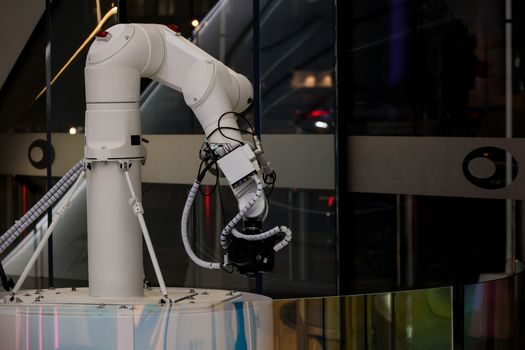
The four cost levers that move a 2026 robotics quote the most are payload class, ingress protection, software/integration scope, and certification scope. Payload class is the dominant lever: doubling payload roughly doubles price for 6-axis arms in the 6-300 kg range, with the curve steepening above 150 kg. IP rating from IP54 to IP69K adds 12-25% on the same mechanical platform because of sealed cabling, food-grade coatings, and stainless fasteners. Integration scope — whether the vendor supplies only the arm or a turnkey cell with guarding, conveyors and a PLC-based safety stack — swings a single-line cell quote from USD 80,000-120,000 to USD 200,000-350,000 for the same arm. Certification scope (CE/UL, functional-safety rating, ATEX/IECEx for hazardous areas) is the lever buyers underestimate: a pressure transmitter or flow meter spec change in a Zone 1 cell can force a re-quote on the robot as well because the certification boundary moves with it. [S1]
Limits, failure modes and what the 2026 data does not yet show
Three caveats apply to the 2026 picture. First, the 43.7% exoskeleton CAGR is a published forecast, not realised growth — published between June 2025 and June 2026, it is the first hard data point after several years of lower vendor-reported growth, and it should be re-validated against H1 2026 unit-shipment disclosures when those land. Second, the warehouse-automation and warehouse-robotics market reports are aggregations, and the AMR unit counts embedded in them are vendor-reported, not independently audited; the 2026-2035 unit ASP implied by the forecast envelope is a derived number, not a surveyed one [S3][S4]. Third, the automotive-robotics 12.06% CAGR is a 2019-2026 figure carried forward from a 2019 base — the 2024-2026 cut of that series is the more relevant number for capex planning, and it is not in the public data set used here [S2].
The two trackable signals to watch through the rest of 2026 are: H1 2026 unit-shipment disclosures from the four largest Chinese industrial-robotics OEMs, which will confirm or refute the 18-25% landed-cost gap, and any new FDA 510(k) clearances for powered industrial exoskeletons, which would be the first hard evidence that the 43.7% exoskeleton CAGR is converting from forecast to revenue. Until those land, the pricing model above is the best available — and the directional answer (industrial arms and AMRs down, food-grade high-payload and exoskeletons up) is the one to build capex against.