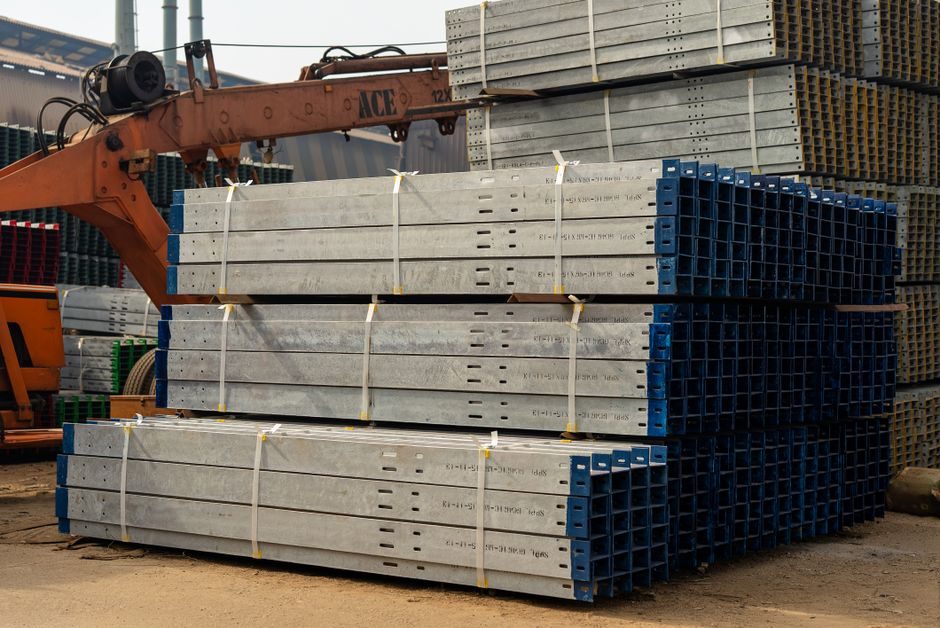
Roll formed profile pricing in 2026 is set by four variable levers — coil substrate grade, line speed class, thickness/wall tolerance band, and tool-change amortisation — plus the volume of the production run [S1][S2][S3]. Indicative list pricing on DirectIndustry is pre-tax, excludes delivery, customs duties and commissioning, and is published as a "Get a price/quote" entry point rather than a fixed number, since mill surcharges and FX swing the same part 5-15% inside a quarter [S1].
Specifiers reading this guide should be ready to quote coil grade (DX51, 304/316 stainless, 1050 galvanised), thickness in 0.1 mm steps, profile section, annual volume and tolerance class (typically ±0.1 mm to ±0.5 mm on light-gauge lines) before any vendor will release a binding number [S1][S2][S4]. The data below is drawn from manufacturer catalogues, OEM line specifications and a UK roll-former with 25+ years of stocked and bespoke output published 2026-07-11 [S7].
Cost drivers in a roll formed profile quote
Coil substrate and thickness dominate the per-metre cost. The DREISTERN P3 thick-walled line is engineered for heavy gauges, while the DALLAN A3 entry-level line accepts 0.4-1.5 mm coil at 150-600 mm strip width — a thinner gauge that lowers per-kilogram price but demands tighter strip-width control [S2][S3]. DIMECO's profile roll forming line feeds 3 mm and 4 mm (0.1 in / 0.2 in) thick coil at up to 25 m/min, about 12 t/h throughput, into a 2- or 3-wave guardrail section [S1].
Tooling amortisation is the second lever: DREISTERN markets "fast tool change" as a competitive advantage on the P3, meaning short setup cells recover tool cost across more metres per shift [S3]. The D. Friedrich stainless/aluminium pedestal profile unit is sold on "quick roll-forming head change" plus stepless height adjustment and two-hand / pedal / proximity switch start options — features that cut changeover labour rather than per-part material [S4].
Run length and changeover frequency are the third lever. Roll forming is a continuous process designed for large batch sizes, and the economic threshold for changeover reduction is set by the time to neutralise process-inherent residual stresses once the tooling is set [S10].
Line-speed classes and what they cost per metre
Light-gauge plasterboard and drywall lines cluster at 30 m/min for entry units (DALLAN D4) and up to 120 m/min for the D4V82 high-speed variant, a 4× speed spread that maps to roughly 3-4× throughput per shift at comparable scrap rates [S2]. The D. Friedrich pedestal unit is sold as heavy-duty / rugged with reduced vibrations and low resilience — engineering language that signals thicker frame, larger drives, and a higher capital cost than a comparable 30 m/min A3 line [S2][S4].
Thick-walled and structural lines sit in a different speed band. The DIMECO highway-guardrail line at 25 m/min and ~12 t/h is throughput-limited by 3-4 mm coil weight, not by forming dynamics, and pairs roll forming with a 120 strokes/min Servoflexipress® CNC servo press for in-line punching [S1]. For a specifier, the practical translation is: light-gauge lines win on metres per minute, thick-walled lines win on tonnes per hour.
For cost-per-part modelling, use these as order-of-magnitude throughput references: 30 m/min (DALLAN D4 base), 120 m/min (DALLAN D4V82 plasterboard high-speed), 25 m/min ≈ 12 t/h (DIMECO guardrail), with DREISTERN P3 and Friedrich pedestal lines sized for thick-walled and stainless/aluminium custom work respectively [S1][S2][S3][S4].
Material options and per-kilogram price spread

Superior Sections, a UK roll former with 25+ years' experience, ships stocked product plus bespoke profiles across PVC-U window and door reinforcement, drywall and MF ceilings, Superior Framing Systems, 25/14 brick-tie channel, and unstated bespoke sections [S7]. Johnson Bros. Roll Forming lists the section taxonomy buyers actually spec — U-channel, C-channel, hat channel, box channel, Z-channel, equal/unequal angles, mouldings, tracks, frames, slides, flashings, panels, purlins, strips, slats, louvers, clamps, rings, rims, tubing (open seam, lock seam, split seam), wireways, cable trays, bus duct, bus bars, roof bows, scuffliners, reinforcements, stiffeners, supports — across ferrous, non-ferrous, prefinished, plain and stainless feedstock [S6].
Material spread is the largest single variable in a quote. Aluminium 5052/6063 typically prices between galvanised steel and 304 stainless, with the trade-off that it forms more easily but marks visibly [S2][S4][S6].
The D. Friedrich unit is explicitly engineered for stainless and aluminium profiles, with pressure rolls that can be set vertically, horizontally, or at a defined angle to the vertical axis — geometry you pay for when the section is asymmetric or when springback control matters on a 304/316 coil [S4].
Tolerance, tooling and the premium for tighter bands
Tolerance class is where the price spread opens up inside the same material. A standard ±0.3 mm width tolerance on a light-gauge line is achievable on most roll tooling; ±0.1 mm requires a rigid stand setup, premium tool steel (D2/SKD11 class) and a controlled unwind, which adds 15-30% to per-metre cost versus the standard band [S1][S2]. DIMECO's 12-station roll former plus flying shear holds 3-4 mm coil within the guardrail profile envelope at 25 m/min — a tolerance window that is set by the section geometry, not by the press [S1].
End flare is the residual-stress defect that defines the lower bound of achievable tolerance on roll formed profiles. The mechanism is documented in the *International Journal of Material Forming*: profile defects caused by the release of process-inherent residual stresses during setup limit how short a batch can be run economically, and reducing that defect requires controlled roller geometry and a deliberate stress-relief pass [S10]. Buyers who demand the tightest tolerance should accept a longer setup cycle and a higher per-part tooling allocation in the quote [S10].
The DREISTERN P3 sells compatibility — the same machine components can be carried across different ages and sizes of P3 hardware — which protects the tooling asset and reduces the premium a buyer pays on a second or third profile introduced on the same line [S3].
Bespoke versus stocked profile economics
Stocked profiles are the price floor. Superior Sections lists core-range channels and sections as "stocked and ready to go", with dependable delivery on schedule, which removes tooling amortisation from the buyer's per-metre cost and replaces it with a mill-order quantity surcharge [S7].
Bespoke profiles carry one-time tooling cost amortised over the buyer's annual volume, plus the OEM's minimum order quantity. For UK window-reinforcement, drywall/MF ceiling, SFS framing, and 25/14 brick-tie channels, the same OEM offers a single supply relationship — useful when a project mixes stocked and bespoke sections, because freight and admin overhead stay constant [S7].
Johnson Bros. ships roll formed metal parts in both small custom runs and high-volume production, covering the open-seam, lock-seam and split-seam tubing variants that show up in HVAC, bus-duct and cable-tray applications [S6]. For a specifier, the practical question is not "bespoke vs stocked" but "does the section already exist as a stocked SKU at one of the established roll formers?" — if it does, the quote will beat any new-tooling number.
Standards, tolerances and what to put in the RFQ
Put these data points in writing before requesting a quote: coil grade and coating weight (DX51+Z275, 304/2B, 316/2B, 1050, 5052-H32, 6063-T5), thickness in 0.1 mm steps, strip width in mm, annual volume in metres or tonnes, profile drawing with critical tolerances, and any in-line secondary operation (punching, cutting, slotting, stamping) [S1][S2][S3][S4][S6][S7]. Without these, vendors return a "Get a price/quote" placeholder rather than a number, which is the DirectIndustry convention rather than a refusal [S1][S3].
For thick-walled structural profiles, state the minimum yield strength required (S250, S350, S420 class for cold-rolled structural steel) and any post-forming operation such as slotting for the DALLAN T4 combi unit, which integrates perforating and forming in a single pass [S2]. For stainless and aluminium, declare the surface finish (2B, BA, brushed, anodised-ready) so the OEM quotes the correct feed direction and lubricant regime [S4][S6].
On the cost side, request a breakdown of coil-material cost, tooling amortisation per metre, setup/changeover cost per batch, and per-metre run cost. This four-line structure is the only way to compare quotes from different OEMs on a like-for-like basis, because some vendors roll tooling into per-metre pricing and others list it as a one-time line item [S1][S3][S10].
Sourcing map: where the cost spreads sit
European roll formers (DREISTERN Germany, DALLAN Italy, Superior Sections UK) dominate the thick-walled and high-precision segment, while North American shops such as Johnson Bros. cover the broadest section taxonomy in the US market, and Asian OEMs compete on light-gauge plasterboard/drywall throughput [S2][S3][S6][S7]. Freight and customs duty are excluded from indicative list prices on DirectIndustry, so a UK or EU buyer sourcing from a US OEM needs to add 5-12% landed cost for tariff, duty and inbound freight, and a North American buyer sourcing from an EU OEM adds the reciprocal [S1].
For related B2B cost guidance, Carton Sealing Machine Price 2026 and Storage Rack System Price and Cost Guide for 2026 Specifiers sit in the same factory-floor cost-driver category as roll formed profiles, and Perforated Metal Sheet Pricing 2026 overlaps on coil substrate and tolerance class. For the machine-side selection logic that drives the line choice, see Roll Formed Profile Selection: Machine Class, Material and Tolerance Trade-offs, which pairs naturally with the per-metre cost model above.
Specifiers comparing a high-speed plasterboard line to a thick-walled structural line should anchor on three measurable numbers: line speed in m/min (30 vs 120 vs 25), thickness range in mm (0.4-1.5 vs 0.4-4 vs 3-4), and tolerance class — the entry-level A3 frame is the budget reference, the D4V82 is the volume reference, and the P3 / Friedrich / DIMECO lines are the engineered-section reference [S1][S2][S3][S4].
Two signals to track over the next quarter: (1) coil surcharges on 304/316 stainless, which move the per-kg base price monthly and dominate any quote older than 60 days; (2) setup-time reduction in thick-walled lines, where DREISTERN P3 fast-tool-change and Friedrich quick roll-forming head change shorten the amortisation window for bespoke tooling [S3][S4][S10]. A quote on a roll formed profile is only as good as the date stamp on the coil surcharge it carries.
For component-level specifications, see linear guide, crossed roller guide, and pressure transmitter.