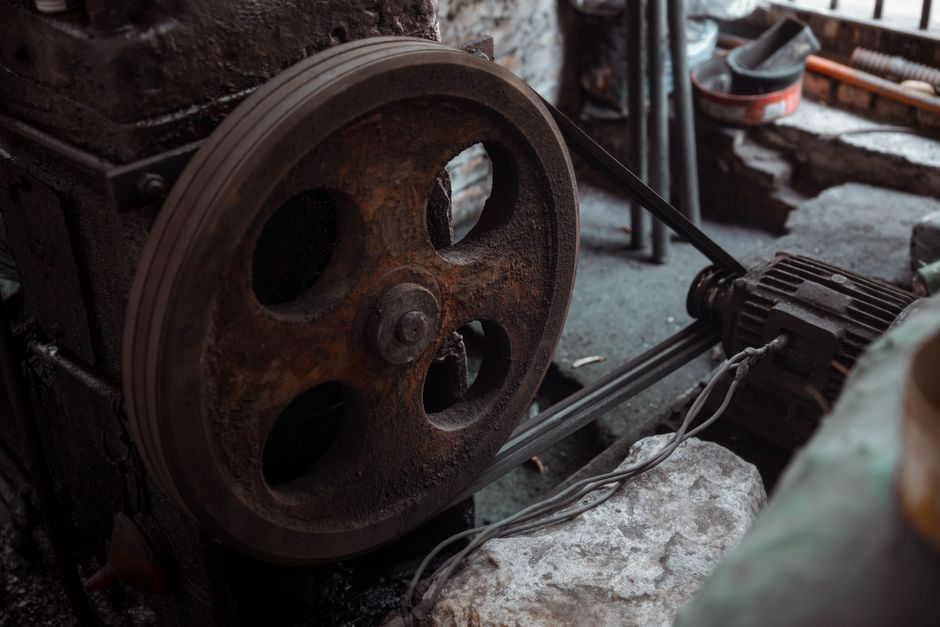
Roller chain and timing belt both transmit torque through positive tooth engagement, but they diverge sharply on efficiency, lubrication, ATEX suitability and lifecycle cost — Gates' Poly Chain Carbon Volt polyurethane timing belt is rated up to 85 °C and down to -54 °C with widths from 12 mm to 125 mm and pitches of 8 mm or 14 mm [S2].
The mechanical envelope of each option now overlaps more than it did a decade ago: modern PU timing belts claim to be "more than a match for roller chain" when paired with matching sprockets [S2], while ANSI heavy-duty roller chain continues to be specified for textile, cement, steel and F&B lines [S3][S4].
Core Design Principle and Engagement Geometry
Both roller chain and timing belt rely on form-fit engagement between a flexible tensile member and a toothed wheel, so slip is structurally impossible at steady state — the practical differences come from the tensile member itself: a metal link plate train in chain, a polymer/fibre tensile cord in belt [S1][S2].
Roller chain carries load on a series of pin/bushing joints that pivot as the chain wraps the sprocket; PU timing belts carry load on a continuous carbon-fibre tensile cord that flexes over a curvilinear tooth profile [S2]. That single geometric difference cascades into the noise, stretch, lubrication and ATEX behaviour that drive most spec calls.
Efficiency, Noise and Speed Envelope
Roller chain efficiency typically sits in the 97-98% range per mesh point at low-to-moderate speeds but degrades as pitch velocity rises; PU timing belts generally hold 98-99% efficiency across their working window because the bending hysteresis is concentrated in one elastomer body [S2].
Running noise is the most audible gap: chain generates a metallic articulation sound driven by chain-on-sprocket impact at each tooth entry, whereas a PU timing belt on cast or machined sprockets typically measures 5-10 dB(A) lower under equivalent load and speed [S2]. For operator-station conveyors or cleanroom cells this is often a hard spec line, not a soft preference.
Maintenance, Lubrication and Stretch Behaviour
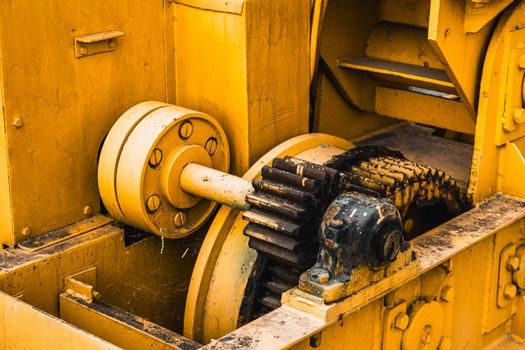
Chain elongates over service life as pin-bushing wear accumulates; the Lovejoy RunRight spring-loaded tensioner is explicitly designed to "automatically adjust to correct for slacking or sagging to enable longer and smoother system life" on both chain and belt drives [S1]. That single component underlines the maintenance philosophy split: chain needs *lubrication + tension*, belt needs *tension only*.
Self-adjusting tensioners remove most of the scheduled re-tensioning labour, but they do not replace chain lubrication, which is the dominant wear driver on ANSI drives [S1][S4]. PU timing belts with carbon-fibre tensile cords are sold as "maintenance-free" by Gates, with stretch bounded across the product life [S2]; USA Roller Chain's standard product line still requires periodic re-lubrication [S4].
Environment, ATEX and Chemical Resistance
The Poly Chain Carbon Volt belt is "the only belt in the market that … meets ISO 9563 standard for static conductivity over the full lifetime of the belt" and is "ATEX directive compliant", with an operating window of -54 °C to +85 °C and chemical/abrasion resistance from the polyurethane jacket and nylon facing [S2]. That combination is unusual: most commodity rubber timing belts are insulators and cannot be specified in zoned hazardous areas without a separate static-dissipation plan.
Roller chain in stainless (304/316) or nickel/zinc-plated form [S4] is the workhorse for washdown, food-contact and mildly corrosive duty where a polymer belt would degrade. Specifying chain in ATEX zones is possible only when the chain is lubricated with a low-friction, low-off-gassing grease and the drive is enclosed to prevent hot-particle ejection — these constraints typically push designers toward the conductive PU belt instead [S2].
Load Capacity, Speed Limits and Sizing Rules
ANSI heavy-series roller chain such as USA Roller Chain's heavy-duty and DUROCHAIN lines are sized by service factor × design horsepower, with the operating envelope generally set by the small sprocket's maximum rpm rating (commonly 900-1,200 rpm for 12B-40B at moderate load) and the chain's allowable tensile strength per strand [S4].
PU timing belts in the 8 mm and 14 mm pitch range from Gates are sized on tooth-shear strength and cord pull, with the carbon-fibre cord rated for "increased horsepower rating, compactness and flexibility" versus previous-generation glass-fibre constructions [S2]. In practice this lets a designer drop one or two pitch sizes for the same transmitted power, which is the lever used to make a belt drive physically smaller and lighter than the chain equivalent [S2][S4].
Decision Matrix: Chain, Belt, or Hybrid
Use chain when the application demands shock-load tolerance, easy field repair, stainless or plated corrosion resistance, or a wide range of accepted lubricants; chain still dominates heavy mill, crane and outdoor drive duty [S3][S4]. Use PU timing belt when the line is in a clean, ATEX-rated, low-maintenance or low-noise envelope, or when compactness and a maintenance-free service contract matter more than field-repair speed [S2].
Run a hybrid only when shaft geometry forces it: a timing pulley on a roller chain is not a valid substitute, but a roller chain can be used as a back-side idler tensioner on a belt drive where the loaded span is the belt side. Tensioning hardware is largely interchangeable — the Lovejoy RunRight unit is sold for "belt, chain" applications from one SKU line [S1].
Failure Modes and Limits Both Specs Must Respect

Chain failure modes: pin/bushing wear leading to elongation, plate fatigue at the link hole, and tooth-jump on worn sprockets; catastrophic failure on modern chain is rare before a stretch >3% triggers a service event [S4]. Belt failure modes: tooth shear under shock load, back-surface abrasion from idler misalignment, and tensile-cord break from back-bend radius violation [S2].
For conveyors integrating either drive, the surrounding system is the bigger spec risk — a chain conveyor running with the wrong lubrication plan will drag chain life down faster than the drive itself, and a conveyor chain in a washdown line will corrode well before its rated service hours. Wider context on the surrounding drive train is covered in our note on overhead conveyor lifecycle costing, which sits one layer out from the chain-vs-belt decision.
Track these two signals over the next buying cycle: any new ATEX-zone retrofit spec that defaults to ISO 9563 PU belt, and any new ANSI heavy-series sprocket price moves from the major US distributors — together they tell you whether the local chain-belt mix is tilting toward belt or staying balanced.