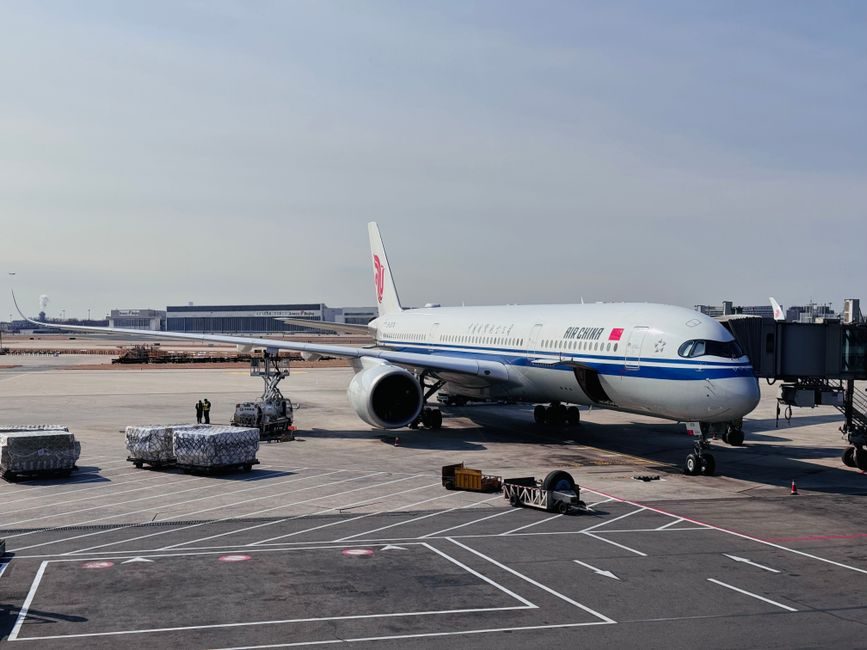
Air-cargo terminal roller conveyors in 2026 are specified first by ULD pallet footprint (LD-3 1534×1562 mm, M-1 2438×3175 mm) and only then by roller diameter and pitch, because a mis-sized deck forces manual rehandling that erases the throughput gain the line was meant to deliver [S5].
Supplier catalogues published July 2026 confirm three roller-diameter families (φ60, φ76, φ89/φ102 mm) and four sleeve materials (galvanized mild steel, HDPE, UHMWPE, nylon) across Chinese and Indian OEMs, while dedicated air-cargo integrators such as Swiss WorldCargo continue to market commodity-focused, modular build-ups rather than fixed turnkey lines [S4][S5][S1].
Roller Diameter and Pitch for ULD Footprints
Roller pitch in cargo lines is governed by ULD base stiffness: 100 mm pitch is a practical lower limit for empty LD-3 dollies, while 150–200 mm pitch is common for fully loaded M-1/main-deck pallets up to 6800 kg to keep deflection under 1 mm per roller [S5].
For air-cargo deck frames the 2026 OEM range is φ76×3 mm for narrow-body ULD lanes and φ89×3 mm or φ102×4 mm for wide-body main-deck lines, with φ60 mm reserved for light parcel and mail handling behind screening [S1][S5]. Tangshan Jieli's 2026 catalogue lists 85 carrier-roller SKUs, 93 return-roller SKUs and 53 UHMWPE/HDPE/nylon-sleeved SKUs, the breadth that a terminal engineer needs to match a mixed fleet of LD-3, M-1 and 16-ft pallets [S1].
Drive Type: Gravity, Belt-Driven, or Motorized-Pulley
For accumulating ULD lines the dominant 2026 choices are zero-pressure chain-to-roller (ZPCR), lineshaft belt-driven (O-ring, 1/2" Poly-V), and 24 V DC motorized rollers, with Tangshan Jieli offering a dedicated 42-SKU MP (motorized-pulley) range in φ219 to φ500 diameters for inclined cargo sections [S1].
Line-shaft drives remain the default for runs longer than 30 m because a single 0.75–1.5 kW shaft drives dozens of rollers through individual O-rings, while 24 V DC MDR zones are now standard for short accumulation zones under 6 m and for cold-chain sections where grease must be food-grade H1 [S5]. Rollcon Engineers' 2026 product page continues to list belt, slat (chain) and screw conveyors as separate build blocks, the modular pattern that lets a cargo integrator add gravity run-out, powered curve, and lift-gate sections independently [S2].
Frame Load Class and Material Selection
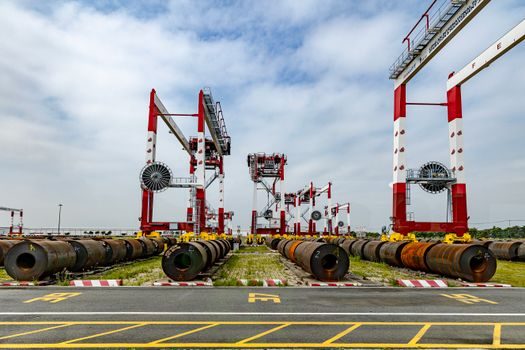
Frame load class for an air-cargo deck is set by the heaviest ULD x the dynamic factor: M-1 at 6800 kg x 1.25 dynamic x 1.1 impact gives a design line load of about 95 kg/cm, which maps to a 6 mm-thick formed-channel frame at 600 mm cross-bracket spacing [S5].
Roller sleeves in 2026 are predominantly UHMWPE where build-up drag matters (transfer tables, gravity curves) and HDPE where cost drives the spec (long straight runs), with nylon limited to high-temperature engine-stand sections; galvanized mild steel is still the default tube material because 304/316 stainless only pays back in cold-store or de-icing-fluid exposure [S1][S5]. Tangshan Jieli lists 67 frame-and-bracket SKUs, 33 impact-bar/cradle SKUs and 106 bearing SKUs in the same 2026 catalogue, evidence that frame class is sold as a matched system rather than a standalone beam [S1].
Slope, Brake, and Safety Constraints on Cargo Decks
Powered cargo decks are normally limited to 5° slope for loaded M-1 ULDs and 7° for empty LD-3 dollies, beyond which hold-back brakes or rack-and-pinion stops are mandatory because standard roller friction (μ ≈ 0.05 for steel-UHMWPE) cannot retain a 6800 kg pallet on a 9° ramp [S5].
Airport side-loaders and tow-bars interfacing with the deck impose a 1.5 kN point load at the deck edge, so 50×25×3 mm side-channel reinforcement is the minimum 2026 spec for any conveyor used at the aircraft interface [S1]. Schiphol's continued slot-constraint story, written up in 2024 and still referenced in 2026 cargo coverage, is a reminder that the ground-time penalty for a single stuck ULD is now a board-level KPI, not a maintenance ticket [S3].
Comparison: Drive Options for Air-Cargo Roller Lines
Three drive families compete on the 2026 air-cargo deck: line-shaft (1.5 kW/shaft, 30–80 m run length, low unit cost, O-ring wear every 12–18 months), 24 V DC MDR (50 W/roller, ≤ 6 m zones, 24 V brushless, quiet, food-grade lube compatible) and motorized pulley (1.5–5.5 kW, φ219–φ500 mm, sealed against wash-down, higher unit cost) [S1][S2][S5].
On selection criteria: choose line-shaft for long straight accumulation where cost per metre matters, MDR for cold-chain and e-commerce parcel spurs where each zone must stop independently, and motorized-pulley for inclined lifts, curved sections, and any zone exposed to de-icing fluid or wash-down, with frame-load class and ULD weight always checked before drive type [S1][S2][S5].
Compatibility and Integration Limits in 2026
Buyers comparing 2026 OEM catalogues should weigh not just unit price but the bearing and impact-bar SKUs behind it; a quote with 33 impact-bar/cradle SKUs and 106 bearing SKUs signals a vendor that can support a mixed-fleet terminal, while a quote with no wear-parts list is usually a trading company with no aftermarket [S1][S5].
Trackable 2026 Signals for the Next Spec Cycle
For deeper reading on adjacent selection logic, the SCARA Robot Selection Guide: Reach, Payload, Repeatability Benchmarks for 2026 Specs and the Wheel Loader Selection for Quarrying: 2026 Spec Map follow the same load-class-first method used here, while the Multi-Gas Detector Selection for Oil and Gas Facilities: Sensor Stack, Zone Rating, Output piece applies the same drive-vs-zone trade-off to a different sensor family. Background on the roller itself is in the roller conveyor reference entry.
Component reference pages worth checking: air pick, and air impact wrench.