
SANY's SR235-C10 crawler rotary rig pairs a 2,000 mm (79 in) maximum drilling diameter with 54 m and 68 m depth options, in a diesel-powered, remote-controlled piling package aimed at small-diameter civil-engineering work [S1].
The larger SR365R-W10 extends that envelope to 2,200 mm and 2,500 mm (87 in) diameters and 65 m / 100 m (213 ft 3 in) depths, again on a crawler chassis, with the OEM's PC EVI telematics layer for real-time construction and maintenance data [S2].
Functional Taxonomy: Single-Purpose vs Multi-Function Rigs
Chinese field references classify rotary rigs by function: a single-mode rig uses one rotary-bucket drill setup, while a multi-function rig is the comprehensive platform that swaps drilling tools, extends working envelopes, and is widely used for cast-in-place piles, diaphragm walls, and foundation reinforcement in sand, clay, and silty soils [S8].
The single-mode bucket-drill version is the low-cost default for repetitive small-diameter bored piles on homogeneous ground; the multi-function version is what most metro, high-speed-rail, and tower-crane foundation jobs now specify because it lets one machine handle casing, auger, and short-helical conversions on the same mast [S8].
Small-Diameter Crawler Rigs: The SR235-C10 Envelope
The SR235-C10 targets 2,000 mm diameter holes to 54 m or 68 m on a crawler undercarriage, with a diesel engine and remote control, and is positioned by SANY for civil-engineering and construction piling where hole spacing and access lanes are tight [S1].
For procurement: the 2,000 mm / 68 m envelope covers most urban building foundations, road-bridge piers in soft overburden, and diaphragm-wall starter piles. Operators on tight sites typically accept the lower torque ceiling in exchange for a shorter wheelbase and lower ground-bearing pressure than larger rigs in the same OEM range [S1].
Heavy Civil Crawler Rigs: The SR365R-W10 Class

The SR365R-W10 is the heavy-class crawler: 2,200 mm and 2,500 mm diameters, 65 m and 100 m (213 ft 3 in) depths, with remote control and PC EVI equipment management feeding real-time construction information back to the fleet operator [S2].
The 100 m (213 ft 3 in) option is the headline figure: it covers deep bridge caissons, large-diameter harbor piles, and the cast-in-place pile foundations used on high-voltage transmission towers and wind-farm substructures. Casing diameter and crowd-cylinder stroke rise sharply versus the SR235-C10 to hold verticality in the deeper bores [S2].
Folding-Mast Transport Rigs: The KR200M Trade-Off
KR-series rigs such as the KR200M use a unique folding-mast structure that lets the overall transport envelope shrink below standard road-load limits, and a rotary angular-displacement output mechanism with a central rotary joint to improve reliability of the swing circuit [S5].
The depth-measurement system on the drilling bucket is positioned as more accurate than the average rig in the same class, and a main-winch bottoming protection with priority control is intended to reduce operator-induced overtravel incidents — a common failure mode in 1.0–1.5 m diameter urban piling where the bucket hits casing shoe steel [S5].
Geothermal and Geotechnical Drilling Conversion
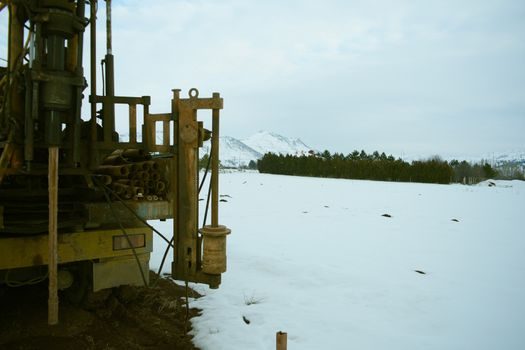
Geothermal drilling rigs are defined as rigs used for exploration and development of geothermal energy stored in the Earth's crust, with the heat source attributed to deep-rock radioactive isotope decay, deep-rock tectonic frictional residual heat, and conduction from the Earth's interior including the core [S9].
On a rotary platform, the same mast and rotary head can be reconfigured with down-the-hole hammers, mud pumps, and casing-advance systems to drill slim geothermal production holes to several hundred meters, though the cited definition is broader and includes any drilling method targeting a geothermal reservoir [S9].
Specification Comparison Across Common Envelopes
Decision matrix for specifiers: the SR235-C10 delivers 2,000 mm × 54–68 m on a compact crawler at the lowest acquisition cost, suits small-diameter urban piling, and the 68 m option is the practical maximum for soft overburden work [S1]. The SR365R-W10 stretches to 2,500 mm × 100 m on a heavier crawler, costs more, and is the right pick for deep caissons, harbor piles, and large-diameter continuous-wall starter bores [S2]. The KR200M-class folding-mast rig targets transport-restricted urban sites, sacrifices some rigidity for a collapsible mast, and integrates a depth-measurement system more accurate than the average rig in its class [S5].
Across the three, the recurring constraints are: ground-bearing pressure for crawler rigs on weak urban subsoils, mast length and transport envelope for road-permitted moves, and torque capacity for the larger diameters — all governed by the requirement to hold verticality under crowd force rather than any single standard on the spec sheet [S1][S2][S5].
Supplier Geography and Sourcing Map

Rotary rig supply is heavily clustered in Shandong, China, where export houses bundle tower cranes, construction elevators, concrete mixing plants, mixer trucks, concrete pumps with boom, asphalt plants, mini excavators, and rotary drilling rigs in mixed container shipments — useful for one-stop project procurement but with longer lead times than direct OEM orders [S4].
Independent contractors such as Rotary Drilling Co. Ltd. (Hungary) continue to operate as regional service providers using their own fleet rather than acting as dealers for a specific OEM, and remain a relevant routing channel for European piling jobs where local-language documentation matters [S3]. For broader heavy-equipment procurement context, see the China Solenoid Valve Suppliers 2026 sourcing map for cluster economics, and the Motor Protection Relay selection spec map for the electrical side of a piling-rig control panel.</h2> <p>Two trackable signals for the next 60–90 days: continued publication of mast-strength and winch-mount studies, including the Hui Mei Kang / Yi She Xu paper on how main-winch mount position (platform vs lower mast) affects drilling-mast axial force and bending moment [S7]; and incremental product-sheet refreshes on the SR-series at DirectIndustry, where OEM sheets are the most reliable public spec reference until dealer datasheets converge [S1][S2].
Spec-level background on the components involved: rotary drilling rig, rotary encoder, and rotary hammer.