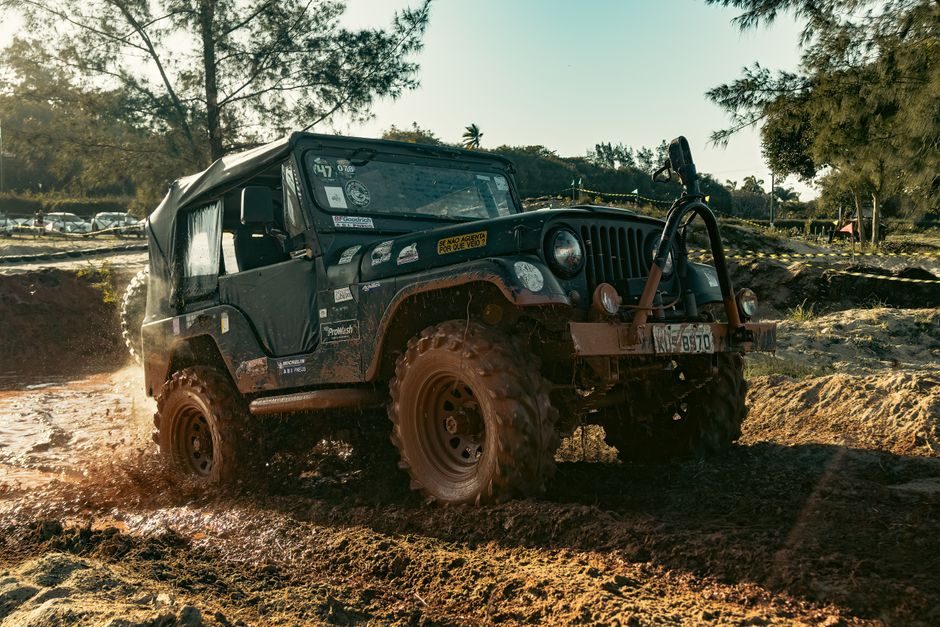
A rough terrain forklift arrives on site as a semi-assembled package: chassis rolling, mast upright but pinned for transport, forks removed, cabin glass (when fitted) crated, and tyres deflated to transport pressure. Site installation is the act of bringing the machine from that state to a first-load lift, and it typically takes a competent fitter 4–8 hours per machine on a level hardstand [S2][S4].
For the 1.5–3.5 t class, HANGCHA's XF Series lists lift heights of 2700–6500 mm against load capacities of 1500–3500 kg, and the 5.0–10.0 t XF variant extends to 3000–7000 mm lift with 5000–10000 kg capacity [S4]. The 4WD 3.5-ton diesel class from Runtx sits in the same envelope and is built around a Shanghai port export configuration [S3]. Across these three payload tiers, the field rig follows the same six-stage sequence; only the rigging capacity and axle pressures change.
Stage 1 — Site Hardstand, Access Slope, and Tyre Selection
Operating a 4×4 rough terrain forklift on uncompacted fill with slope above 15% is the single most common cause of a tipover on commissioning day, and Agrimac's UK specification explicitly calls out "Various Tyre options for numerous applications" as a configurable item rather than a one-size solution [S2]. For muddy yards, specify agricultural-pattern pneumatic tyres; for mixed paved and broken ground, specify an industrial block-pattern tyre at the same 4×4 axle.
Ground pressure under a 3.5 t rough terrain forklift with 4WD engaged and load on the mast is typically 80–110 kPa per tyre at recommended inflation — this is a load/contact-area calculation, not a manufacturer spec, and the actual value depends on the specific tyre size fitted [S2]. Acceptance criterion before first lift: a level, compacted hardstand pad of at least 4 m × 6 m rated for the loaded axle weight, with a clear approach ramp under 10% gradient [S2].
Stage 2 — Mast Pinning, Lift Cylinder Bleed, and Chain Pre-Tension
The transport lock pin that holds the mast to the axle yoke must be removed only after the lift cylinders are pressurised; pulling the pin first allows the mast to fall under residual hydraulic pressure and bend the tilt rams. Hangcha's XF/XH mast assemblies are designed for vertical mast and dual-stage telescopic configurations, and the lift height window is set by the chain length — not the cylinder stroke [S4].
Chain pre-tension on a 3.5 t class unit should be checked with the mast at full free-lift and a 200 kg test load: each chain should show equal deflection within 5 mm when measured at mid-span, and the equaliser pulley should sit centred in its bracket. Out-of-spec chain tension is the leading cause of a skewed mast at first commissioning lift, and replacement chain sets are stocked items for most OEM lines [S2]. Skip the bleed step only on factory-fresh units where the hydraulic reservoir is sealed; field-installed cylinders must be bled with the engine at idle and the mast cycled three full times [S2].
Stage 3 — Forks, Carriage, and Load Backrest Verification
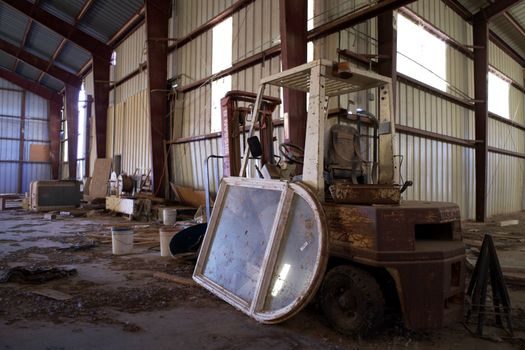
Fork installation on a rough terrain unit is dimensionally identical to a standard forklift — fork hooks engage the carriage top and bottom bars, and a retaining pin or latch secures the heel — but the rating on rough terrain forks is typically de-rated by 10% versus a smooth-floor unit of the same fork size because of dynamic loading on uneven ground [S2].
For a 3.5 t machine, that places the per-fork pair rated load at roughly 1575 kg each at 600 mm load centre when the rough-terrain de-rating is applied. Load backrest extension must clear the tallest load expected on site; Hangcha's high-voltage XH telehandler variant uses a carriage geometry compatible with the XF 1.5–3.5 t class, so backrest and fork hardware can be shared across that range [S4]. Acceptance: forks must hang level within 3 mm at the tip when the carriage is raised 300 mm, and the heel pin must be seated fully in the carriage hook with the latch spring returned.
Stage 4 — 4WD Axle, Differential Locks, and Driveline Run-In
Where a 4×4 rough terrain forklift differs sharply from a conventional unit is the front drive axle engagement and the locking differential — both must be functionally checked on the commissioning walk-around, not just visually inspected. With the machine on level ground and the parking brake set, engage 4WD at zero travel and confirm front-axle rotation by jacking the front and rotating one front wheel by hand; the opposing front wheel and the rear wheels must turn in the opposite direction at a ratio consistent with the transfer box [S2].
On Runtx's 3.5 t 4WD diesel platform, the front axle is a rigid portal type with a fixed engagement lever; run-in is 30 minutes of low-speed manoeuvring under no load before any loaded lift is permitted [S3]. Acceptance: no binding in the steering at full lock, no clunk from the front propshaft on engagement, and differential-lock indicator (where fitted) extinguishing within 2 seconds of release. Do not lift a load with the differential lock engaged on a hard surface — the lock is for traction, not for loaded handling, and the resulting wind-up can shear an axle shaft [S2].
Stage 5 — Cabin, ROPS/FOPS, and Operator Controls Checkout
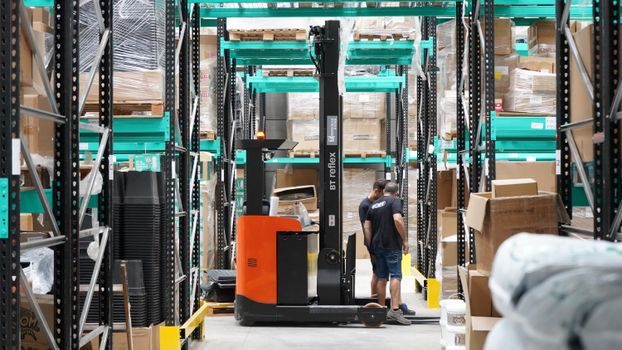
Full glass cabins, heaters, and air conditioning are options Agrimac offers across the Agrimac 4×2 and 4×4 off-road range, and the cabin mounting is part of the commissioning scope, not a dealer add-on [S2]. ROPS (rollover protective structure) and FOPS (falling-object protective structure) certification must be verified before any site lift; both are standard on 1.5–10 t class XF units per Hangcha's published configuration [S4].</h2> <p>Operator control checkout covers the parking brake holding on a 15% gradient, the horn, the reverse alarm, the load moment indicator (LMI) self-test, and the seat-cutout interlock that disables travel when the operator stands. Acceptance: LMI must reach 100% of nameplate capacity with a known test load and cut lift at 110% with audible alarm. A cabin-equipped Hummerbee rough terrain unit, designed for orchards and apiaries, ships with a simpler analogue gauge cluster and no LMI — for those machines, the rated capacity decal on the chassis is the only load-limit reference, and that decal must be present and legible before commissioning [S7].
Stage 6 — Hydraulic Fluid, Filtration, and First-Lift Acceptance
Hydraulic fluid grade for a 3.5 t rough terrain diesel is typically ISO VG 46 mineral hydraulic oil; the reservoir on factory-fresh units is filled at the OEM and the breather must be inspected for damage in transit before the engine is started. Filtration spec on Hangcha's XF/XH range uses a 10 µm return-line filter, and a 25 µm suction strainer; both must be confirmed fitted and sealed [S4].
First-lift acceptance procedure: park on level ground, lower forks to 100 mm, apply parking brake, set travel direction to neutral, start engine, warm hydraulics for 5 minutes at idle, then cycle mast full-up/full-down three times with no load. Lift a known test load equal to 50% of nameplate capacity to 1 m, hold for 30 seconds, and check for mast drift (must be zero measurable drift over 30 s) and hydraulic weep at cylinder rod seals. Acceptance is signed off only when the 100% load lift to rated height holds with no drift and no alarm. For a Hangcha XF 5.0 t unit, that test load is 5000 kg at 600 mm load centre lifted to 3000 mm mast height — the bottom of the published lift-height window [S4].
Failure Modes and When to Stop the Commissioning
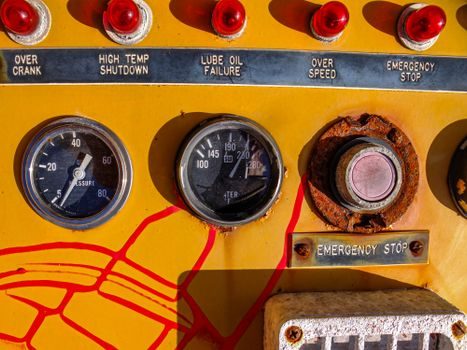
Common installation-stage failure modes are: (1) mast drift under load — root cause: cylinder seal damage in transit or unbleed-ed lift ram, corrective: re-bleed and re-test, replace seal kit if drift persists; (2) front axle no-engage — root cause: transfer box linkage out of adjustment, corrective: re-set linkage per OEM service manual, do not force the lever [S2].
(3) LMI over-rate alarm at nameplate load — root cause: load cell calibration lost in shipping, corrective: re-calibrate with a known weight, do not bypass the alarm; (4) excessive steering play — root cause: worn steering ram seal on the rear-axle articulation joint, corrective: replace seal kit, do not lift loads until repaired. When any of the above cannot be cleared with parts on hand, the correct call is to stop the commissioning, lock out the machine, and escalate to the OEM technical line — Agrimac explicitly advertises "full factory technical backup" and "All parts are available" as part of its supply contract [S2].
Trackable signals to watch: the next HANGCHA Europe XF/XH product page revision for any new load-class addition, and the 2026 Qingdao Yihao International Trade Co. supplier listing (Shandong, account registered 2024) as a sourcing-side data point for the 1.5–3.5 t export class [S4][S6]. For a wider view of off-highway installation work, the slewing ring bearing bolt-up and run-out acceptance procedure and the aerial work truck envelope map share the same site-prep discipline and are useful adjacent references.
Spec-level background on the components involved: linear guide.