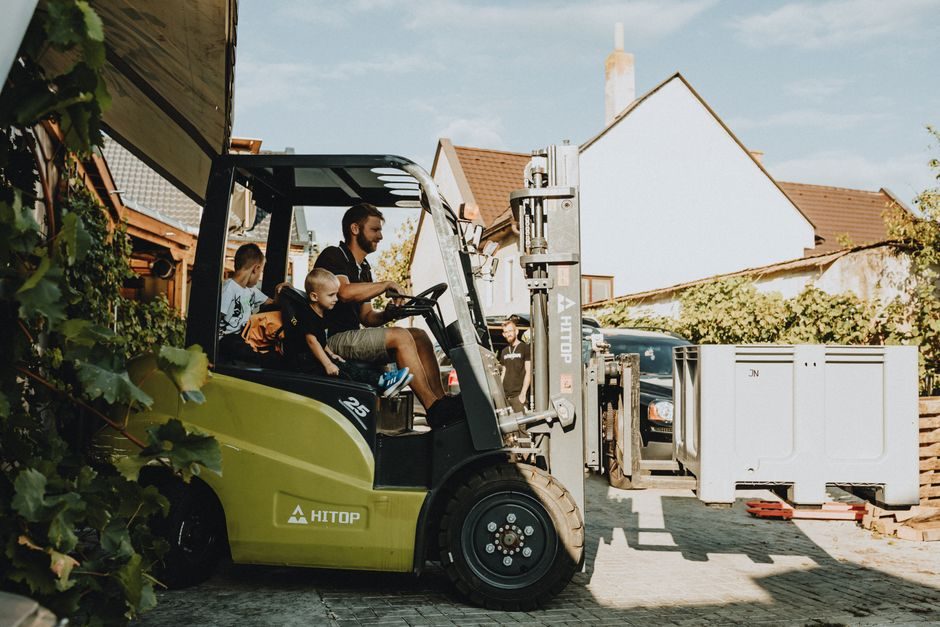
Rough terrain forklifts cover a 4,000-12,500 lb lift-capacity band and routinely climb 16-30° grades on mud, gravel, and broken ground [S2][S6]. That is a wider envelope than a standard warehouse forklift, but it comes with a price, weight, and tire penalty buyers must price in before signing a PO.
Typical RTF configurations pair a four-wheel-drive chassis, oversized pneumatic tires, and a high-ground-clearance mast, with compact models like the Harlo H4 at 4,000 lb and heavy units such as the Harlo 12-FIVE at 12,500 lb sitting on the same platform family [S2]. Chinese-built articulated units such as the CPCY-30 publish a 3,000 kg rated load, 3,500-3,800 kg overall weight, 16-30° grade capability, and 30 mm ground clearance on a 490-series engine [S6].
Where a Rough Terrain Forklift Earns Its Keep
RTFs are specified where warehouse-style cushion-tire forklifts cannot keep traction: lumber yards, nurseries, construction sites, agricultural load-out, military logistics, and beekeeping operations with soft, rutted lanes [S8]. The defining capability is grade handling — the CPCY-30 publishes a 16-30° climb envelope on four-wheel drive [S6] — combined with a rough terrain forklift chassis that absorbs shock loads the mast and frame of an electric sit-down rider would not survive.
Capacity coverage is also wider than the warehouse class. Harlo's 2026 line-up runs H4 Compact (4,000 lb), HP5000 (5,000 lb), HP6500 (6,500 lb), HP8500 (8,500 lb), 10-FIVE (10,500 lb), and 12-FIVE (12,500 lb), letting a single OEM cover most outdoor yard duties without fleet fragmentation [S2]. Hummerbee extends the same idea into compact articulated loaders aimed at construction, tree care, landscaping, and dairy farming, with configurable platforms that accept hydraulic attachments [S8].
The Cost Side: Purchase, Fuel, and Maintenance
Internal-combustion RTFs cost less to buy than electric equivalents but more to run over the asset life, because diesel and LPG units carry ongoing fuel and higher maintenance overhead [S3]. A telehandler-class machine — closely related to an RTF and often used for the same tasks — is built around a single telescopic boom, a rear counterweight, and a side cab, and that design makes the boom a pivot point: lifting capacity drops as the load center moves further from the front wheels, a stability trade-off the operator must manage on every lift [S3].
Rough-terrain tires and heavy-duty axles also raise replacement and wear-part spend. Pneumatic-drive tires are sized for traction and ground clearance, not for long indoor runs on smooth concrete; running an RTF on finished slabs accelerates sidewall wear and chews up the surface. IC diesel and LPG engines also exceed electric units for noise and exhaust emissions, and that pushes indoor or food-adjacent work back toward electric [S3].
Comparison: RTF vs Telehandler vs Electric Warehouse Forklift
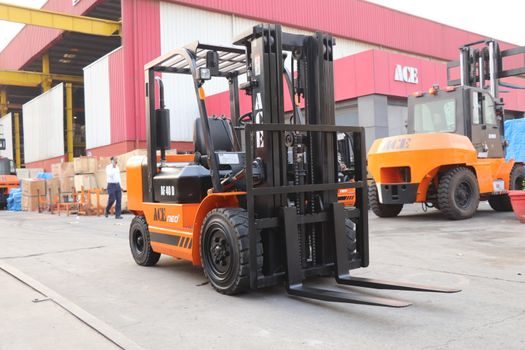
Line the three against the same four buying criteria and the trade-off picture is clear: (1) Best ground conditions: RTF and telehandler on mud/gravel/grade, electric warehouse forklift on smooth concrete only [S3]. (2) Capacity ceiling: telehandler and RTF both reach 10,000-12,500 lb in current production, while most electric sit-downs top out in the 6,000-8,000 lb band common to that class [S2][S3]. (3) Operating cost over life: electric wins on energy and maintenance, IC-powered RTFs and telehandlers win on continuous-shift duty and faster refueling [S3]. (4) Operator comfort/ergonomics: warehouse electric units lead on noise and vibration, RTFs sit highest and roughest because the same suspension and tire package that handles terrain transfers shock into the cab [S3].
The telehandler's one major limitation is reach-related stability: as the boom extends, the weight-bearing moment grows and lifting capacity falls off, a rule the operator must read off the load chart for every lift [S3]. An RTF with a vertical mast trades that reach envelope for a more forklift-like load path, which is why yards with both reach and rough ground often run a mixed fleet.
Selection Criteria Buyers Should Lock Down First
Five hard specifications drive RTF selection in 2026: (1) Rated load and load-center, typically 3,000 kg at 500 mm for compact articulated units like the CPCY-30 [S6]; (2) Maximum grade, with published 16-30° climb envelopes the baseline for true off-road duty [S6]; (3) Ground clearance, with 30 mm a minimum and 250-400 mm typical for forestry and construction classes; (4) Engine and driveline, with 490-series diesel common on Chinese-built 3-ton units [S6] and tier-4 final emission packages increasingly mandatory in regulated markets; (5) Tire and axle package, where pneumatic-drive tires sized for traction, not floor surface life, are the default [S2][S6].
Add three soft criteria: dealer coverage, attachment hydraulics (the Hummerbee platform markets itself on configurable hydraulic attachments for beekeeping, tree care, and landscaping [S8]), and parts availability. Harlo's distributor locator and dealer-portal model [S2] is the kind of support network that matters when an RTF is working 50+ hours a week in remote yards.
When an RTF Is the Wrong Machine
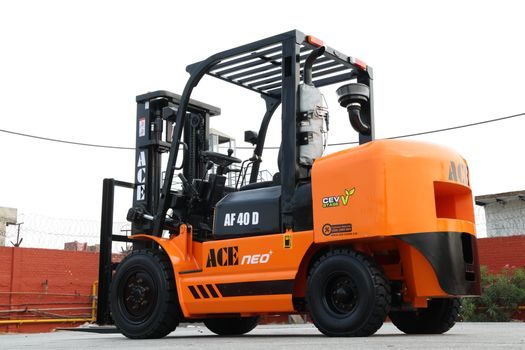
Skip a rough terrain forklift when the work is indoor, the floor is finished concrete, the duty cycle is multi-shift continuous, and the loads stay under about 6,000 lb — that is the band where electric sit-down counterbalance forklifts win on energy cost, noise, emissions, and operator ergonomics [S3]. Electric units are also weak on wet floors and on continuous high lifts, but those are tractable with the right tire compound and battery sizing, not solved by throwing a rough-terrain chassis at the problem [S3].
Skip an RTF — and consider a telehandler instead — when loads must be placed onto rooftops, upper floors, or trailer beds that a vertical mast cannot reach. The telehandler's telescopic boom was developed in England by Matbro from articulated forestry forklifts and is the practical tool for unloading pallets from trailers and lifting onto structures [S3].
Installation, Acceptance, and Operating Constraints
Even before the first shift, a new RTF needs site prep: a hardstand for the charging or refueling point, clear travel lanes wide enough for the longer wheelbase, and tire-pressure or track inspection routines that warehouse forklifts never demand. Operators need load-chart training specific to the unit, because both telehandler and RTF load charts drop capacity fast as the load center moves out from the heel of the fork, and a misread chart is the root cause of most stability incidents [S3].
Daily checks should cover tire condition, hydraulic hoses, mast chains, and engine fluids on IC units, plus battery state-of-charge and connector condition on the rare electric RTFs. Warranty terms, dealer response time, and parts stocking are part of the spec, not a footnote — see the Rough Terrain Forklift Installation: Site Prep, Mast Rigging, and Acceptance reference for the acceptance-test side of the same workflow. The trade-off principle is the same one the broader aerial work platform market applies: a Aerial Work Truck Advantages and Disadvantages spec map runs the same capacity-versus-stability logic, just on a different chassis.
Track two signals in the next buying cycle: (1) tier-4 final / stage V emission-compliant diesel RTF launches in the 5,000-10,000 lb band, which will reshape fleet-replacement math for yards currently running older units; (2) growth of compact articulated loaders like the Hummerbee platform into non-traditional segments such as beekeeping and dairy [S8], which will pull attachment-hydraulics options out of the niche and into the mainstream spec sheet.
Spec-level background on the components involved: pressure transmitter.