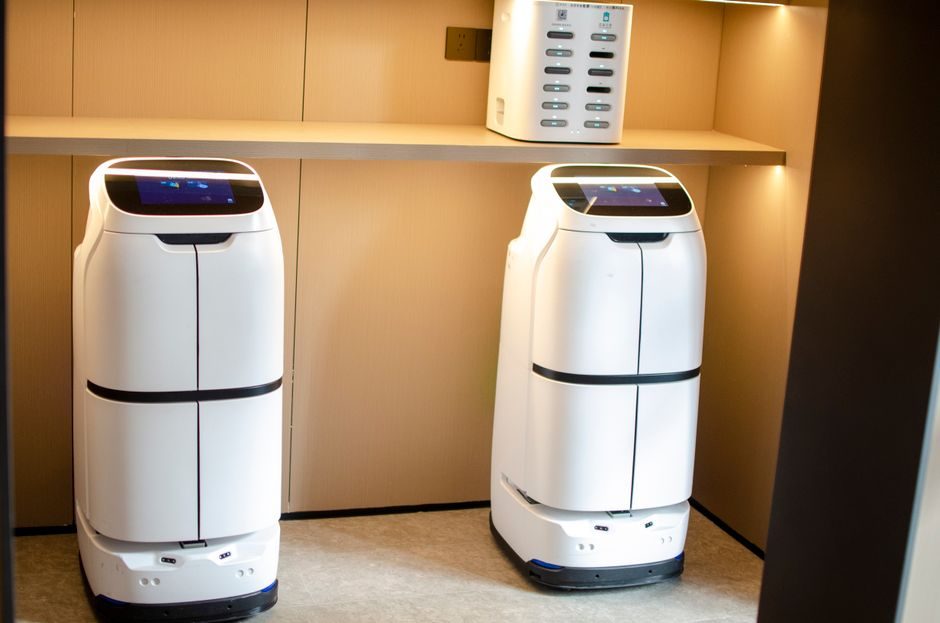
Cobots have shifted from pilot novelty to production-grade workhorses: NONEAD Corporation (Suzhou Industrial Park) has cumulatively delivered over 400 flexible smart-manufacturing projects at a 100% project implementation rate, spanning automotive parts, 3C electronics, semiconductors, optics, food, home appliances, and machining [S3].
The vendor map now separates on three axes — Chinese integrated-cell builders, US light-payload specialists, and the Universal Robots / MiR ecosystem that NONEAD distributes as East-China agent for Teradyne Robotics [S3]. JAKA Robotics simultaneously promotes a multi-payload cobot family for "various industries and different scenarios" with embodied-intelligence extensions [S4], while US-based Productive Robotics (OB7, Blaze) reports 500+ shop deployments on its homepage [S5].
Safety Standards That Actually Constrain the Cell
ISO 10218-1/-2 (industrial robot safety) and ISO/TS 15066 (collaborative-operation guidance, including the biomechanical limit values for quasi-static and transient contact) remain the binding documents for any collaborative cell, and the Springer operationalization study explicitly cites the Valori et al. (2021) review of those standards as the reference baseline [S1]. Collaborative operations are restricted to four modes defined there: safety-rated monitored stop, hand guiding, speed-and-separation monitoring, and power-and-force limiting — and power-and-force limiting is what defines a "cobot" at the cell level [S1].
Practical consequence: a 6-axis cobot arm with payload in the 3–16 kg band, marketed as "collaborative," is only legally collaborative inside a risk-assessed cell whose PFL thresholds, pinch-point geometry, and stop categories meet ISO/TS 15066; a UR3-class arm used in the human-centered-design study at the learning factory was operated under the same document with NASA-TLX workload scoring layered on top [S2]. NONEAD's certified-software posture (ISO 9001 quality management, dual-software certification) is the minimum paperwork counterpart to that hardware safety case [S3].
Cell Stack: Arm, End-Effector, Vision, Mobile Base
A production cobot cell in 2026 is rarely a single arm — it is a composite of four subsystems. NONEAD's product family explicitly bundles an industrial collaborative composite robot, a flexible palletizing robot, a welding robot, and a telescopic fork-rail transfer robot, all running on the self-developed nCobotCenter cross-platform programming control system and the nCallSystem call-dispatch system [S3]. The vision layer is supplied by NONEAD's "collaborative robot visual positioning system" plus flexible end-effectors; the mobile layer is sourced from the MiR East-China partnership the same firm holds [S3].
Independent of the Chinese stack, the AGV robot class of mobile base has become the standard transport layer feeding cobot cells, and the smart camera is the dominant perception upgrade over the simple 2D fiducial systems of 2018-era cells. The additive-manufacturing community has converged on the same four-block decomposition for hybrid cells, as catalogued in the additive manufacturing material reference, and that taxonomy transfers cleanly to cobot cells.
Human-Centered Design: Workload, Trust, Cell Geometry

Cell design choices that look cosmetic measurably move operator outcomes. The Springer learning-factory study with a UR3 found that "subtle changes in robot cell design, such as arm movement and speed, significantly influence workload, trust, and usability perceptions among human operators," with NASA-TLX as the workload instrument and structured questionnaires for trust/usability [S2]. That is not a marketing line — NASA-TLX scores mental demand, physical demand, temporal demand, performance, effort, and frustration on a 0–100 scale, so a stated change in cell geometry must show up as a delta in at least one of those subscales to be credible [S2].
For MSME deployments, the Springer 2024 chapter on enablers and barriers flags that cobot success is not a robot problem — it is a task-allocation, workforce-trust, and cell-geometry problem — drawing on Malik & Arne's complexity-based task allocation framework and Peternel et al.'s fatigue-adaptive behaviour work as the underlying primitives [S1]. Three things follow for a buyer: (1) specify the NASA-TLX or equivalent workload instrument in the cell FAT, (2) require ISO/TS 15066 contact-event logging on the safety controller, (3) treat the collaborative robot selection and the cell-layout selection as one engineering decision, not two.
Selection Criteria: Payload, Reach, Repeatability, Ecosystem
Four criteria separate the candidates on the 2026 shortlist. Payload — UR-class arms cover 3–16 kg in the mainstream cobot tier, and JAKA's "Collaborative Robot Family" is explicitly positioned for multi-payload flexibility across industries [S4]. Reach — composite cells (arm on a linear rail or a telescopic fork-rail) push effective reach past 1.3 m, and NONEAD's telescopic fork-rail transfer robot is the production embodiment of that [S3]. Repeatability — mainstream cobots quote ±0.03 mm to ±0.1 mm; the precise number is OEM-dependent and must be pulled from the datasheet, not the brochure. Ecosystem — distribution and integration matter more than repeatability for MSME buyers, which is why NONEAD's dual role as Universal Robots East-China agent and MiR East-China agent is a procurement advantage, not a marketing footnote [S3].
Productive Robotics sells on a different axis: "Designed & Built in the USA" with a 500+ installed base across shops and manufacturers, positioning OB7 and Blaze for buyers who want domestic support over a global supply chain [S5]. The same engineering trade-off shows up in our deeper dive on the Collaborative Robot Manufacturing Process: Cell Stack, Safety Specs and Line Choices, where the cell-level decision tree ends at the same four-criterion shortlist.
Use Cases: SMT, 3C, Automotive Tier-1, Semiconductor Backend

Empirically grounded use cases line up with NONEAD's named served industries [S3]. SMT full-factory automation is the firm's headline offering, which is why it pairs with its Universal Robots and MiR distribution lines for end-of-line palletizing and intralogistics [S3]. In 3C electronics, the high-mix / low-volume profile is the textbook fit for collaborative arms on linear rails; in automotive parts, screw-fastening and sub-assembly with PFL is the dominant cell pattern; in semiconductor backend (test, inspection, singulation), cobots handle wafer-handling-class loads in cleanroom-compatible skins.
For 3C and semiconductor lines, the chip packaging AOI, robotics and digital-twin stack is a directly comparable architecture where cobots sit downstream of AOI and upstream of palletizing, and the EV traction motor line automation map shows the same cobot role inside rotor magnet handling and stator winding cells. The pattern is consistent: cobots anchor the handoff between deterministic automation and human-exception tasks.
Limitations and Failure Modes
Cobots do not remove the integrator. The Springer 2024 chapter on MSMEs treats integration cost and workforce trust as the dominant barriers, not the arm's price — a result that has not changed materially since the Bauer et al. (2016) "best to start simply" guidance cited in the same chapter's references [S1]. A second hard limit is payload: cobots in the 3–16 kg band cannot replace a 50–100 kg industrial arm in heavy-payload cells, and the marketing around "collaborative" arms does not change that force envelope. A third limit is the safety controller's stop category: a PFL-rated cobot must still default to a protective stop on a contact event, which caps cycle time relative to a fenced industrial cell — a known trade-off, not a defect.
Fourth, the digital twin claim. NONEAD markets digital-twin-friendly control software [S3], and the broader smart-manufacturing narrative leans heavily on smart meter-class data capture, but the cobot cell is only as observable as the fieldbus and the safety controller's event log; a buyer who treats "digital twin" as plug-and-play is buying a slide deck, not a cell. Finally, the additive-manufacturing-material taxonomy warns that process parameters outside the OEM envelope — speed, payload, duty cycle, ambient temperature — are the most common sources of cell failure, and the same warning transfers verbatim to cobot cells.
Sourcing, Standards, Trackable Signals

Two trackable signals to watch in the second half of 2026. First, the revision status of ISO/TS 15066 and its biomechanical limit values — referenced in both Springer sources as the live constraint [S1][S2] — and any OEM datasheet deltas that follow. Second, the Universal Robots / MiR / Teradyne channel reporting: NONEAD's "Best Supplier of Schaeffler Wuhu Plant in 2022, 2023, and 2025" is the kind of award cycle that prefigures the 2026 OEM partner-of-year announcements, and the underlying sales-channel data lands first in Chinese vendor disclosures before aggregating into English market reports [S3].
On the integration side, the UPS for Smart Manufacturing: Topology, Sizing and 2026 Integration Map and the smart valve positioner encyclopedia entries are the right adjacent references for buyers wiring a cobot cell into a plant-wide power and process-control backbone, and the Data Center Cooling Smart Manufacturing: 2026 Automation Stack article shows the same cobot pattern transplanted into a non-manufacturing control loop.