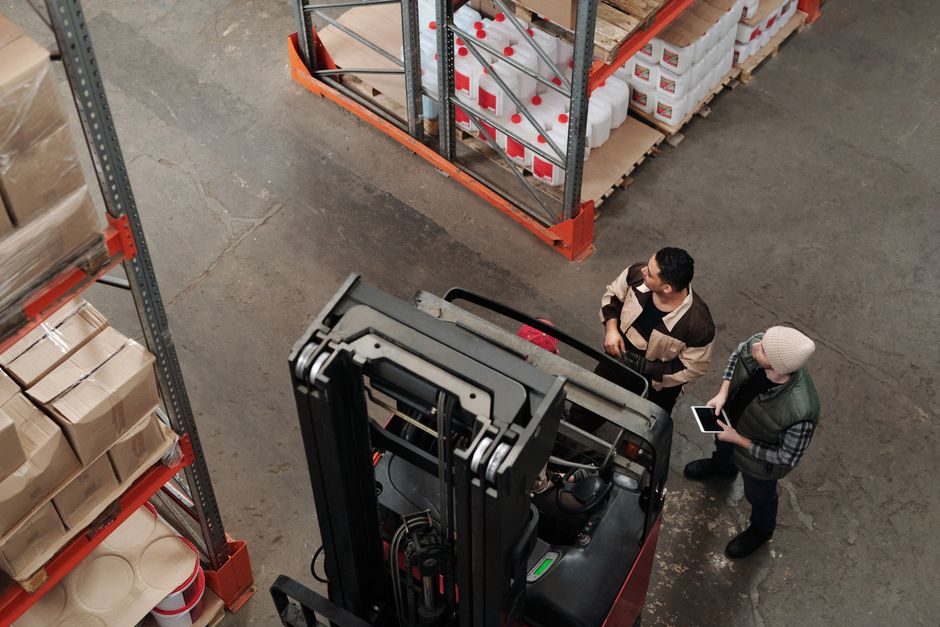
Robot palletizer pricing on Made-in-China spans US$12,000–78,000 per piece with 1-piece MOQ for an "Automatic Intelligent High Speed Robot Arm Stacker" suited to carton, case, bag and water-bottle end-of-line packaging [S2]. The wider palletizer-bearing category on the same platform shows a US$10,000–70,000 envelope for 1-piece MOQ integrators shipping out of Shanghai [S6], framing the realistic budget band a specifier should anchor against before requesting quotes.
Selection boils down to four variables: payload (kg), throughput (units or cycles per hour), product geometry (case, tray, bag, bottle, egg flat) and factory floor footprint. Food, beverage, chemical and pharmaceutical lines are the dominant verticals served by Chinese integrators such as Dalian Jialin [S3][S4], with egg-grading and beverage-bottling the two most documented robotic cells — Kantec's Yaskawa GP225-based ROBOTEGG cell, for example, places 20 egg trays in five layers at 3,600 trays/h [S1], and the WSD-MD410ib/450 stacks 24,000–36,000 bottles/h on a single host base [S5].
Three Platform Types: Conventional, Layer-Forming and Robotic Palletizers
Conventional low-level or high-level palletizers use a fixed sweep or row-forming head to build full layers on a transfer table, typically running 20–40 cases/min and excelling on uniform case geometry. Layer-forming palletizers add a servo-driven layer pad and pattern squaring, with Dalian Jialin's "automatic carton palletizer" — also called a case palletizer — used across food, chemical, medicine, paraffin and logistics lines where layer integrity matters more than SKU flexibility [S4][S7].
Robotic palletizers (4-axis or articulated arm) dominate new 2026 capex because one robot often replaces two or three conventional heads; Kantec specifies 1 robot serving 4 doors with 3,600 trays/h and 10 pallets/h, and 1 robot serving 2 doors at 960 trays/h and 57.5 parcels/h, sharing one Yaskawa GP225 between infeeds [S1]. The WSD-MD410ib/450 stacks 24,000–36,000 bottles/h — equivalent to roughly 400–600 BPM in beverage terminology [S5] — proving that articulated-arm cells now match conventional throughput in many bottle lines. A side-by-side view: conventional (lowest capex, rigid SKU, footprint 4–6 m), layer-forming (mid capex, layer squaring, footprint 5–8 m), robotic (highest capex, multi-line flexibility, footprint 6–12 m including safety fencing).
Throughput, Payload and Cycle-Time Math
Kantec's published ROBOTEGG spec sheet lists 1 robot at 3,600 trays/h = 10 pallets/h × 360 trays/pallet, with one parcel = 12 trays at 960 trays/h = 57.5 parcels/h [S1]. Translating: a single Yaskawa GP225 cell delivers 10 pallet loads/h, the same duty class as many conventional bag palletizers running 600–800 bags/h with a single sweep head.
Beverage applications scale higher: the WSD-MD410ib/450 lists 24,000–36,000 bottles/h, composed of a host base, host, and downstream end-of-arm tooling [S5]. Chinese integrators on Made-in-China quote robotic palletizers for cartons/bags in 20–40 kg payload classes, with one product line explicitly covering "20kg 25kg 30kg Cartons Pallet Stacking" [S2]. A 4-axis robot arm palletizer in the Alphapack APR-C20H class targets food and medicine with CE certification [S2], a useful proxy for specifiers who need EU food-grade paperwork on top of throughput.
Selection Criteria: Footprint, Pattern Range, Safety and Standards
Footprint and ceiling height drive layout decisions more than throughput. Robotic cells need a 2–3 m safety-fenced envelope plus operator access; collaborative robot (cobot) palletizers, such as the "Cobots Safety Fence Light Curtain Optional" units on Made-in-China, allow fence-free deployment when payload and speed stay inside the cobot power-and-force-limiting envelope [S2].
Pattern range and gripper change-over are the second axis. The ROBOTEGG uses a "specially developed gripper" for egg trays, sized to 5 layers × 4 packs = 20 trays/pallet, and includes a reject line for non-compliant products [S1] — a feature worth specifying for any food line running vision or weight grading upstream. For 20–30 kg cartons, articulated-arm grippers with clamp or fork tooling dominate; for empty PET bottles, bag, or layer-pad lines, vacuum or fork heads are standard. End-of-line wrapping is a separate decision handled by stretch wrappers (covered in a companion sourcing guide) — see a stretch wrapper pricing breakdown for capex context.
Use-Case Map: Food, Beverage, Chemical and Pharmaceutical
Food and egg lines: Kantec's ROBOTEGG integrates upstream of egg grading and downstream of carton erector + case packer, running 3,600 trays/h on a Yaskawa GP225 [S1]. The line is sold in-line with egg-tray stacking and packaging modules [S1], meaning a buyer does not need to integrate palletizing in isolation. The Dalian Jialin product line explicitly references "food, chemical, medicine and logistics" and lists cake, paraffin and medicine as documented end-products [S4][S7].
Beverage and bottle lines: the WSD-MD410ib/450 cell at 24,000–36,000 bottles/h on a single host is the strongest data point in the 2026 research pool for high-rate bottlers [S5]. This rate class pairs naturally with a rotary or linear bottle filler upstream; if you're also specifying filler-side equipment, our carton sealer selection guide lays out how sealer throughput must match palletizer infeed. Chemical and bag lines: a 4-axis robot arm with bag gripper is the default, with 1 robot commonly covering 500–800 bags/h; if your line also bags powder, our vacuum packaging machine selection guide covers upstream pack-format choices that determine palletizer infeed geometry.
Limitations, Failure Modes and Sourcing Red Flags
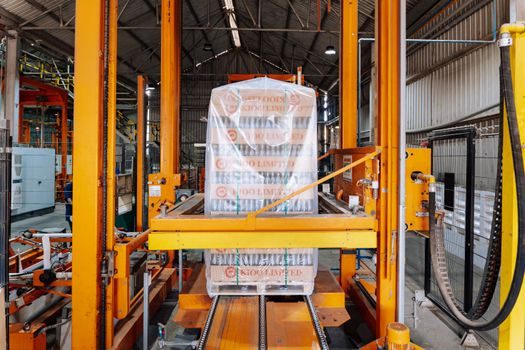
Robotic cells are throughput-limited by gripper cycle, not arm travel — so a poorly chosen EOAT (end-of-arm tool) will cap your line regardless of robot model. The Kantec ROBOTEGG spec breaks this out explicitly: 1 robot serves 2 doors at 960 trays/h, or 4 doors at 3,600 trays/h, meaning the same Yaskawa GP225 cannot do both duties simultaneously and door count is the actual capacity lever [S1]. Specifiers who treat "max throughput" as a single number will under-size the cell.
Sourcing red flags in the 2026 Chinese supply base: 1-piece MOQ is standard [S2][S6], so single-unit buyers carry more risk than multi-line integrators; "Manufacturer/Factory" badges are common but CE/UL paperwork varies — only confirm CE if the listing names it (Alphapack APR-C20H is the example with explicit CE certification [S2]). Lead times of 30–60 days are typical for a configured cell, and budget quotes under US$12,000 generally exclude EOAT, safety fencing, and conveyor tie-in. For adjacent capital lines — for example, when the palletizer sits downstream of a wash station — review our parts washer selection guide to align wash-cycle with pallet infeed timing.
Standards, Compliance and Sourcing Channels
CE marking under the EU Machinery Directive 2006/42/EC is the de facto specifier demand for any palletizer shipping into European food or beverage plants; the Alphapack APR-C20H line is the named example carrying CE certification in the 2026 research pool [S2]. North American buyers should require UL 508A panel certification and ANSI/RIA R15.06 compliance for the robotic cell. For food-contact zones, the upstream conveyor and gripper surfaces typically need 304/316 stainless and food-grade contact materials — a separate decision from the palletizer's structural frame.
Verified sourcing channels: direct OEM portals such as Dalian Jialin (Dalian, China; tel +86-411-39952788 EN / +86-13322288239 JA) [S3] handle custom smart-factory lines, while Made-in-China aggregates a wider vendor base with explicit MOQ, price band, and audit status [S2][S6]. DirectIndustry is the cleanest channel for European-spec robotic palletizers (Kantec, Turkey) with model-level spec sheets including throughput, door count, and robot OEM [S1]. Track for 2026 H2: tightening CE documentation discipline from Chinese vendors and an emerging "robot-as-a-service" rental model on lower-tier cobot cells; both will shift the US$12,000–78,000 capex band meaningfully within 12–18 months.
For component-level specifications, see linear guide, crossed roller guide, and coding machine.