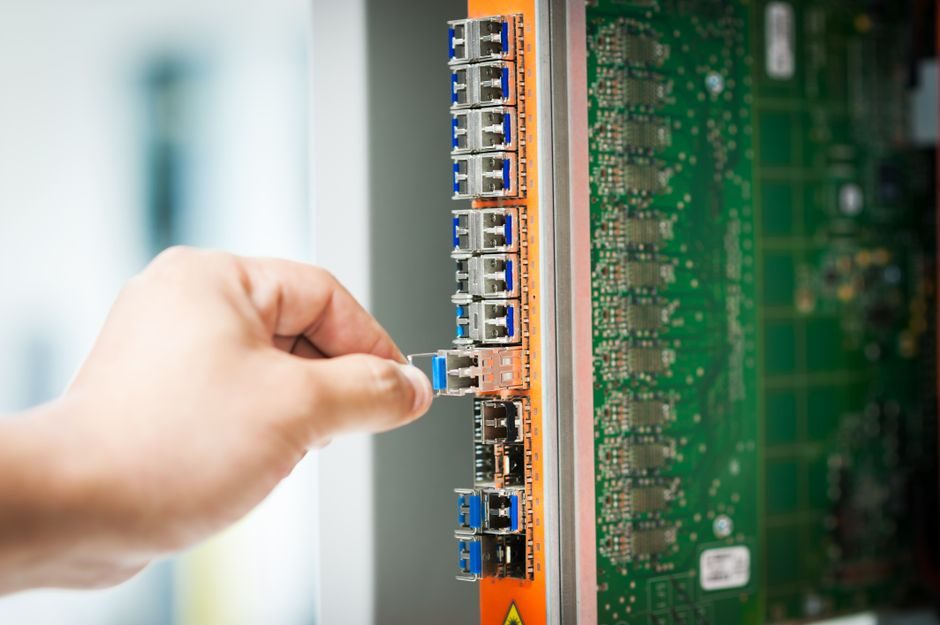
Safety interlock switches are guard-door sensors that report gate state to a safety relay or safety PLC, and the spec sheet is governed by three international standards before any brand or housing choice: EN ISO 14119 (type and coding), EN ISO 13849-1:2015 (Performance Level and Category), and IEC 61508 / IEC 61508 (SIL) [S3]. A switch quoting "PL e, Category 4, Type 4, SIL 3" on the same datasheet — as the KEYENCE GS-M series does on its published spec page — is operating at the top of all three scales simultaneously, which is the practical ceiling for new guard-door designs in 2026 [S3].
Selection should not start from the actuator or the cable gland; it starts from the risk assessment. The risk graph in EN ISO 13849-1 yields a required Performance Level (PLr) from a to e, and the Severity × Frequency × Possibility-of-avoidance product must be calculated before a single switch shortlist is opened. Holding force (N), contact arrangement (1NC/1NO, 2NC, OSSD pairs), and locking principle (power-to-release vs power-to-lock) are downstream decisions, gated by that PLr value.
Standards Stack: ISO 14119, ISO 13849-1 and IEC 61508 in Plain Terms
EN ISO 14119 defines the four interlock "types" (Type 1 to Type 4) by construction, with Type 1 and Type 2 being mechanical (positive-opening contacts, uncoded or coded actuator) and Type 3 and Type 4 being non-contact (magnetic, RFID-coded, optical). The same standard defines four coding levels for the actuator — low, medium, high, and unique — which determine how easily the guard can be defeated with a generic tool. A "Type 4, high-level coded" RFID switch is the typical answer for a perimeter safety fence door in a robotic cell where motivated bypass is a credible hazard. [S1]
EN ISO 13849-1:2015 defines five Performance Levels (PL a through PL e) and four Categories (B, 1, 2, 3, 4) that map structural redundancy, diagnostic coverage, and mean time to dangerous failure (MTTFd) onto a quantitative target failure rate, expressed as PFHd (probability of dangerous failure per hour). Category 4 demands the highest diagnostic coverage and resistance to fault accumulation; PL e corresponds to a PFHd between 10⁻⁸ and 10⁻⁷ per hour, and is what most EU machinery directives call for on hazardous-moving-parts guards [S3].
IEC 61508 (functional safety of electrical/electronic/programmable electronic safety-related systems) is the parent standard for SIL 1 through SIL 3 claims. SIL 3 corresponds to a PFHd between 10⁻⁸ and 10⁻⁷ per hour — the same hazard rate band as PL e — which is why a correctly-designed guard-door subsystem can credibly claim both PL e and SIL 3 on the same datasheet, as the GS-M series does [S3]. EN 62061 is the machinery-sector derivative of IEC 61508 and is the alternative compliance path to EN ISO 13849-1 for electrical subsystems on EU machinery.
The Four Spec Gates That Decide a Build
Gate 1 — Required Performance Level (PLr). Output of the risk graph; non-negotiable. If the calculation says PL d, do not buy a PL c switch even if it is cheaper. Conversely, over-spec to PL e for a low-risk guard and the audit will not fail, but the BOM cost rises noticeably with redundant outputs and higher-grade diagnostics. [S2]
Gate 2 — Type and coding level per EN ISO 14119. Type 1/2 (mechanical) suits hinged doors that physically align a cam into the switch head; Type 3/4 (non-contact, coded) suits sliding gates, removable panels, and any door where alignment drift or vibration would defeat a mechanical actuator. The coding level (low/medium/high/unique) trades bypass-resistance against the inconvenience of replacement actuators — a unique-coded actuator is field-replaceable only by the manufacturer, which is the right choice for tamper-resistant perimeters and the wrong choice for a service door that is opened 200 times a shift.
Gate 3 — Holding force (Fzh) in newtons, and locking principle. KEYENCE's GS-M series is published as a "power-to-release" locking family with a typical holding force band that allows the guard to be opened on power loss (fail-safe escape), which is the convention for personnel gates on industrial machinery [S1][S2]. Power-to-lock is the inverse — the guard stays locked on power loss, used for process-side guards where the hazard must remain isolated during a blackout. A 1000 N holding force is a common minimum for personnel doors on robot cells; 2000 N and up is typical for heavy sliding gates on press lines.
Gate 4 — Output interface: discrete contacts vs OSSD. Traditional switches expose 1NC/1NO or 2NC mechanical contacts that wire into a safety relay. OSSD (Output Signal Switching Device) pairs are self-monitoring pulsed outputs designed to be read directly by a safety PLC or a Cat 4 / PL e light curtain controller. The KEYENCE GS-M spec page publishes both external-input current values (safety input ≈ 1.5 mA × 2, EDM/reset ≈ 5 mA, lock control ≈ 2.5 mA) and an OSSD switching input current of ≈ 2.5 mA, indicating a modern OSSD-capable interface rather than a legacy volt-free contact block [S3]. Max voltage drop is published as 2.5 V at 5 m cable and 3.5 V at 31 m, which is the figure to check against the safety PLC's input voltage tolerance at the longest planned cable run.
Mechanical vs Non-Contact: Decision Matrix

Mechanical (Type 1/2) interlock switches use a tongue or key actuator that physically enters the switch head, and a positive-opening contact block driven by a stiff spring. They are tolerant of misalignment up to a few millimetres, cheap, and easy to retrofit, but the actuator wears, the switch head accumulates metal swarf, and the contact block has a finite mechanical life (typically 1–10 million operations depending on the load). Specify mechanical for hinged doors with infrequent access, low contamination, and a low-to-medium coding requirement. [S3]
Non-contact coded (Type 3/4) switches read an RFID tag, a magnetic pattern, or an optical target on the moving guard. There is no contact block to wear, no actuator keyway to fill with debris, and the alignment tolerance is loose (several millimetres in any axis on typical RFID heads). They are the right answer for sliding gates, washdown environments (food, pharma, semiconductor), and any guard that is opened more than 50 times per shift. Cost is higher, and the unique-coded variant is not field-programmable.
Holding force and locking principle vary independently of type: a Type 4 RFID switch can be either power-to-release or power-to-lock, with a published holding force that has nothing to do with the sensing technology. A common audit finding is to specify a high-coding RFID switch on a personnel door but in a power-to-lock configuration, which traps a person inside the cell during a power loss. The lock direction and the escape path must be reviewed together during the risk assessment, not at the BOM stage.
Application Fit: Robot Cells, Fenced Perimeters, Service Doors
Robotic work envelopes and fenced perimeters are the dominant use case and the one where the standards chain bites hardest. A typical 2026 specification reads: Type 4, high-level coded RFID, power-to-release, ≥ 1000 N holding force, dual-OSSD outputs, PL e / Cat 4 / SIL 3, with the safety outputs landing on a Cat 4 / PL e safety controller that monitors the door state along with the robot's safe-stop inputs. The "advanced function" variants on the GS-M line — distinguished by an EDM/reset input (≈ 5 mA) and an OSSD operation-switching input (≈ 2.5 mA) — are aimed at exactly this kind of integrated cell [S3].
For machine tools, presses, and injection-moulding guards, a Type 2 mechanical switch with positive-opening 2NC contacts is still the workhorse for guard interlocking; the holding force here is often lower (500–1000 N) because the guard is smaller and the risk graph may not demand PL e. Where the guard is also a safety barrier (e.g. a thermoforming station), a power-to-lock switch is often layered on top of a position sensor so that the heater cannot energise until the guard is locked.
Service doors and access panels on conveyors or chain conveyors are a frequent weak link. They are opened hundreds of times a shift, often by cleaning or maintenance staff who do not reset them, and the temptation is to fit a low-cost Type 1 switch. The correct answer is usually a Type 4 coded switch with EDM monitoring, because the door's high cycle count defeats mechanical contacts and the bypass risk is non-trivial. Note that interlock switches are a guard-state sensor, not a presence-detection sensor — for personnel detection inside the cell, a safety light curtain or a pressure-mat is the right primary device, with the interlock switch handling the access-gate logic.
Integration: Safety Relay, Safety PLC, and the EDM Loop
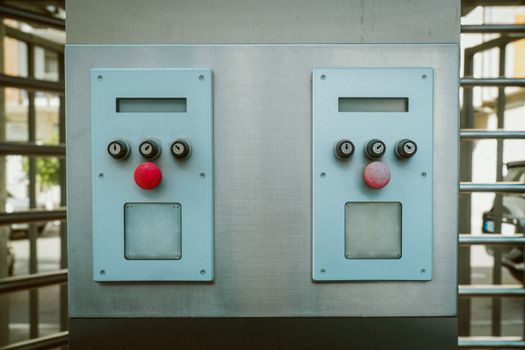
External Device Monitoring (EDM) is a feedback loop from the safety controller back to the switch, verifying that the downstream contactors have de-energised. A PL e / Cat 4 architecture normally requires EDM; a Cat 3 architecture can omit it at the cost of a more limited fault tolerance. The GS-M advanced-function variants publish a dedicated EDM/reset input at ≈ 5 mA, which means EDM is implemented as a discrete low-current input on the switch rather than as a hard-wired loop through the contactors [S3]. For plants still using a traditional safety relay, the EDM wiring path is through the normally-closed auxiliary contacts of the two redundant contactors; for plants on a safety PLC, EDM is a soft-channel input from the contactor's status output.
Reset behaviour (manual vs automatic) is a configuration choice, not a switch feature, but it constrains switch selection. A manual-reset cell needs a reset pushbutton wired through the safety controller and a Reset input on the interlock switch (≈ 5 mA on the GS-M advanced-function variant) [S3]. An automatic-reset cell — where the door closing immediately re-energises the machine — is the lower-cost option but is forbidden by EN ISO 12100 and most machinery directives for hazards where unexpected start-up can injure. Confirm the reset philosophy in the risk assessment, not in the wiring diagram.
Selection Checklist and Common Pitfalls
Selection in 7 steps: (1) Run the risk graph, record PLr. (2) Choose Type 1/2 vs 3/4 from alignment and cycle count. (3) Choose coding level from bypass-risk. (4) Choose power-to-release vs power-to-lock from the escape path. (5) Size holding force from guard mass and vibration. (6) Choose discrete contacts vs OSSD from the safety controller interface. (7) Verify PL / Category / SIL on the datasheet, with PFHd quoted in the same band as the standard requires (PL e: 10⁻⁸ to 10⁻⁷ /h; SIL 3: 10⁻⁸ to 10⁻⁷ /h). The KEYENCE GS-M spec page publishes the full EN 61508 / IEC 61508 (SIL 3), EN ISO 13849-1:2015 (PL e, Cat 4), and EN ISO 14119 (Type 4) triplet on a single line, which is the audit-ready format to ask every vendor for [S3].
Common pitfalls: quoting PL on the actuator but not on the switch (they are different components with different failure rates); specifying a power-to-release switch on a guard where the process is hazardous on power loss (e.g. a heated platen); fitting a Type 1 mechanical switch on a sliding gate that drifts 4 mm in six months and goes out of alignment; treating EDM as optional on a Cat 4 build; and reusing a "PL e" claim across a subsystem that mixes a PL e switch with a Cat 3 safety relay. The PL/SIL number on the switch datasheet is a component rating, not a subsystem rating — the subsystem PFHd is the sum of the parts, and the worst PFHd in the chain sets the ceiling.
For facilities in mainland China, the term 安全联锁装置 (safety interlock) is the GB 4943.1 definition for "a device that prevents access to a hazardous area before the hazard is removed, or that automatically removes the hazard when access occurs" — the same functional description as EN ISO 14119, applied to information-technology equipment [S5]. This is useful when a Chinese-built production line is shipped into the EU under the Machinery Directive: the GB definition and the EN ISO definition are functionally equivalent, but the EU build still has to carry the EN ISO 14119 / 13849-1 paperwork for CE marking.
Sourcing, Standards Currency and What to Verify on the Datasheet

Three datasheet items to verify before signing a PO: (a) the exact standard designations — EN ISO 14119, EN ISO 13849-1:2015, and IEC 61508 — and the claimed Type, PL/SIL, and Category [S3]; (b) the PFHd figure with units of 1/h, which is the only number the TÜV / notified-body auditor will compare against the risk assessment; (c) the operating-temperature range, the IP rating, and the vibration/shock spec, which are the figures that decide whether the switch survives on a press, a washdown line, or an outdoor perimeter. KEYENCE publishes the GS-M series as a "next evolution of door interlocks" with intuitive design, versatile mounting, and seamless system integration as the design pillars [S1][S2] — the technical substance is the standards triplet plus the published electrical interface (1.5 mA safety input × 2, 2.5 mA OSSD switching, 5 mA reset/EDM, 2.5 mA lock control) and the 2.5 V / 3.5 V voltage-drop figure at 5 m / 31 m cable [S3].
Two trackable signals for the next purchasing cycle: (1) the publication of EN ISO 13849-1's next revision and any change to the PFHd bands — when that drops, the existing PL d and PL e datasheets will need a re-issue rather than a re-quote; (2) the harmonisation status of EN 62061 under the Machinery Directive 2006/42/EC, which determines whether SIL-based compliance (IEC 61508 family) is an alternative path or the primary path for new EU machinery builds. The audit signal to watch on incoming shipments is the lot number on the switch body and the manufacturer's Declaration of Conformity listing all three standards by their full EN ISO/IEC designation, not a marketing summary.