Type 4 safety light curtains certified to IEC/EN 61496-1, such as the Pepperl+Fuchs SLC30-450-S with 30 mm resolution, 15 m sensing range and 1650 mm protection field height, are the spec baseline for hand-protection guarding on machinery in fire-adjacent industrial environments [S3].
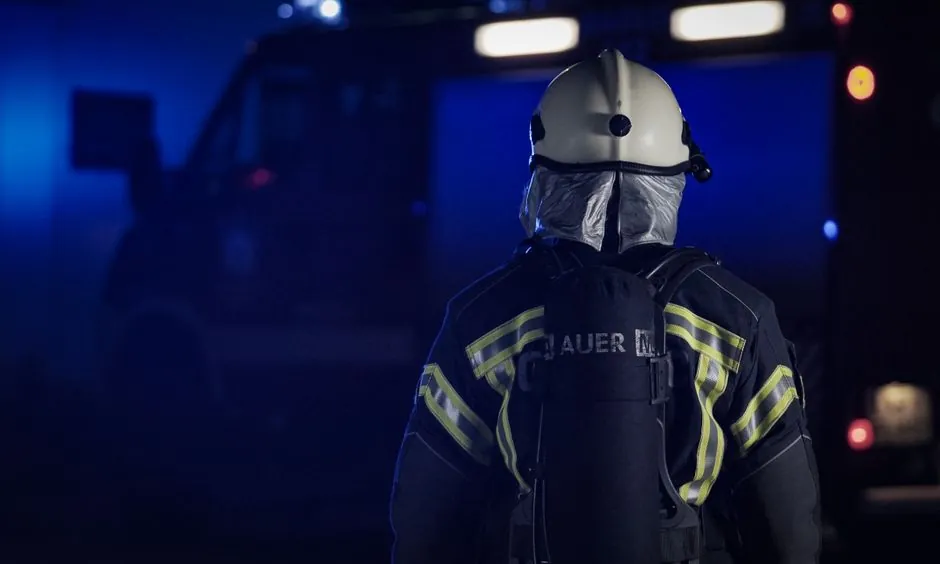
Firefighters themselves do not use light curtains; their turnout gear relies on inherently flame-retardant aramid fibers for thermal protection, not optical presence-sensing devices [S1]. This article maps where the two domains actually meet, on industrial sites that also operate fire crews, fuel handling, or hot-work cells.
Where safety light curtains fit (and where they do not)
Safety light curtains are electro-sensitive protective devices (ESPE) that create a vertical or horizontal infrared beam field; any opaque object breaking one or more beams forces the connected safety controller into a stop state within the response time declared on the datasheet [S6]. They guard human entry into the hazardous zone of a machine, they do not detect flame, heat, or smoke [S6].
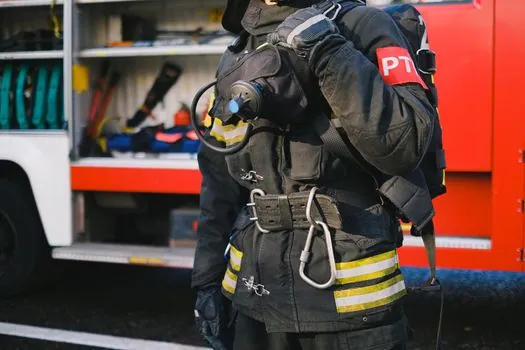
Firefighter PPE is a separate product class: high-performance heat-resistant fibers with inherent flame retardancy for turnout coats, proximity suits, and electrical-arc gear, where the protection is thermal and mechanical rather than optical [S1]. Specifying one where the other is needed is a common procurement error, so the two product trees should be kept clearly separated on a bill of materials even on a shared site.
Selection criteria for fire-adjacent industrial sites
Type 4 (ESPE category 4) per IEC/EN 61496-1 is the conservative default for fire-adjacent cells because the standard mandates dual-channel, self-monitoring redundancy and fault exclusion on a single component [S3]. The SLC30-450-S, marked "NO LONGER FOR SALE" by Pepperl+Fuchs in 2026, still illustrates the spec envelope most engineers anchor to: 30 mm optical resolution for hand detection, 15 m operating range, and a 1650 mm protected height for press and cell guarding [S3].
Three numeric gates drive the right model: (1) resolution matched to the body part at risk (14 mm finger, 30 mm hand, 50+ mm arm or leg); (2) protective height covering the full opening plus overshoot allowance; (3) range covering emitter-to-receiver distance with margin for thermal expansion on outdoor or process-hot installations [S3][S7]. Keyence's SL-V series publishes detection capability down to ø14 mm and beam axis pitch of 10 mm on the SL-V23F, which is the finger-protection tier used in robotics and small automated cells [S7].
A useful sizing rule on a 2 m cell opening: pick a protective height of 1850–2000 mm so the top and bottom beams sit clear of the floor and any fixture where a hand could reach under or over the field, then verify that the safety distance formula (ISO 13855) using the curtain's published response time keeps the stop point outside the hazard [S3][S6].
Comparing the main options: Type 4 finger, hand, and body protection
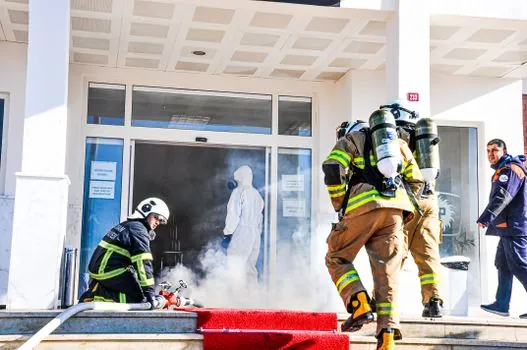
Three tiers cover almost every fire-adjacent cell; choose by the smallest body part that can credibly reach the hazard, then by mounting geometry. [S1]
Option A, Type 4 finger protection (14 mm): the Keyence SL-V23F detects a ø14 mm opaque rod, beam pitch 10 mm, lens diameter 4 mm, suited to small-parts assembly, robotic pick-and-place, and pharmaceutical or electronics cells where finger intrusion is the worst case [S7]. Strongest where nuisance-trip cost is low and cycle time matters; weakest on long ranges because the tight beam pitch demands precise alignment.
Option B, Type 4 hand protection (30 mm): the Pepperl+Fuchs SLC30-450-S anchors this tier at 15 m range and 1650 mm height for press brakes, palletizers, and warehouse docks where the hand is the credible reach [S3]. The right pick for general machine guarding in fire-adjacent mechanical rooms, fuel-loading halls, and process skids; the 30 mm aperture still passes through narrow tooling fixtures without false trips.
Option C, Type 4 body / perimeter protection (50+ mm or multi-beam): used for full-body access guarding around conveyor lines, robot cells, and ASRS aisles; lowest resolution demand means the longest ranges and the highest tolerance to alignment drift in outdoor or warm-cell installations. This is the tier most often paired with a machine safety risk assessment that already flags a separate flame or gas hazard, because the light curtain is guarding the mechanical hazard, not the fire one.
For process plants handling flammable atmospheres, the cabinet and wiring side matters more than the curtain itself: the safety controller, power supply, and any interposing relays should sit in panels rated for the area classification, separate from the intrinsically safe barrier chain that may already be protecting flame detectors and gas sensors in the same room.
Standards and sourcing the engineer must verify
IEC/EN 61496-1 is the umbrella standard for electro-sensitive protective equipment, and it is the document a TÜV or UL certifier will name on the datasheet when a vendor claims Type 4 [S3]. ISO 13855 governs the safety distance calculation that places the curtain far enough from the hazard that the machine can stop before contact. Regional fire codes (NFPA 79 in the US, EN ISO 13849-1 for safety-related parts of control systems) sit on top of those, and they do not relax the optical spec because the site has sprinklers.
On fire safety for the same building, light curtains do not substitute for flame detection, smoke detection, sprinkler water curtains, or fire-rated fabric partitions: each product line is certified against its own test regime, and mixing the language across them is a common audit finding. Where a safety light curtain is mounted near a fire-rated assembly, the enclosure IP rating (typically IP65 for indoor cells, IP67/IP69K for washdown or outdoor) and the operating temperature window (commonly -10 to +55 °C) must be checked against the fire-system heat and water exposure assumptions.
Limitations, failure modes, and what the spec cannot tell you
Optical blanking, muting, and override functions look attractive on a datasheet but each one is a documented failure mode if misapplied: a muted beam that does not re-arm on the correct cycle becomes a permanent hole in the protection field, and the same applies to floating blanking that ignores a fixed object [S6]. On fire-adjacent sites, the dominant nuisance-trip source is heat shimmer and steam plumes refracting the beam, not actual intrusion, which is why outdoor-rated curtains with tighter beam geometry and heated lenses are worth the cost premium over the indoor SKU.
Curtain response time is the single most underrated number on the cut-sheet: doubling the protective height to cover a taller opening often doubles the cycle time of the internal scan, and the safety distance must be recalculated against the new figure, not the one in the old datasheet [S3][S6]. Vendors mark old SKUs as "NO LONGER FOR SALE" while still hosting their pages, which is a signal to re-spec the replacement rather than order from inventory.
Procurement signals worth tracking
On 2026-08-02, Keyence launched a US-only selection portal for the GL-S series that emails a recommended parts list once the engineer enters application data, a procurement-channel shift away from catalog PDFs toward configured quoting [S4]. On 2026-08-04, the UK site for the SL-V series was refreshed with the "focused on visibility" campaign, with updated model codes SL-V23F / V31F / V39F / V47F / V55F tied to beam-pitch tiers [S5][S7]. A spec-first warehouse buyer comparing light curtains for material-handling lines can read the warehouse safety light curtain selection guide for the ASRS and dock-door criteria that overlap with this article, and a plant engineer balancing the same selection against overhead crane perimeters can cross-check the overhead bridge crane selection guide for beam-pitch and range overlap at shared service bays.