Single-girder top-running bridge cranes in the 5 to 20 ton capacity range, classified CMAA 70 and driven by VFD-controlled bridge and trolley motions, are the default specification written into most 2026 urban-infrastructure bid packages for transit maintenance, water-treatment, and light-rail yards [S1][S2].
Where the work happens inside a public-right-of-way maintenance building, near fueling islands, or in a wastewater headworks with classified areas, buyers move up the duty ladder to CMAA 74 and pair the bridge with explosion-proof hoists, festoon or insulated conductor bar electrification, and a 24/7 service contract [S2][S3].
Capacity, span and duty class: how the envelope is set
Urban-infrastructure bays are typically 24 to 40 ft clear height with runway spans of 40 to 80 ft, and most lift points are 5 to 10 ton transformer, pump, or hatch covers, with a small share of 15 to 20 ton motor or gearbox pulls [S1]. The Crane Manufacturers Association of America (CMAA) duty classifications 70, 74 and higher set the structural fatigue and motor sizing basis; CMAA 70 covers indoor general-purpose service, while CMAA 74 covers heavier indoor or outdoor service and is the practical minimum for transit and water utility shops [S1][S2].
End-truck wheel load, runway rail size, and building column spacing must be confirmed against AISC steel and CMAA running-surface tolerances, with 50 to 60 lb crane rail (CR) common for the 5-15 ton class and 75 to 90 lb rail preferred once a single-girder bridges the 60 ft mark [S1].
Bridge configuration: single-girder vs double-girder
Single-girder top-running cranes with an under-running hoist deliver the lowest first cost and the lightest runway reaction, which keeps existing column footings usable in retrofit urban maintenance buildings, per OEM design literature published in August 2026 [S1]. Capacities above roughly 15 to 20 tons, hook approaches below 4 ft, or hoist duties above CMAA 74 normally force a switch to double-girder construction [S1][S2].
Waukesha Crane, for example, lists double-girder cranes up to 65 ft as a primary product and has installed single units to 500 ton capacity for heavy industrial sites, which illustrates the structural ceiling of the double-girder format when urban specs drift upward [S3]. For a project stuck on a 6-8 ton transformer lift inside a 50 ft bay with CMAA 70 service, single-girder remains the cost-correct answer.
Hoist, electrification and control package

Electric wire-rope hoists dominate urban-infrastructure bids because they pair cleanly with VFD bridge and trolley drives, while pneumatic and manual chain hoists are usually limited to work-station and low-utilization jib circuits [S2]. For Class I Division 1 or Division 2 areas such as wastewater headworks or fueling bays, explosion-proof overhead cranes with purged enclosures and rated pendant stations are commercially stocked configurations rather than specials [S2].
Power delivery is typically 480 V, 3-phase through insulated conductor bar (4-bar or 8-bar) for the bridge run, with festoon flat cable on the trolley; VFD controls and radio-pendant operation are now treated as baseline rather than optional, and remote radio controllers are standard line items on most 2026 quotes [S1][S2]. For accurate load monitoring during picks over live tracks, integrators increasingly add a dedicated crane scale rated for the hoist service class, with a typical 0.1 percent full-scale accuracy and a Bluetooth or 4-20 mA output tied into the SCADA tag.
Standards, inspections and compliance stack
Compliance on a 2026 urban-infrastructure crane package stacks CMAA 70/74 for mechanical duty, ASME B30.2 for overhead and gantry cranes, NEC (NFPA 70) for runway electrification and grounding, OSHA 29 CFR 1910.179 for operator training and inspection, and AWS D1.1/D14.1 weld procedures on the girders and end trucks [S1][S3]. Annual OSHA safety inspections and a documented third-party load test are standard requirements; Waukesha Crane and similar regional builders staff certified inspectors specifically for these audits [S3].
For yards that occasionally handle outside or partially exposed service, the same equipment is offered in a weather-protected configuration with IP54 enclosures on the bridge drives, NEMA 4 pendant stations, and an additional CMAA 73 outdoor service class, keeping the spec document compact for engineers juggling multiple bid packages [S1][S2].
Comparison of the main bridge-crane options for urban work

For a structured comparison, the three bridge-crane types actually written into 2026 urban-infrastructure specifications are single-girder top-running, double-girder top-running, and underslung single-girder, which can be lined up against four decision criteria used by most specifiers:
Single-girder top-running: best for 5-15 ton lifts up to about 60 ft span, CMAA 70/74 service, lowest runway reaction, fastest install. Double-girder top-running: required for 15-20+ ton lifts, hooks needing tight approach, CMAA 74 and above, higher headroom but heavier runway [S1][S3]. Underslung single-girder: used when the existing building has adequate ceiling beams, lower headroom, and lighter duty, but harder to inspect and more sensitive to runway alignment [S1].
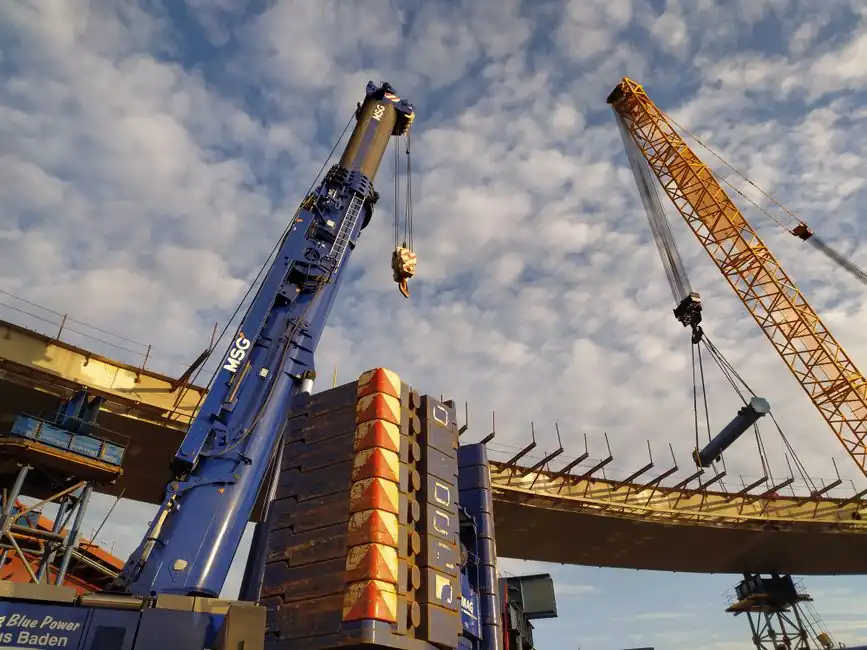
For mobile or short-term jobs, buyers will sometimes cross-spec a mobile crane or crawler crane instead of installing a permanent bridge, but the unit cost per lift is typically 3 to 5 times higher than amortized bridge-crane ownership over a 10 year service life.
Use cases: where each spec actually wins
Transit-maintenance shops with car-hoist pits and 30-50 ft bridge runs almost always take a 10 ton single-girder top-running crane on 50 lb rail with VFD bridge and a 5 ton auxiliary hoist, and pair it with interlock transfer cranes to move bogies between bays [S2]. Water-treatment plant headworks and pump rooms needing explosion protection specify explosion-proof overhead cranes in the 5-10 ton class, with rigid conductor bar electrification and dedicated exhaust paths on the hoist motor [S2].
Forged and fabrication shops serving bridge and station steel typically install double-girder cranes in the 20-30 ton class, often with telescoping bridge configurations where the existing building footprint cannot be expanded [S2]. Across all three cases, the runway design and the support steel are the long lead items and the main driver of total project cost, which is why engineering outreach is normally pulled forward 8 to 12 weeks ahead of the crane delivery.
Limitations, failure modes and what to push back on
The most common spec failure in urban-infrastructure cranes is a mismatched duty class, with engineers writing CMAA 70 equipment into a 24/7 transit yard where actual service lands at CMAA 74 or higher, leading to premature wheel, bearing, and gearbox wear [S1][S2]. The second most common error is undersizing runway rail; a 10 ton single-girder on 40 lb rail running a 50 ft span will deflect beyond CMAA running-surface tolerances and accelerate end-truck wheel flanges [S1].
For hazardous-location work, a standard NEMA 4 hoist is not a substitute for an explosion-proof hoist; the spec must call out the NEC Class, Division, and Group, plus any listed purge controller, and this is the line item most often accepted as a cheap equal during value engineering [S2]. For facilities considering a switch to gantry crane or overhead conveyor layouts, the trade-off is usually ground-floor flexibility against ceiling clearance and roof-column cost, which is rarely economic for greenfield urban sites.
Sourcing path: builders, dealers and what to ask for
For 2026 procurement, three sourcing paths are working in parallel: direct OEM build (AFE Crane, Mazzella/FHS, Waukesha Crane) for engineered single- and double-girder packages, regional dealer networks (Columbus McKinnon distributors stocking Coffing JLC, CM Man Guard hoists) for parts and standard units, and turnkey crane-and-runway installation contracts that include the support steel [S1][S2][S3]. Each builder publishes the relevant compliance list up front: AFE Crane lists CMAA, NEC, OSHA, and ASME explicitly on its engineering page, while Waukesha Crane publishes double-girder capability up to 65 ft and a 24/7 field service model [S2][S3].
When evaluating a builder, the practical checklist is: confirmed CMAA duty class stamped on the general arrangement, ASME B30.2 compliance statement, AWS D1.1 weld procedure qualification, OSHA-documented commissioning load test at 125 percent of rated capacity, and a written inspection cadence aligned to 29 CFR 1910.179 [S1][S3]. A quote that does not answer all five in writing is the specifier's first red flag.
Track the next two signals: the rollout of CMAA 70/74-clarified revision sheets and any 2026-2027 updates to OSHA 29 CFR 1910.179 inspection frequency tables, which together govern whether 5-20 ton single-girder units continue to be the default urban-infrastructure bid, or whether the market tilts further toward modular double-girder and telescoping bridge designs. For related spec work on runway and bearing selections, the Pillow Block Bearing Selection for Material Handling Lines guide is a useful companion read.