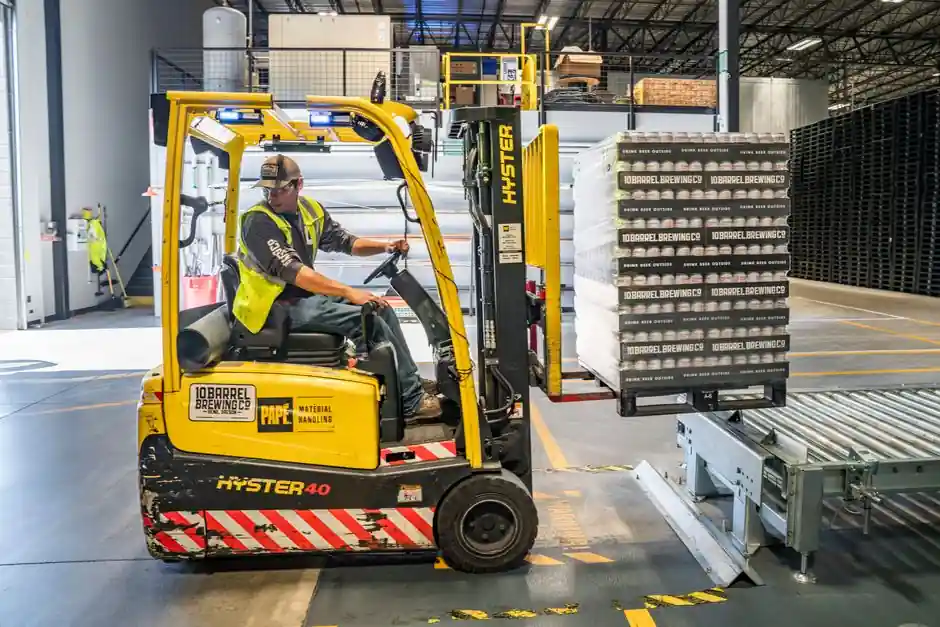
Type 4 PLe/SIL3 light curtains with 14-45 mm resolution and a maximum 70 m detection range cover the bulk of conveyor, AGV, and rack-interface guarding tasks in modern warehouses, with Type 2 PLc reserved only for low-risk zones where ISO 13849-1 permits it [S1].
Selection in a warehouse is driven by four numbers: the risk assessment's required Performance Level, the smallest object that must be detected (finger 14 mm, hand 30 mm, arm/leg 45 mm), the safety distance computed under ISO 13855, and the operating environment (IP65/IP67, washdown, cold-store, AGV exposure) [S1][S2].
Functional Safety Architecture: PL, SIL, and Type
ISO 13849-1 Performance Level (PLa through PLe) and IEC 61508 SIL (1-3) are the two parallel integrity scales; a Type 4 light curtain per IEC 61496-1/2 maps to PLe and SIL3, while Type 2 maps to PLc and SIL1 [S1]. For conveyor lines, dock doors, and AS/RS transfer stations, the warehouse safety baseline is Type 4 / PLe / SIL3, because the hazard is unrestricted access to moving rollers, chains, or shuttles.
A safety light curtain creates a monitored protective field between an infrared transmitter and receiver; if the beam is interrupted, the control circuit drives the safety relay or safety PLC and stops hazardous motion [S2]. PLe-grade devices use dual OSSD (Output Signal Switching Device) outputs and periodic self-test pulses so a single internal fault cannot leave the curtain in a pass-through state, which is the reason warehouse risk assessments rarely justify Type 2 on powered conveyors.
Resolution, Range, and Safety Distance
Resolution (the smallest opaque object that reliably darkens a beam) is chosen from the detection need: 14 mm for finger detection near robotic pickers, 30 mm for hand protection on palletisers, and 40-45 mm for body/limb detection at AGV crossings [S1]. QJKH-family Type 4 curtains cover 14-45 mm resolution and a maximum 70 m detection range, which is sufficient for wide-span warehouse aisles without external repeaters [S1].
Safety distance is then calculated per ISO 13855 from the formula S = (K x T) + C, where K is the approach speed (typically 1600 mm/s for hand, 2000 mm/s for whole-body), T is the total stopping time including the curtain's response time, and C is an intrusion-depth allowance tied to resolution. Most modern Type 4 receivers quote a response time of 8-20 ms, so for a 250 ms machine stop the S value lands between roughly 0.4 m and 1.6 m, which dictates column height and mounting standoff. Engineers should never use the maximum 70 m range in safety distance math; the relevant number is the operating range at the actual installation.
Light Curtain vs Physical Door: When Each Wins
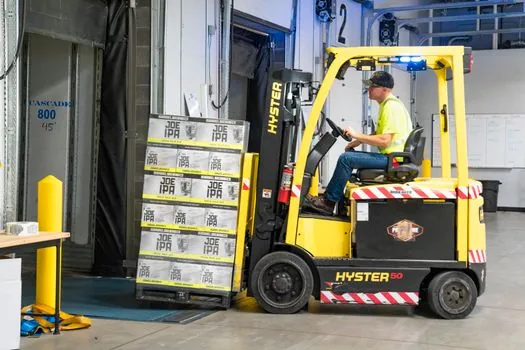
Light curtains and machine protection doors solve different problems and warehouses often run both side by side. The table below lines them up against four decision criteria drawn from current guard-selection guidance [S2].
Throughput and ergonomics: a light curtain allows continuous material flow, so palletisers, conveyor transfers, and AGV-coupled pick stations stay running; a physical door enforces a stop/start cycle and slows throughput. Hazard containment: doors physically stop sparks, hot chips, hydraulic spray, and ejected parts, which a light barrier cannot; robotic weld cells, metal-fabrication bays, and high-pressure hydraulic zones therefore require doors even if a curtain is also installed.
Floor space and flexibility: curtains take a footprint of roughly 50-100 mm per side plus the safety distance envelope, while doors need a swing or slide arc and a guarding frame. Access control and auditability: doors provide a hard interlock that auditors can see; curtains are preferred where ergonomic access, muting, and frequent changeover dominate the workflow [S2]. For mixed zones, a common warehouse pattern is Type 4 curtain at the conveyor, hard door at the robotic palletiser cell, and a safety area scanner covering the AGV turning envelope behind the line.
Muting, Override, and AGV Integration
Muting is the warehouse-specific feature that decides whether a curtain is a productivity asset or a bottleneck. A muted curtain temporarily suspends its protective function for a pre-validated object, typically a pallet on a conveyor or an AGV passing through a doorway, using two or four muting sensors that must agree on the object's direction and timing [S2]. Without muting, every pallet crossing trips a stop and the line starves; with a properly engineered muting sequence, the same curtain protects personnel but ignores material flow.
For AGV-coupled zones, a layered stack is now the default: Type 4 PLe curtain at the fixed transfer station, a safety laser scanner covering the AGV's approach arc, and a vehicle-side bumper; a useful reference for the ATEX Zone 2 / IP67 envelope that often applies in the same facility is the mining-focused spec primer on Type 4, IP67, and ATEX Zone 2 selection. The conveyor-side spec has its own trade-offs, covered in the 2026 conveyor sorting line selection guide, which pairs the curtain with the line's stop-time budget.
Environment, Mounting, and Failure Modes
Warehouse environments are kinder than stamping or welding floors but still kill the wrong curtain. Cold stores (-25 to 0 °C) demand low-temperature-rated housings and anti-condensation heaters; washdown zones (food, pharma) need IP67/IP69K stainless brackets and food-grade cables; AGV-impact zones need shock-absorbing columns because a 1.5 m/s bumper hit will crack a standard aluminium profile. IP rating is non-negotiable in any zone where a forklift can splash or a sprinkler can hit, and IP65 is the practical warehouse minimum [S1][S3].
Common failure modes to design against: (1) reflective surfaces behind the receiver causing an "around the object" path, fixed by mounting the receiver in a shielded bracket or angling it 5-10° away from shiny racking; (2) vibration-induced nuisance trips, fixed by anti-vibration mounts and response-time filtering; (3) muting sensor misalignment, fixed by using cross-beam muting sensors rather than single-beam retro-reflectors; and (4) bypass via defeating the reset, fixed by a dedicated reset button located outside the protected zone with a restart interlock. The encyclopedia entry on machine safety covers the reset-interlock and EDM (external device monitoring) wiring pattern that PLe curtains require.
Procurement Checklist and Sourcing Signals
Every quote for a warehouse light curtain should be checked against this minimal data sheet: IEC 61496-1/2 Type 2 or Type 4, ISO 13849-1 PL and category, IEC 61508 SIL, resolution in mm, protected height in mm, operating range in m, response time in ms, OSSD output count, IP rating, ambient temperature range, muting/override function, EDM input, and the manufacturer's test certificate number [S1][S3]. If any of these is missing, the vendor is not yet at quotation stage; warehouse safety engineers should treat that as a red flag.
Trackable signals for the next quarter: (a) whether the warehouse's existing conveyors are mapped to ISO 13849-1 PLd or PLe, since PLe curtains on a PLd-rated upstream stop are over-spec and SIL3 stop-time budgets need to be re-checked; (b) whether the racking vendor is integrating reflective column covers, which change the optical budget; and (c) any facility-level fire-safety review that pulls emergency-stop categories into the same risk assessment, because EN ISO 13850 stop categories can force a different curtain model than the one originally specified. The 2026 spec guide for welding cells is a useful contrast case for warehouses that also run a maintenance weld bay inside the same envelope.
For component-level specifications, see safety light curtain.