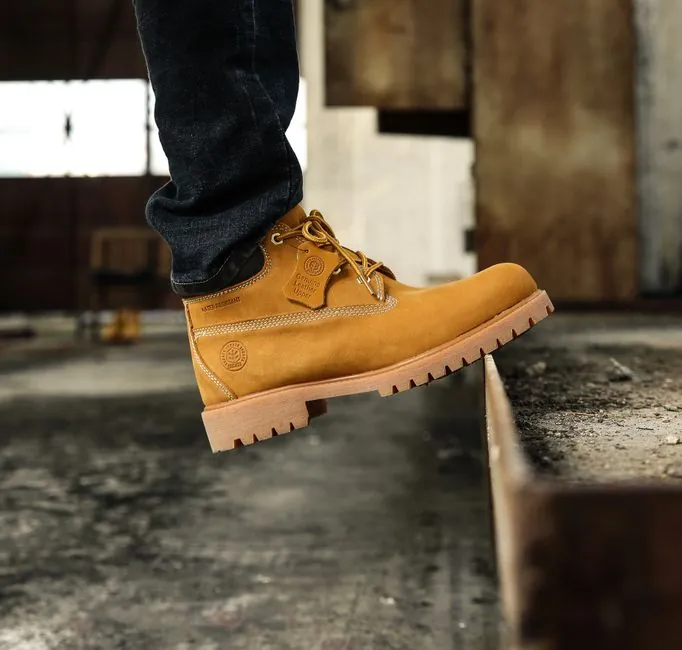
For work at height, EN ISO 20345 S3 or S5 boots with SRC-rated slip-resistant outsoles and ankle-high uppers are the baseline specification; an integral toe cap (steel or composite) plus an anti-perforation midsole is required whenever a dropped tool, rebar, or shingle can strike or roll onto the foot [S1][S5].
Slips, trips, and falls from elevation remain the dominant mechanism of fatal injury on construction sites, and roughly a quarter of fall incidents are linked to inappropriate or worn footwear, which is why the sole pattern, outsole compound, and upper height are non-negotiable for this duty [S1].
What the standard actually requires: EN ISO 20345, S1 through S5
EN ISO 20345 is the European standard that grades safety footwear by performance level, and the codes are the quickest way to communicate intent to a supplier: SB is a basic safety toe only, S1 adds a closed heel, antistatic properties, and energy-absorbing heel, S2 adds water resistance of the upper, S3 adds a cleated outsole and anti-perforation midsole, and S5 is the rubber- or polymer-boot equivalent of S3 (fully waterproof upper plus penetration resistance) [S1][S7].
Where US sites are involved, OSHA 29 CFR 1926.95 and 1926.96 require protective footwear for construction and specify impact and compression resistance around the toe plus, where applicable, puncture protection, but the standard does not mandate a specific outsole pattern, which is why the EN ISO 20345 code is often written into the procurement spec even on American projects [S5].
The four selection criteria that actually decide the boot
Toe and midsole protection is criterion two: a steel toe cap rated to 200 J impact and 15 kN compression (the EN ISO 20345 requirement) or a composite cap that meets the same numbers at roughly half the weight is required wherever a hammer, wrench, or drill can fall; an anti-perforation midsole, either steel woven wire or a non-metallic textile like Kevlar, blocks the nail, rebar tie, or sheet-metal screw that routinely penetrates a worn outsole on a roof deck [S1][S5].
Upper height and lateral support is criterion three, and it is the criterion most often missing from low-cut "athletic" safety shoes: ankle-high boots with a padded collar, a defined heel break, and a lacing system that locks the heel in the footbed are specified for height work because an inversion sprain on a ladder rung or a roof ladder hook is a fall event in its own right [S5].
Material and construction is criterion four: Goodyear-welt or direct-injection leather uppers dominate the S3 segment, rubber or PU/rubber dual-density outsoles dominate the S5 segment, and the trend is toward composite toe plus textile penetration-resistant midsole to cut roughly 400-500 g per pair relative to all-steel construction, which directly reduces calf fatigue on long ladder climbs [S1].
Steel toe vs composite toe vs alloy toe: a side-by-side for height work

Steel toe caps are the lowest-cost option, pass the 200 J / 15 kN EN ISO 20345 test, but add weight and set off metal detectors; they are the default on S3 budget lines and on most construction-rental boots [S1][S7].
Composite toe caps (fibreglass, carbon fibre, or moulded polymer) meet the same impact and compression numbers at typically 30-50% less mass than steel, are non-metallic for site security gates, and provide better thermal insulation in cold-weather height work; the trade-off is a slightly thicker cap profile and higher unit cost [S1].
Alloy toe caps (aluminium, titanium) split the difference: lighter than steel, thinner than composite, but still conductive and still trigger metal detection, so they are used where thin profile matters (electricians working at height in tight switchgear rooms) but where composite is preferred for cold or detector-free sites [S7].
For the penetration-resistant midsole, steel woven wire is the cheapest and most common on S3 boots, while non-metallic textile midsoles (often aramid) are roughly half the weight, more flexible at cold temperatures, and are the right pick for anyone walking on a hot rooftop where a steel midsole would conduct heat into the foot [S1].
Fit, break-in, and inspection: where most height-work boots fail in service
EN ISO 20345 boots must be tried on with the sock weight and insole the worker will actually use, and the heel must lock into the heel pocket with no slippage when laced, because a 3-5 mm heel lift on a rung is the textbook mechanism for a ladder fall; laced boots are not optional for height work, and pull-on or slip-on styles are normally ruled out for that reason [S2][S5].
Outsoles are the wear part: once the lug depth falls below roughly 3 mm, or once the SRC-rated tread plane is worn flat at the heel or ball, the boot no longer meets the slip class it was certified to and must be replaced; this is the same inspection logic used across the safety shoes category, and it is the single most common root cause found in post-incident reviews of height-work slips [S1][S5].
For cold or wet sites, a S5 PU/rubber safety wellington with cleated outsole and steel midsole is paired with a thermal liner sock; the height-work helmet specification is reviewed alongside the boot, since EN 12492 (mountaineering) chin-strap retention under EN 397 (industrial) impact testing is a common dual-cert requirement on rope-access and tower work, and the same ladder is used to walk up to the head of the work as is used to step off it.
What the rules do not cover, and what fails off the shelf
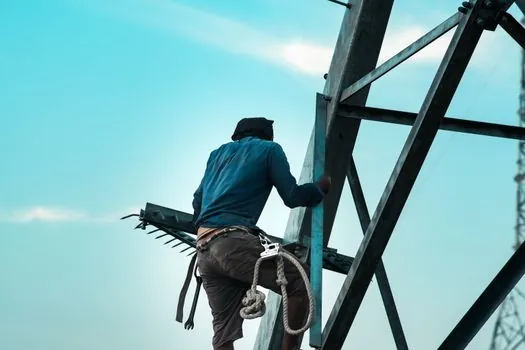
EN ISO 20345 does not certify the boot for fall-arrest lanyard attachment: height-work harnesses clip to a full-body D-ring, never to the boot, so a boot marketed as an "anchor point" is non-compliant and any procurement document that mixes the two should be rejected at the gate [S1].
EN ISO 20345 also does not certify electrical hazard: an EH-rated boot (ASTM F2413) or a dielectric boot (EN 50321 class 0, 1 kV) is required for live-line or substation work, and the standard rubber-PVC safety wellington with cleated outsole is the wrong pick because it is not tested for dielectric breakdown; for those duties, see the respirator selection for electrical work logic to understand how hazard-class overlays stack on top of a baseline PPE spec.
Finally, fashion-marketed "work shoes" that carry a toe cap but no anti-perforation midsole and no cleated outsole are SB-rated, not S3, and they fail the height-work specification on two independent counts; the procurement spec should always call out the EN ISO 20345 code by letter, not by marketing name, because the code is the only auditable line in the supplier's declaration of conformity [S1][S7].
The next trackable signals are the EN ISO 20345 revision ballot (next major amendment under IEC/ISO review for possible thermal- and chemical-resistance updates) and the gradual shift in US specifications toward ASTM F2413 EH (electrical hazard) overlays on S3-equivalent boots; both will reshape the default boot issued for height work in the next procurement cycle [S1][S7].
For component-level specifications, see height gauge, and aerial work platform.