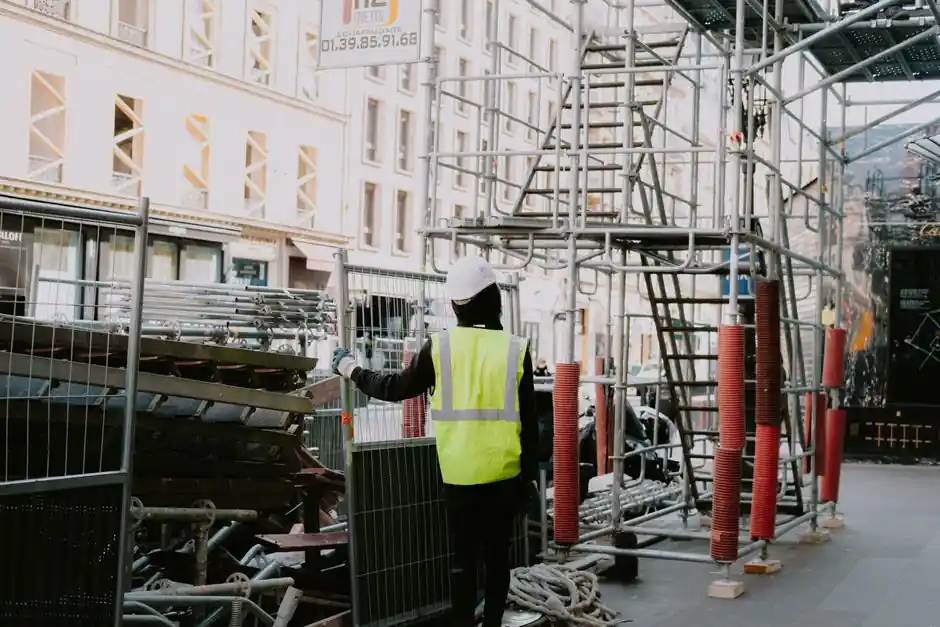
Work above 2.5 m of fall potential is the threshold at which EN 12492 mountaineering helmets, not EN 397 industrial hard hats, become the correct spec for European projects [S1].
There is still no U.S. consensus standard explicitly for "at-height" helmets, so procurement teams must combine ANSI Z89.1 Type/Class ratings with a 3-point chin-strap retention harness to match EN 12492 behaviour [S2][S3].
EN 12492 vs EN 397: which standard governs work at height
EN 12492 is the European mountaineering helmet standard and is explicitly described as the standard for climbing and work at height, including mandatory side-impact protection in its test set, while EN 397 covers only industrial falling-object hazards [S1][S3][S9]. The two standards produce physically different products: EN 12492 helmets carry a chin strap designed to keep the shell on the head during a fall, whereas EN 397 industrial helmets historically do not require retention, which is why a standard EN 397 hard hat "can fall off a worker's head in case of sudden movement such as a slip, trip or fall" [S1][S4]. For procurement, that single difference (retention) is the dominant decision driver on any site with a fall potential of 2.5 m or more, per the EN 12492 scope cited by Hellberg Safety [S1].
EN 14052 sits above EN 397 for high-performance industrial use, adding side-impact testing on top of the falling-object baseline, but it is still an industrial standard and does not mandate the climbing-style retention harness that EN 12492 requires [S1]. A useful rule of thumb when reading supplier datasheets: EN 397 = top impact only; EN 14052 = top + side impact, industrial; EN 12492 = top + side impact + retention, work at height [S1][S9]. For a deeper read on industrial ratings, see this safety helmet classification reference.
ANSI Z89.1 Type and Class matrix: G, E, C plus Type I vs Type II
ANSI Z89.1-2014 splits every compliant industrial helmet into one of three electrical Classes and one of two impact Types, and the combination is what spec sheets must show [S3][S5]. Class G (general) is dielectric-tested at 2200 V, Class E (electrical) at 20,000 V, and Class C (conductive) provides zero electrical insulation, so Class C must never be specified near energised conductors [S3]. Type I covers top impact only; Type II adds lateral and side impact protection, which is the geometry that mimics the side hit of a swinging tool or pendulum fall [S3][S7].
For work at height specifically, ANSI Z89.1 alone is not enough: PMI's technical team is explicit that a "helmet used for work at height should have a three-point retention harness, a feature not addressed by the standard," so ANSI Z89.1 compliance must be paired with that harness in the bill of material [S3]. Vented shells are also restricted: under ANSI Z89.1-2014 and Canadian CSA Z94.1-2015, a helmet cannot be vented when used in electrical work, because vents could allow an energised conductor to contact the scalp [S5].
EN 12492, EN 397 and ANSI Z89.1 compared on the four criteria that matter

Putting the three standards against each other on the four criteria that drive a purchase decision: [S3]
1) Top impact: EN 397, EN 12492, EN 14052, and ANSI Z89.1 Type I all require it [S1][S3].<br>2) Side impact: EN 12492 and EN 14052 require it; EN 397 does not; ANSI Z89.1 Type II requires it, Type I does not [S1][S3][S7].<br>3) Chin-strap / 3-point retention: EN 12492 requires it; EN 397 and EN 14052 do not mandate it; ANSI Z89.1 does not address it, so it must be specified separately [S1][S3][S4].<br>4) Electrical class: EN 397 has an optional electrical insulation mark; EN 12492 has none of equivalent scope; ANSI Z89.1 sets the G/E/C ladder at 2200 V, 20,000 V, and 0 V respectively [S3][S5].
That comparison is the basis for the practical rule used by HexArmor: there is no U.S. standard that defines an "at-height rated" helmet, so any marketing claim of "at-height rated" against an ANSI Z89.1-only product is a description, not a certification [S2].
Chin straps, brim profile, and the "climbing-style" terminology trap
Chin straps, short brims, and a more compact fit are the physical traits most often marketed as "climbing style," but the term itself has no regulatory definition in either OSHA or ANSI frameworks [S2]. OSHA's general guidance nevertheless recommends chin straps on safety helmets "for added stability, especially when working at heights," and HexArmor's reading is that chin strap + short brim + compact fit is the practical EN 12492 look without the formal EN 12492 test certificate [S2][S6]. The short brim is functional, not cosmetic: it widens the upward field of vision, which is exactly what a worker on a ladder, telecom pole, or scaffolding needs when looking up past the shell [S5].
One failure mode to call out: a climbing-style shell with only a 2-point chin strap is still not equivalent to a 3-point retention system, and suppliers differ on which they ship, so the spec must say "3-point chin strap" in writing, not just "chin strap" [S3][S6]. For adjacent PPE decisions, this explosion-proof electrical selection guide walks through the same retention-and-certification logic for hazardous-area electrical gear.
Where EN 12492 fits, and where it does not
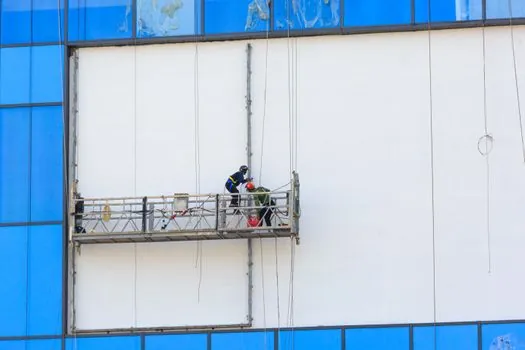
EN 12492 is the right pick for tower work, scaffolding above 2.5 m, rope-access and technical rescue, and any industrial task where the worker may invert, swing, or pendulum during a fall, because the retention and side-impact test set is built around that energy [S1][S3][S5]. It is also the right pick when a brim would catch on harnesses, lanyards, or rigging, which is why MSA's Heightmaster and Linesman climbing helmets are brimless [S5].
EN 12492 is not the right pick where the dominant hazard is purely vertical falling objects on flat ground with no fall potential above 2.5 m; there, EN 397 or ANSI Z89.1 Type I Class G/E covers the risk at lower cost and with a brim that deflects debris and sun [S1][S3]. It is also the wrong pick as a stand-alone for electrical work without a verified dielectric rating, since EN 12492 is not framed around the G/E/C electrical ladder the way ANSI Z89.1 and EN 397 are [S3][S5]. Firefighter helmets are deliberately out of scope, covered by NFPA 1951 for technical rescue and other NFPA documents for structural firefighting [S3].
Selection workflow and sourcing checklist for procurement
Step 1 is a written risk assessment that names the fall potential in metres, the dominant impact direction, and the electrical environment, because every later clause in the spec must trace back to that document [S1][S8]. Step 2 is the standard call: EN 12492 for fall potential above 2.5 m; EN 14052 for heavy industrial side-impact exposure without a fall potential; EN 397 for falling-object-only industrial sites; ANSI Z89.1 with explicit Type II and Class E for U.S. electrical work, paired with a separately specified 3-point chin strap [S1][S3][S5]. Step 3 is the parts list: shell material (ABS or polycarbonate are common), 3-point textile chin strap, 4- or 6-point webbing suspension, and slot attachments that are documented as compatible with the chosen ear, eye, and face protection [S1][S6].
Step 4 is verification: any helmet shipped to site must carry the standard number on the inner shell, the production date, and the manufacturer's declaration of conformity, because ANSI/ISEA Z89.1 conformity is the only signal that the Type and Class claims on the box are real [S8]. Step 5 is compatibility sign-off with other PPE, since a climbing-style shell that is fine on its own can interfere with a full-body harness, fall-arrest lanyard, or arc-flash face shield, and the manufacturer must certify the combination [S1]. Adjacent site decisions, like fixed gas monitoring on the same plant, follow the same "standard + retention + verified compatibility" pattern covered in this fixed gas detector selection reference.
Trackable signals to watch over the next planning cycle

Two signals are worth tracking. First, OSHA has not codified a distinct "at-height" helmet class, so any future rulemaking that adds one would shift U.S. procurement away from generic ANSI Z89.1 shells toward EN 12492-equivalent retention, and the ANSI/ISEA Z89 committee is the body to watch for that signal [S2][S8]. Second, EN 12492 revisions and any move to harmonise it with industrial EN 397 retention rules would collapse today's two-standard decision into a single documented spec, which is the cleanest outcome for cross-border EPC projects [S1][S9]. Until either moves, the safe default is EN 12492 with a 3-point chin strap for fall potential above 2.5 m, and ANSI Z89.1 Type II Class E with an added 3-point harness for U.S. sites that do not buy to EN standards [S2][S3][S5].
For component-level specifications, see safety helmet, height gauge, and aerial work platform.