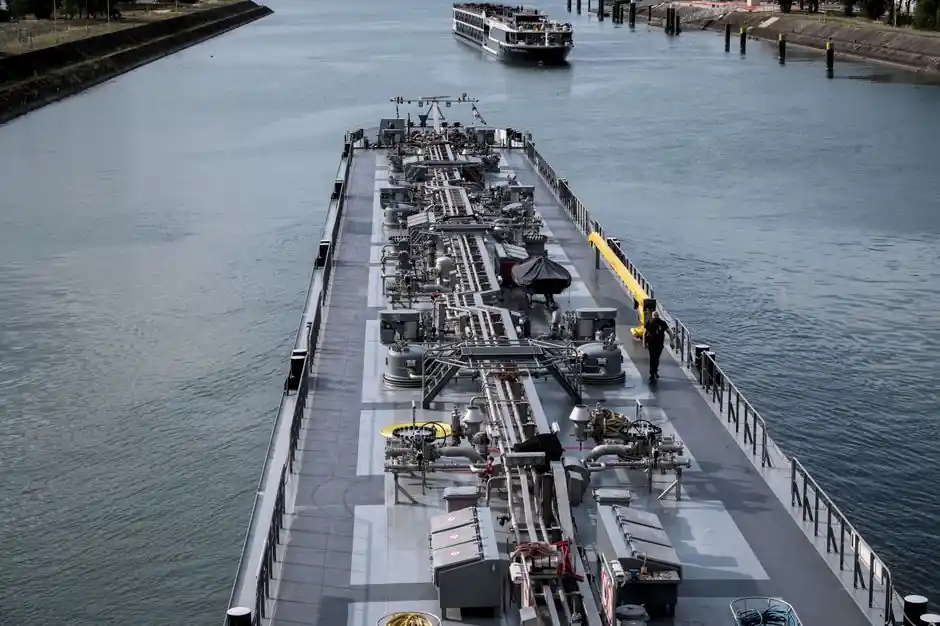
Slip-trip-fall (STF) incidents are the dominant foot-injury mechanism in chemical and petrochemical plants, and the most widely specified mitigation is an EN ISO 20345:2022 class S3, S3S or S3L safety shoe with ESD (antistatic) dissipation and a chemical-resistant rubber outsole [S2][S4].
Procurement teams that treat safety shoes as a generic PPE line item, rather than a chemical-contact-rated assembly, routinely over-spec toe protection while under-specifying outsole chemistry, the exact failure mode that drives midfoot burns, sole delamination, and electrostatic discharge near solvent handling [S2][S4].
EN ISO 20345 Protection Classes for Chemical Plants
EN ISO 20345:2022 defines the safety classes and the S3, S3S, S3L split (introduced in the 2022 revision) distinguishes between steel/metal and non-metal toe-cap and puncture-plate constructions while keeping the same S3-level performance [S2][S4]. The mandatory S3 baseline covers a closed seat region, antistatic properties, energy absorption in the heel, water resistance of the upper, and a pierce-resistant midsole; the S3S and S3L suffixes specify steel-type or lightweight (composite/textile) components without weakening the protection envelope [S2].
For chemical plants, the practical question is not S3 versus S3S/S3L, it is whether the certification document explicitly lists chemical resistance at the outsole and whether ESD/antistatic limits meet the site's hazardous-area classification [S2][S4]. ELTEN's chemical-and-petrochemical product line treats S3, S3S and S3L as the mandatory baseline, then layers on material-specific chemical resistance rather than re-engineering the class [S2].
Outsole Material vs Chemical Resistance
Rubber outsoles in the chemical-grade tier are typically rated for short-term contact heat of around 300 °C, with verified resistance to petrol, oil, microbes, and a documented list of acids, alkalis and solvents; this combination is the practical working envelope for routine plant-floor exposure [S2]. PU outsoles give better cushioning but degrade faster under aggressive solvents, while nitrile rubber offers stronger hydrocarbon resistance at the cost of higher density and colder flex behaviour in winter yards [S2][S4].
Bulkchi's manufacturing notes confirm the outsole-upper bond is a frequent failure point: cement-constructed soles delaminate under cyclic chemical attack, while direct-injection moulding fuses the multi-density outsole matrix to the upper and survives the same service window [S4]. For buyers, the procurement-relevant test is not the marketing term "chemical resistant", it is the supplier's published resistance list with exposure time, concentration and temperature, plus a bond-strength test method [S4].
Upper Material Selection: Leather vs Synthetic
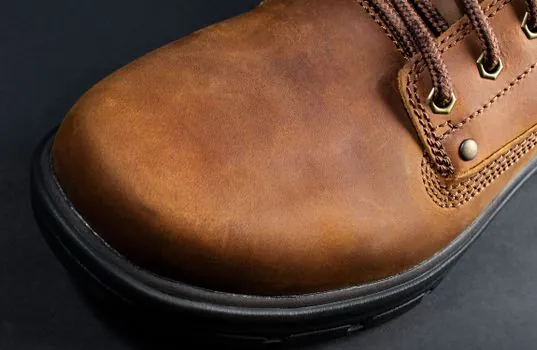
Full-grain leather is the default upper for chemical and petrochemical safety shoes because it combines breathability, dimensional stability, and easy decontamination, a smooth leather surface does not retain spilled chemicals the way textile uppers do [S2]. Synthetics (microfibre, PU-coated textiles) lighten the shoe and dry faster, but they require a chemical-resistant surface coating that wears off in service, so the underlying textile becomes the absorption layer after 6-12 months in solvent-exposed zones [S2][S4].
For sites where acids dominate the exposure profile, specify chrome-tanned leather with a documented pH resistance range; for hydrocarbon-dominated environments, a PU-coated microfibre with a chemical-resistant topcoat is a lighter alternative, provided the coating is recertified on the maintenance schedule [S2][S4]. EMMA Safety Footwear's chemical-line criteria explicitly call for water-repellent, heat-resistant uppers with a smooth surface for easy cleaning, the same logic that drives the leather default in German petrochemical PPE [S1][S2].
ESD, Antistatic, and Hazardous-Area Compatibility
Antistatic or ESD-dissipative footwear is mandatory in chemical and petrochemical environments because static discharge is an ignition source near flammable vapours; the EN ISO 20345 antistatic requirement is the baseline, but the actual resistance range must be cross-checked against the site's hazardous-area equipment protection level (EPL) zoning [S2].
ESD-rated shoes (typically 1×10⁵ to 1×10⁸ ohm volume resistance) protect electronics in pharmaceutical and fine-chemical lines, while purely antistatic S3 shoes are sufficient for bulk-petrochemical areas where the concern is spark ignition, not component damage [S2]. Confirm the supplier's published resistance range in ohms, the certification alone does not tell you which dissipation band the shoe was tested in [S2][S4].
Comfort Systems That Reduce Long-Shift Injuries
More than half of all recordable foot injuries in industrial settings are sprains, dislocations, or ligament damage, not impact or puncture, so ankle stabilisation and cushioning are injury-prevention features, not luxury add-ons [S2]. The WELLMAXX system from ELTEN uses BASF Infinergy expanded thermoplastic polyurethane (E-TPU) in the sole core, a closed-cell foam that returns energy step-to-step and reduces joint loading on hard tiled and concrete plant floors over 8-12 hour shifts [S2].
BIOMEX PROTECTION is a published ankle-stabilisation technology that allows natural plantar/dorsiflexion while blocking the inversion angles responsible for sprains; it is specified as a standard feature on several chemical-line models rather than a premium upcharge [S2]. For shift-worker foot health, fit is the single biggest variable, an ill-fitted S3 shoe loses the heel-energy-absorption and ankle-stabilisation benefits the certification assumes are present, and on-site mobile fitting (measuring foot length, width, and arch) is the documented mitigation [S1].
Comparison: S3, S3S, S3L Selection by Plant Zone
S3 with steel toe + steel midsole: lowest unit cost, cold-environment tolerant, accepted on most existing chemical sites with metal-detector screening at the gate; heavier (typically 1.4-1.7 kg per pair) and a thermal conductor in cold yards [S2][S4].
S3S keeps the S3 protection envelope with a steel toe cap; the L variant specifies a non-metal (composite or textile) toe and puncture plate, which cuts weight by 20-35% and passes through metal-detection checkpoints used in pharma and electronics-adjacent chemical lines [S2]. For a site with mixed zones (bulk storage, process unit, packaging), S3L is the lowest-friction default; for a refinery or tank farm, S3 remains the conventional specification [S2][S4].
The decision is not which class is "safer" (EN ISO 20345 sets the same performance minimum), it is which construction passes your site's access control and matches the chemical-resistance list the supplier has actually tested [S2][S4].
What Safety Shoes Cannot Do, and Common Failure Modes
No EN ISO 20345 safety shoe is rated for continuous immersion in aggressive solvents, the outsole chemical-resistance list is for contact and splash, not for standing in a spill; if the hazard assessment includes pool contact, the PPE layer must be a chemical-resistant overshoe or boot on top of the safety shoe [S2][S4].
Sole delamination after 9-18 months is the most common field failure mode in chemical service; direct-injection moulded construction is the documented mitigation, and buyers should require the bond-test method (typically ≥4 N/mm peel strength) in the purchase specification rather than trusting the marketing term "cementless construction" [S4]. For a broader PPE perspective on chemical-plant PPE, the fixed-gas-detector selection guide and the toxic-gas-detector selection guide cover the respiratory and atmospheric hazard side that footwear alone cannot address.
Procurement Spec Checklist
EN ISO 20345:2022 class S3, S3S or S3L (state the suffix); ESD/antistatic with published ohm range; outsole material with documented chemical-resistance list (acids, alkalis, hydrocarbons, concentration, exposure time); contact heat rating ≥300 °C short-term; direct-injection or equivalent bonded construction with published bond-strength test value; full-grain leather upper unless a synthetic is chemically justified; ankle stabilisation (BIOMEX-type or equivalent) and energy-return cushioning (E-TPU or PU) for shift workers; per-batch traceability from raw hide to finished pair [S2][S4].
Reference the safety shoes encyclopedia entry for the protection-class definitions, the chemical material page for compatibility against specific reagent families, and the fire safety entry for the ignition-hazard context that drives the antistatic requirement in solvent-handling zones.
For broader PPE context, see safety helmet selection for work at height: EN 12492 vs EN 397 vs ANSI Z89.1 and the respirator selection for warehouse operations: a 1910.134 spec workflow, both of which sit on the same EN/ANSI dual-standard selection logic that governs safety footwear in chemical plants.