
Counter-flow rotary sand coolers used in foundry and resin-sand lines typically list at USD 8,000-15,000 for a 5-10 t/h unit, USD 25,000-55,000 for a 20-40 t/h mid-range, and USD 70,000-120,000+ for 60-80 t/h heavy-duty installations, per 2026 manufacturer listings on Made-in-China.com [S1].
Total delivered cost runs 1.3-1.8x the bare equipment price once freight, refractory lining, ducting, cyclone separator and PLC control panel are added; an OEM is rarely comparing like-for-like without those line items on the quote.
Throughput and cooling-media class are the two largest price levers
A 5-10 t/h water-film sand cooler at a small jobbing foundry is a different machine class from a 60-80 t/h counter-flow rotary unit feeding an automatic moulding line, and the price gap between those two classes routinely exceeds 8x [S1]. Buyers who skip the throughput class question first end up comparing a USD 10,000 drum cooler against a USD 100,000 rotary shell and treating the difference as margin, when it is actually scope.
Cooling media is the second axis. Water-spray drum coolers (used for dry sand with strict moisture control, often tied to a sand mixer upstream) cost less than indirect air-cooled or nitrogen-purged designs, but cannot hold the <0.2% moisture target that some chemically bonded systems require [S1].
Materials of construction and refractory lining move price 15-30%
Shell material is the most quoted variable: Q235 carbon-steel shells are the price baseline, while 16MnR and 304/316 stainless shells add 10-25% depending on plate thickness (commonly 8-16 mm for shells 1.2-2.4 m diameter) [S1]. Buyers in chemically bonded resin-sand service who specify 304 stainless for corrosion resistance pay for it on every tonne of throughput capacity, but recover the premium through longer refractory life and lower contamination rework.
Refractory lining choice is the sleeper cost. A basic 50-75 mm calcium-silicate lining is cheap to install but typically lasts one to two years in continuous service; a 100-150 mm high-alumina (Al2O3 65-75%) or castable lining doubles lining cost but extends life to 4-6 years [S1]. The total-cost-of-ownership swing between those two lining options over a 10-year equipment life can easily exceed the original capital cost of the cooler itself.
Drive system, sealing and dust collection are the standard configuration battleground

Drive and reducer selection is where many Chinese and European vendors diverge on price. Buyers comparing two same-throughput quotes should check whether the quoted kW matches the gear rating, not just the nameplate.
Sealing and dust control are the line items most often omitted from a low-ball quote. Spring-loaded labyrinth seals at drum/trunnion interfaces plus a cyclone + baghouse dust train typically add USD 4,000-9,000 to a 20 t/h installation; for an industrial sand-cooling train that must comply with regional PM emission limits, omitting these parts to win a quote is a known failure mode and a warranty dispute waiting to happen [S1].
Control package and instrumentation are small money, big lock-in
Most 2026-spec sand coolers ship with a basic PLC (Siemens S7-200 SMART, S7-1200 or Mitsubishi FX5U) plus a 7-10 inch HMI, drum-outlet RTD, inverter on the drum drive, and interlock to the upstream sand mixer feed conveyor. Adding SCADA-ready Modbus TCP or PROFINET, redundant temperature loops, and a moisture probe at outlet adds USD 2,500-6,000 but is the cheapest way to stabilise sand temperature within the ±5 °C band a resin-bonded moulding line needs for consistent cure [S1].
OEMs that ship a closed control loop (drum speed, water flow, exhaust-damper position) effectively force the buyer into that vendor's service path; a specifier who needs multi-vendor serviceability should pin the PLC family in the RFQ, not the brand sticker on the panel door.
Where sand coolers sit in a typical foundry or resin-sand line

In a green-sand system the cooler sits between the sand mixer and the moulding line, dropping sand from 80-120 °C (return sand) to the 30-45 °C window the mould demands. In a resin-sand line the temperature target is tighter (often 25-35 °C) because warmer sand accelerates binder reaction and shortens bench life; this is why resin-sand operators more often choose water-cooled drum designs over air-cooled rotary [S1].
For a 10-20 t/h jobbing foundry, the typical capital split is: cooler 35-40%, ducting + cyclone + baghouse 18-22%, refractory installation 10-14%, structural steel + foundations 12-16%, electrical + control 8-10%. For a 40-80 t/h automatic line serving automotive castings, the cooler drops to 25-30% of the capital pile, with dust-collection and structural work climbing [S1].
What to leave off the spec — and the failure modes that follow
Specifying a cooler only by rated throughput and price is a known route to a thermal short-circuit: sand passes the drum residence time (typically 8-20 minutes for a 5-15 m length) but exits above the target temperature because L/D ratio, drum inclination (commonly 1.5-4 °) and internal flighting were not pinned [S1]. Buyers should fix drum diameter, length, inclination range and flighting pattern in the inquiry, then verify them on the GA drawing before issuing a PO.
Three common failure modes after commissioning: (1) refractory spalling from thermal cycling when the cooler is fed hot sand above 200 °C without a pre-cooling hood, (2) drum-shell scoring from sand carry-over of tramp metal — solved by adding a magnetic separator ahead of the cooler feed, and (3) bearing failure from dust ingestion when the seals were value-engineered out of the original quote [S1]. Each of these is cheaper to specify at the RFQ stage than to retrofit on a running line.
Sourcing, freight and standards that move the landed cost
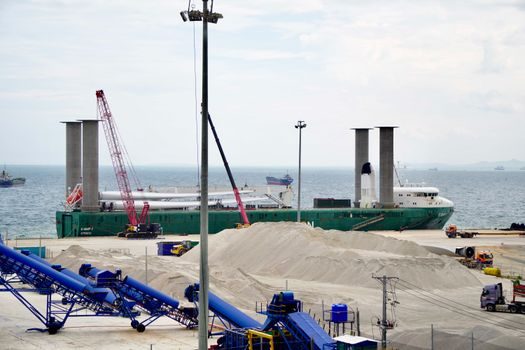
For buyers sourcing from Asian OEMs, expect CIF sea-freight at roughly 4-8% of equipment value for a 20-40 t/h unit, with inland trucking and crating adding another 2-3%. For a 60-80 t/h unit shipped as oversize/breakbulk, ocean freight can climb to 8-12% and rigging at site another 1-2% [S1]. Buyers can compare this landed-cost discipline against the 2026 air compressor market benchmarks for a sense of how freight-to-equipment ratios behave across industrial equipment classes.
Relevant standards for spec writing include ISO 9001 for OEM QA, GB/T 9439 for grey-iron castings used in trunnion and gear-housing parts, and EN 16282-1 (or the equivalent NFPA 96 approach) for the dust-collection train that usually accompanies the cooler. A useful cross-reference for selection is how knife-gate valve 2026 pricing handles material and seat upgrades, because the same cost-lever logic (body material, lining, actuator class) applies to the ducting valves on a sand-cooler exhaust train [S1].
Two trackable signals for the second half of 2026: watch for an uptick in 304/316 stainless-shell quotes on Made-in-China.com as resin-sand line builders chase lower contamination rework, and watch for cooler OEM bundling with upstream sand mixer + downstream sand blasting machine packages — the bundled line is where the 15-25% discount on the cooler itself usually hides.