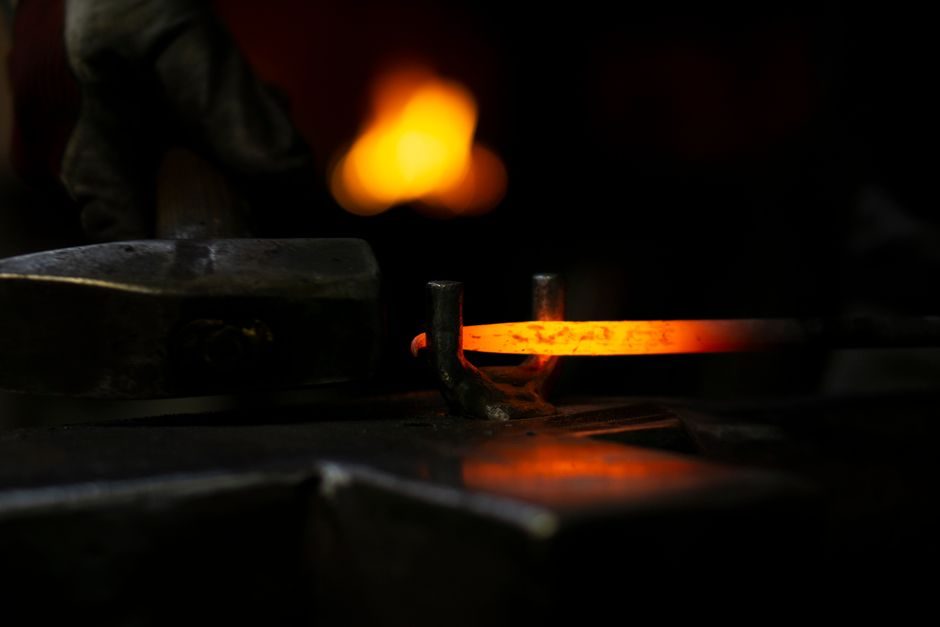
Foundry process engineers who route spent molding sand back into the mix line need a sand cooler; metallurgical shops that demand controlled austenitising, tempering or stress-relief need a heat treatment furnace. These two asset classes share a refractory lining and a burner train, but their duty cycle, atmosphere and capital envelope are not interchangeable.
Cooling capacity is typically rated in t/h of sand at ΔT 150-250 K, while furnace throughput is rated in kg/h of workload at peak temperature. Vendor catalogues list gas-fired chamber and rotary retort designs for forging reheat, ball-annealing (spheroidising) and bogie hearth variants, plus a separate line of drop-bottom quench units for aluminium [S1][S4][S5].
Process Duty: Cooling Sand vs Heating Steel
Foundry sand leaving a shakeout or knock-out station carries 2-5% moisture on top of 200-300°C sensible heat, and it must reach <50°C at the sand mixer inlet to avoid bentonite burn-off and moisture-driven defects. A fluidised-bed or rotary drum cooler sized at 20-80 t/h is common in high-output resin sand line operations, with energy recovery on the exhaust stream now a near-standard ask in tenders issued since 2024 [S4][S5].
Heat treatment furnaces invert that duty: a vacuum or controlled-atmosphere unit ramps the workload from ambient to 800-1200°C on a multi-segment profile, holds for metallurgical soak, then quenches or cools. The Yokogawa SMARTDAC+ GX note documents a vacuum furnace where HOLD, ADVANCE and WAIT program events run alongside PV events for recipe integrity [S2]. Partial-heat variants with two-zone insulation plates have been patented for tool bits where the cutting edge and the shank need different thermal histories [S3].
Selection Criteria Side-by-Side
The four decision criteria that actually move a purchase order are: peak temperature, atmosphere control, batch vs continuous duty, and refractory grade. A sand cooler never goes above ~400°C and uses no protective gas; a vacuum furnace routinely holds 10⁻³ mbar with argon or nitrogen backfill [S2][S3].
Batch-mode bogie hearth and drop-bottom quench furnaces dominate the small-and-medium job-shop segment listed by Indian and Chinese vendors in 2025-2026 catalogues, with refurbishment, refractory relining and burner spares offered alongside new builds [S5]. Continuous roller-hearth and rotary retort designs appear where forging reheat runs at 1100-1250°C with throughputs of 5-15 t/h [S1].
Atmosphere, Sensors and Control Architecture
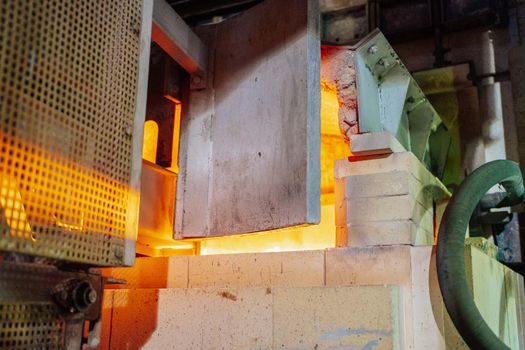
Controlled-atmosphere chamber furnaces rely on gas-fired radiant tubes plus oxygen-probe trim to hold ±5°C at 850°C, with cascade loops on zone thermocouples feeding a paperless recorder. The SMARTDAC+ GX application note specifies a dedicated program-control screen, simultaneous PV/SP trending, and digital events tied to HOLD, ADVANCE and WAIT logic [S2].
Sand coolers, by contrast, run on a much smaller instrument envelope: bed-temperature thermocouples, exhaust draught transmitter and a VFD on the drum drive. Leak-detection on a heat detector chain in the cooler exhaust has become common in resin sand plants after 2023, but the loop count rarely exceeds six analogue inputs versus twenty-plus on a multi-zone furnace [S4][S5].
Capital and Operating Cost Bands
Heat treatment furnace line items in 2025-2026 Indian and Chinese vendor catalogues cluster around chamber/bogie hearth units; add-ons such as recuperators, drop-bottom quench tanks and aluminium-specific linings are listed as separate options, with refractory and burner spares quoted as aftermarket SKUs [S5]. Non-standard sizing and full EPC packages including installation and commissioning appear on 2026 manufacturer sites, where the same vendor typically also lists hot-dip galvanising and electroplating lines for cross-selling [S6].
Sand coolers are typically priced per tonne-per-hour of throughput, with rotary drum, fluidised bed and vibrating-tray variants. Energy-recovery options on the exhaust air can claw back 15-25% of the cooler electrical input on resin sand lines running above 30 t/h, which shifts the payback calculation on new builds since 2024 [S4]. Cost and capacity logic for upstream and downstream equipment is covered in a sand casting mold vs mold base spec and sourcing guide.
Who Each Asset Is For — and Who It Is Not
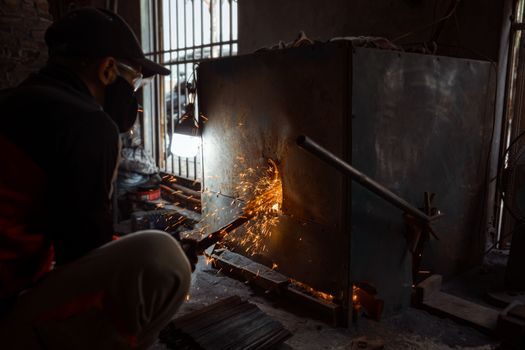
A sand cooler pays for itself only when the foundry pushes >10 t/h of return sand and the sand mixer upstream is bottlenecked by hot-sand temperature. A small jobbing foundry running 2-3 t/h of green sand has no economic case for anything beyond a simple rotary drum with ambient-air dilution. [S1]
A heat treatment furnace is the wrong asset for a shop whose end product is as-cast: the casting has already solidified and a reheat step adds cycle time without metallurgical benefit. Conversely, specifying a sand cooler for stress-relief duty on castings wastes both capex and floor space; the heat exchanger and refractory specification are mismatched to the duty.
Failure Modes and Common Engineering Mistakes
Heat treatment furnace failures cluster around element burnout at the hot zone, atmosphere-seal leakage on vacuum retorts, and refractory spalling from rapid quench cycles. The Degussa partial-heat patent explicitly addresses zone-isolation between the work surface and the clamping shank, where uncontrolled heat flow destroys tool hardness gradients [S3].
Sand cooler failures are mechanical: drum shell warping from thermal cycling, lifter-bar erosion in resin sand service, and baghouse filter blinding when exhaust moisture is not drained. Vendor refurbishment offerings now include drum shell repair and lifter-bar replacement as a defined service line, with refractory relining quoted separately for furnaces on the same order [S5].
Standards, Sourcing and What to Verify in 2026
Buyers should confirm the furnace rating against the work envelope (uniform zone length × width × height), the number of Type-K or Type-S thermocouples per zone, and whether the controller is a paperless recorder with program event handling, not a stripped-down PID [S2]. For sand coolers, request throughput at a stated ΔT, motor kW, and exhaust filtration class; the latter is the common audit finding in 2024-2026 environmental inspections [S4][S5].
Trackable signals for the next sourcing cycle: 2026 H2 price updates from Indian and Chinese EPC vendors who also list galvanising and electroplating lines [S6], and any 2026 product launches from refractory and burner-spare aftermarket suppliers [S5]. Foundry engineers weighing mixing-line capacity against cooler throughput can cross-check the upstream cost levers in a sand mixer buying guide for 2026.